
Monkey Forest Tales: Some notes about armadillos and sloths

SM Junio 2011 050

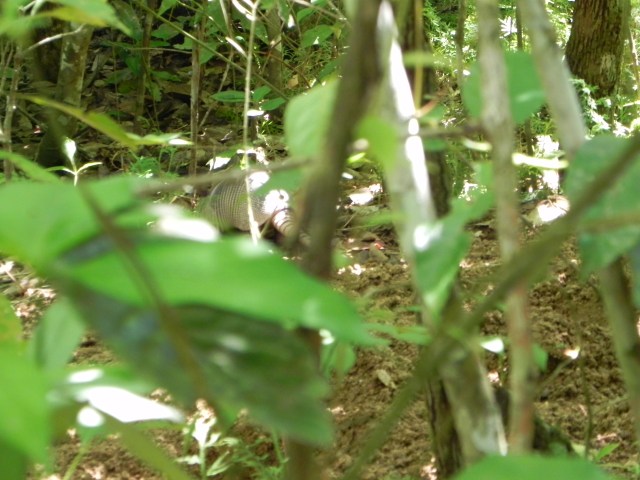
An armadillo searching for food in a forest fragment at the study area.

We continue with the series of posts talking about other mammals present in the study area. We are talking about two groups of very different, but beautiful mammals, sloths, and armadillos.

The species of sloth we had identified in the study area is the southern two-toed sloth (Choloepus didactylus), they are solitary, and we had seen them eating in trumpet trees (Cecropia spp.).

They are nocturnal and difficult to see. As other sloths, they go down to the ground to defecate, but most of their time is spent in the treetops. They mainly eat leaves and can camouflage very well the leaves of the trees in which they rest or feed, making it even more difficult to see them.

They are not hunted in the study area but sometimes found it as pets. Their main threat is deforestation. There are reports of local people in the study area who had seen them crossing pastures during the day. There are a few reports from local people who found dead individuals on the electricity cables as they sometimes used them to move.

Armadillos are in general, small-sized mammals, except by the giant armadillo. In the study area, we had seen nine-banded long nosed armadillos (Dasypus novemcinctus). We also now from other colleagues work that in the region, especially in the biggest forest fragments in the study area it is possible to find the giant armadillo (Priodontes maximus), although it is rarely seen.

All species of armadillos are hunted in the area although is illegal. It has been traditionally hunted by indigenous and peasants in the region over centuries. When hunted, people usually use dogs to find them and if they hide in their burrows, people dig big holes surrounding the hole in which the dogs follow the armadillo.

They are scarce and difficult to see. They are mainly nocturnal, although the nine-banded long nosed armadillo can be seen during the day too.  We had seen them using living fences areas to feed and move between forest fragments. They mainly eat insects. Burrowing holes are common in most of the forest fragments in the area.

© Copyright Disclaimer. All pictures used on this web page are protected with copyrights to Xyomara Carretero-Pinzón. If you want to use any of these pictures, please leave a message on the website. Thank you.

Monkey Forest Tales: Some notes about tamanduas and giant anteaters

SM Junio 2011 128

We continue with some additional notes on some of the most amazing mammals in the region of the study area. Although tamanduas and giant anteaters can be found also in the deep Amazon forest, they are also common in fragmented landscapes, especially the giant anteaters.

Tamanduas are small-sized mammals with a long snout and a sticky tongue used to capture termites, ants, and bees. They are good climbers and you can see them walking on the ground or climbing trees in search of food. We had found both. They have a prehensile tail like the one from howler monkeys that help them while climbing trees.

They are diurnal and nocturnal, and we found them sleeping on the upper part of medium-sized trees. Solitary animals. We mostly found them inside forest fragments, although on a few occasions we saw them using living fences to move between forest fragments. In general, in the area, they are not hunted, and farmers pay little attention to them.

Giant anteaters are a larger mammal, terrestrial. They are diurnal, although sometimes you can also see them moving at night. They mainly feed on ants and termites. They use their long and sticky tongue to extract ants and termites from the tunnels in their nest that they destroy with the strong arms and claws.

We usually saw them in the pastures walking looking for food. On some occasions we also found them inside the forest resting on the ground, covering their bodies with their long hairy tail on top of them.

They are solitary, although on a few occasions we had seen up to three of them walking together, probably a female with a juvenile and a male trying to mate with the female. Babies are carried in the back of their moms and their fur pattern is like the back of their mom’s back hair.

They have a developed smell sense that they use to find their food. However, their sight is not so good and some of my closest encounters with them are in pastures where they just walk towards me because they didn’t notice me until they are too close.

Probably one of their main threat in the area additional to deforestation is roadkill, Although the can gallop and move fast when they need it, they usually walk slowly and cars crossing roads at high speed in the area (and region) didn’t stop or slow down for them and there is a lot of casualties because of this reason. They are not hunted in the study area.

Although both tamanduas and giant anteaters are still present in the area, they both still need forest areas to live and rest. Wildlife crossing, such as culverts, tunnels, overpasses, and viaduct could be important tools to reduce roadkill impact especially on giant anteaters and other terrestrial mammals that still persist in the region.

DSCN9768

© Copyright Disclaimer. All pictures used on this web page are protected with copyrights to Xyomara Carretero-Pinzón. If you want to use any of these pictures, please leave a message on the website. Thank you.
Monkey Forest Tales: Some notes about tayras, short-ear dog, and bush dog

Matarredonda Dic 2013(2) 148

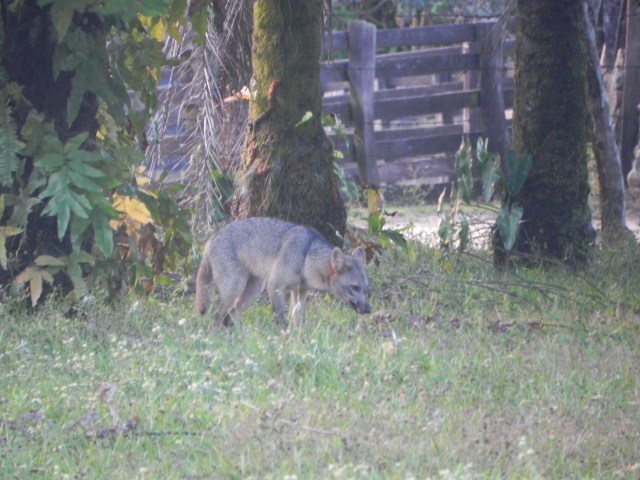
These series of posts continue with some of the medium-sized predators that persist in some parts of the study area. Probably the most common are tayras and short-ear dogs. They can be found crossing pastures, tertiary roads, savannas, and palm oil plantations as well as inside forest fragments.

They eat small birds, mammals, and reptiles. Tayras are more omnivorous as they also eat fruits and insects. We had observed tayras attacking primate groups in the study area, especially of squirrel monkeys and black-capped capuchins, targeting the younger individuals. Groups of up to three tayras had been observed in the area. They are good climbers and sometimes when scared by humans or domestic dogs they climb to escape.

Short-ear dogs have been seen using palm oil plantations as hunting grounds, it seems opportunistically, while dispersing in the study area. They are carnivorous and they have crepuscular habits. Usually observed alone or in pairs in the study area.

Local people also reported both tayras and short-ear dogs attacking chickens and other domestic birds. Therefore, on some farms in the area, they are killed when near to the houses.

The less known are the bush dogs, very similar to domestic dogs in appearance. We had seen them only in the biggest fragments in the area (Carretero-Pinzon 2013), but there are reports in the Llanos of their use of savannas as hunting grounds too. Bush dogs are cryptic animals that live in pairs or small groups. We observed them near to the edge of a big forest fragment using a trail used by humans, early in the morning.

All observation of these medium-sized predators had been opportunistic with some few occasions in which we also had found feces or footprints that seem to be from them.

In recent years we had observed an increase of feral dogs in the area as well as the use of dogs in hunting inside of the biggest forest fragments. Although we still don’t know what the effect of these feral dogs on the populations of medium-sized predators can be. There are reports of disease transmission, especially skin problems, transmitted from feral dogs or dogs used in hunting to bush dogs, from other parts of their distribution area. This can be especially important for the population of this species that we suspect is low and rare in the area. More monitoring on this will be needed in the future.

Carretero-Pinzón, X. 2013. Bush dog sighting in a large forest fragment in the Colombian Llanos. Canid Biology & Conservation 16(5): 16 – 17.

© Copyright Disclaimer. All pictures used on this web page are protected with copyrights to Xyomara Carretero-Pinzón. If you want to use any of these pictures, please leave a message on the website. Thank you.

Monkey Forest Tales: Some notes about coatis, crab-eater raccoons, other mammals in the area

Marzo 2011 SM 073

Solitary coati from one of the forest fragments in the study area.

Today’s post we are going to talk about other mammals present in the study area, that are perhaps a bit less attractive to people but all the same important for the forest. Mammals are the group of animals that are covered by hair or hair modifications, such as thorns in porcupines. They can be omnivorous (which means that they eat other animals, fruits and other plant parts) or they can be carnivorous, which means that they eat other animals. In this post, we are going to talk about all the other mammals present in the study area that we didn’t mention in the previous posts, like all the wild cats, peccaries and tapirs.

Today we are going to talk about coatis, medium-sized mammals with long snouts that usually are found in the forest in big groups up to 30 individuals (usually females and their infants) or solitary individuals, generally males. The first time I saw a big group of coatis was in a big forest, I was walking looking for monkeys of course, when a feel some noise near to the ground and on the trees. Coatis are great climbers and sometimes they climb to escape from predators. When they notice me, they just stop every movement, it was like if they were playing freezing. A kind of a game we used to play when I was a kid in which someone screams “freeze” and everyone needs to stop their movements in the position they were when they hear the scream, and you can move until someone scream again after a few minutes. It looks the same to me. It was funny some animals were just moving their eyes following my movement, some had a hand in the air as if giving a step forward or trying to catch something in midair. They are omnivorous and goes around the forest looking for fruits and insects. In the study area they are present in some forest but not in all. In the forest fragments where this project started 15 years ago, there were not common to see coatis in the past, however in the past 5 years or so it has been more common not only to find solitary males dispersing but also to some groups of females and their offspring.

An even less common mammal present in the study area is the crab-eating raccoon, I only had seen them once in the study area. They are solitary and nocturnal animals. They eat small crabs, fish, mollusks and some frogs and insects. I only notice his presence because he had to move a bit from his hidden place in a high tree cover with lianas and vines after the group of squirrel monkeys I was following wake him up. A couple of times after this I had found some tracks that seem to belong to them.

Porcupines are more common in the study area, not so easy to see as they are nocturnal, but we sometimes found some thorns in the ground or even some dead animals. It seems domestic dogs attack them very often. When waking in the forest at night sometimes it is easy to hear them scratching bark from dead trees and it is one way to spot them as the noise, they do is loud.

Even more common and less loved are the common opossum as well as other smaller opossums that can be seen in the area. They are marsupials, like koalas and kangaroos, which means that their babies grow up outside of the body in a small pouch located in their belly. They are omnivorous and one of the reasons most people in the study area don’t like them is that sometimes they eat small chickens. They are solitary and nocturnal; they climb trees and their tail is like another limb they can use to hang to reach fruits.

Although all these mammals had been observed in the area, all of them had been observed inside forest fragments and we still don’t’ know how much they use pastures and palm oil plantations. For the crab-eaten raccoon, it’s possible that their persistence in the area is due to their use of forest around streams that are the most common in the study area. Porcupines and opossums, in general, seem to move between forest fragments using living fences as well as pastures. Local people had reported coatis crossing pastures and savannas on a few occasions, and they probably use living fences as well to move through the area.

Unamas - SR Enero 2012 302

A common opossum in the study area.

© Copyright Disclaimer. All pictures used on this web page are protected with copyrights to Xyomara Carretero-Pinzón. If you want to use any of these pictures, please leave a message on the website. Thank you.

Monkey Forest Tales: Some notes about wild cats in the area

DSCN9646 (2)

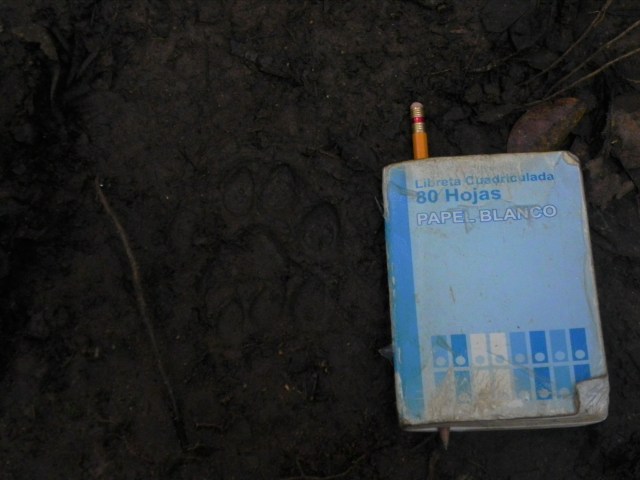
Cougar footprint found in a tertiary road in a cattle ranching farm in the study region.

Today’s post is about another group of native fauna inhabiting the study region. We are going to talk about the wild cats that persist in the study region. As I mentioned previously, the study region is highly transformed landscapes with forest fragments of different sizes (range 0.5 to > 1000 ha) in a matrix of palm oil plantations, perennial crops, cattle ranches and natural savannas covering several thousand hectares.

Because of the constant human activity in the area, you could think wild cats, especially the big ones, jaguars and cougars, won’t be able to live in the area. However, that is not true. Although not very common and mostly observed in the farthest part of the study region, towards the “serranía”, as it is locally known, it is possible to find some wild cats.

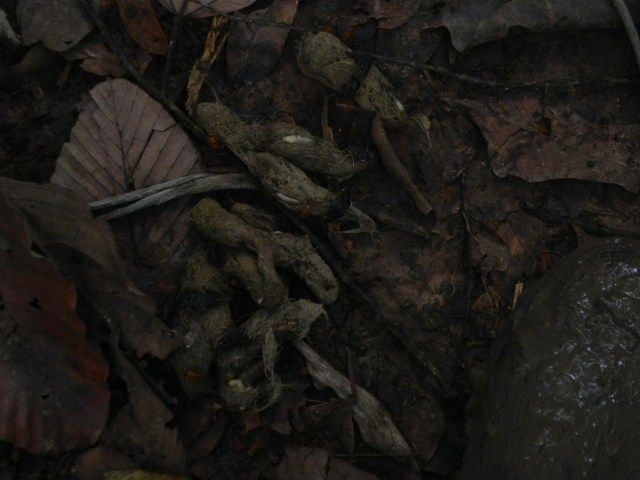
Mostly footprints, as well as some feces and tracks, are possible to be found for the bigger cats, like jaguars and cougars. Small cats like margay, ocelot, oncilla, and jaguarundi are sometimes found on pastures, natural savannas and even in small forest fragments. Observations are rare over the years but from time to time we found footprints and tracks that let us know they still present in the region despite the human activities.

From time to time, there are also reports from some cattle ranchers about cougars or jaguars attacking livestock, and some of these reports ended in the killing of a jaguar or cougar in the region. Fortunately, those cases are still rare.

Tracks and footprints from all species had been observed on tertiary roads, as well as pastures, natural savannas and inside of forest fragments of different sizes over the last 15 years. No clear pattern of more observation in some years than others is evident from our surveys.

The region still maintains a prey population that seems to be stable in general, with some local extinction in the more human-populated areas, close to towns and main roads. This is probably the reason that wild cats are still present in the region.

Some reports of chickens and other small domestic animals killed in farms are more often attributed to more conspicuous carnivorous and opossums such as tayras, short-eared dogs and the common opossum, which are more visible and often seen by local people.

The persistence of gallery forest fragments in the area around small streams is probably one of the reasons we still have some wild cats moving in the region without many observations except by some sporadic tracks and footprints.

DSCN9647

Feces of a wild cat found in a forest fragment at the study region.

© Copyright Disclaimer. All pictures used on this web page are protected with copyrights to Xyomara Carretero-Pinzón. If you want to use any of these pictures, please leave a message on the website. Thank you.
 

Monkey Forest Tales: Some notes about peccaries and tapirs

DSCN0154.JPG

The study region despite to be highly fragmented are, still has some areas in which native wildlife of big size persist. Today’s post, as well as some post in the following weeks, is about that fauna different from monkeys that is still present in the region in which the study area is located.

Over the years, I had the opportunity to survey some of the biggest forest fragments in the region (500 – 1000 ha). Although immersed in a cattle ranching matrix combined with tertiary roads and perennial crops, as well as palm oil plantations. These forest fragments still have the characteristic mammal fauna typical of more preserved areas, including big mammals such as peccaries and tapirs, as well as their predator’s jaguars and cougars.

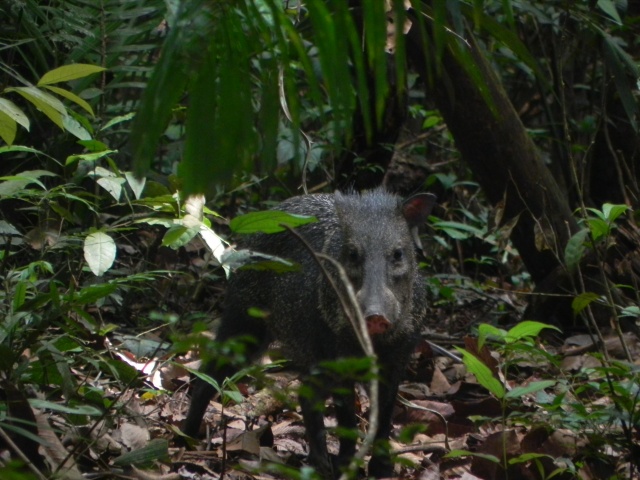
In those fragments, it is in some ways common to find tracks and even to see groups of collared peccaries (Tayassu tajacu) when they are present in those fragments. Observations of small groups and solitary individuals have also been done in fragments around 100 ha in the area, but with less frequency.

Rarer are the observations of white-lipped peccary (Tayassu peccari) in the area, although there are still present and in the past, they use to reach the town park. Last time a group of white-lipped peccaries was observed in town was 10 years ago, according to some local people. However, in the largest fragments, herds of white-lipped peccaries had been reported by locals the last year. Both are still hunted in the region and their meet is highly appreciated by locals.

Landowners in the region have problems with illegal hunting for the town’s market although it is illegal as it is not a subsistence practice. Information from local people suggest that a kilogram of peccary’s or tapir’s meat in the illegal market can cost around USD 11.5 in 2014. Today, probably that price had increased substantially due to the long-distance and time needed to hunt these species in the area.

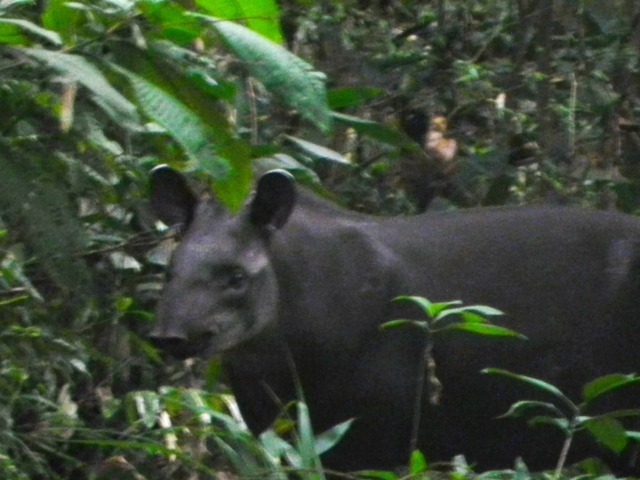
Also, it is still possible to see tapir (Tapirus terrestris) in the region, especially tracks and footprints more than observe them. Most of the observations in the region have been done in forest fragments of more than 500 ha surrounded by savannas, with some observations were done in the savannas near to watercourses. Swamp areas inside of big forest fragments are the areas where most observations have been done in the area, as well as close to the main streams in the region. Observations in small fragments are rare, probably because of hunting.

Unamas Enero 2011 150Dantamodif

Most observations of collared peccaries lasted just a few minutes, depending on how fast they perceived my presence. However, I had the opportunity to see groups as bigger as 15 individuals, including several females, a few males, and some young individuals. No threatened behaviors towards the observer has been observed on all those encounters, even when the peccaries’ herd had small individuals. Mostly once they perceived my presence, the whole group just scape, running sometimes in opposite directions. Sometimes it is possible to observe some individuals coming back to follow the rest of the group after the initial encounter.

© Copyright Disclaimer. All pictures used on this web page are protected with copyrights to Xyomara Carretero-Pinzón. If you want to use any of these pictures, please leave a message on the website. Thank you.
Monkey Forest Tales: Challenges for the new year, 2020

DSCN0232

As we approach a new year, I want to share with you some of the plans we are making to continue this project. Thanks to the willingness of some of the landowners in the study area and some new collaborations with people in the area. During 2020, we are planning to continue doing the long-term monitoring of native fauna in the region, as well as include some new areas close to the main city in the region, Villavicencio.

One of the main lessons for me over the past 15 years has been the importance of being in the region over time with perseverance despite the challenges. This presence had increased the interest of landowners to know and learn about the native fauna that they have in their land and in some cases to go beyond that simple knowledge to try to preserve it.

Some of the new data we want to collect on this new year in collaboration with institutions like William Barrios Foundation and Professor Martha Ortiz, Ph.D. from Universidad del Llano is:

  1. Information about the effects of road killing on primates and other fauna in the urban and rural areas of the region
  2. Establish the current conservation state of dusky titi monkey in their distribution area
  3. Continue with the demographic data collection on primate species in the San Martin area and expanded to other towns in the region
  4. Information about the economic cost of crop-raiding by black-capped capuchins on perennial crops in the region
  5. Expand our data collection to other native fauna in the region
  6. Implement some citizen science data collection in the region to monitor threats for native fauna in the region
  7. Assess the impact of food provision on urban monkeys in the Villavicencio area

Although some of the topics are more challenging than others, new collaborations were formed in the past months that make me confident that it is possible to reach this new information. My main motivation is the increased interest from students from the regional universities that want to work for the native fauna in their region.

If you want to support any of these initiatives or want to be involved in any way, please don’t hesitate to leave a message on this website or write to me at xcarretero@zocayproject.com. There are many ways in which you can be involved and we will be happy that you join us.

© Copyright Disclaimer. All pictures used on this web page are protected with copyrights to Xyomara Carretero-Pinzón. If you want to use any of these pictures, please leave a message on the website. Thank you.
Monkey Forest Tales: Thinking about families: how similar are monkey’s and human’s families


We are at the time of the year when we think about families more than probably other times during the year. So I thought will be nice to make a comparison of how similar monkeys and human families are?
Depending on the human society, families came in different sizes and forms, in the same way monkeys families varies depending on the species. So we have big families with several males and females and many young members of different ages, we also have families were the males are not the father of the younger ones, we also have families with lots of aunts or lots of uncles and families with just a mother, a father and their youngsters.
Same as in human families conflict appears motivated by the same reasons…. Resources…either mates or food. In humans food resources had a cover that we can put all under money.
Same as in humans, monkeys strongest relationship with the out world started with their mothers and the closest members of their groups. Through them they learn about how their world works? where they can find food? who are their friends? and who are their enemies? where to move and sleep?
Also, same as humans, in monkey’s families, mothers sometimes have the support of sisters and grandmothers to educate their babies. Sometimes they help carrying the babies other times they help watching over them while playing. And they always give alerts when some danger is close to them or give their lives to protect them.
Monkey’s families also have individuals who are greedy, jealous or just difficult, same as human families. Although some human families expel those members some others just accept them and deal with them in a different way. In a similar way monkey’s families also have some of these complicated members. They can also be expelled or just relegated to the edge of the family group depending on how much support they have from other members of the group or how much the alpha males tolerated them.
But all these families, human and monkeys, are the center of their societies. They are the center of their social lives and all are based on the same biological principle to pass their genetic information to the next generation.
I wish you all a happy holiday season and let’s hope we all can accept the diversity of our human families during this season.

© Copyright Disclaimer. All pictures used on this web page are protected with copyrights to Xyomara Carretero-Pinzón. If you want to use any of these pictures, please leave a message on the website. Thank you.
Monkey Forest Tales: Importance of edge plants for food for all monkeys species

Unamas - SR Enero 2012 212

Black-capped capuchins eating arthropods from branches of a Schefflera morotonini tree at a forest fragment edge.

Today’s post will explore the importance of edge plants as food for monkey species in the study area. One of the main effects of fragmentation is the creation of forest edges, a series of conditions that differs from the center of the forest in terms of light, humidity, plant species, temperatures, therefore affecting the use of those areas for monkeys species and in general for all animals in an area.

Some species can be more or less tolerant of those edge conditions and use it in different ways and intensities. In the case of the monkey’s species living in the forest fragments of the study area. The use of these areas for monkey’s daily activities varies with the season and it depends strongly on the plant species producing fruits in those areas.

For example, when species of plants from the Melastomataceae family (nispero (Bellucia grossularoides), Miconia spp.) and other species such as Tapirira guianensis, Protium sp., Cecropia spp, produce fruits, the use of forest edges increase for all the monkey’s species. In the case of Colombian squirrel monkeys the use of forest edges reached up to 26 % of their time in some months and for the endemic species of dusky titi monkeys, the preference for forest edges has also been associated with the use of plant species typical from this areas.

Another factor that can influence the use of forest edges by the monkey’s species in the study area is the proposed increase of arthropods abundance that forest edges can have. Arthropods are used by many monkeys as food in the area.

Probably, the most important factor is that the plant species common on forest edges which are consumed by monkeys are also the same species that appear in the earlier stages of natural regeneration in the study area, locally and at a more regional level. These are especially important if connectivity projects want to be implemented.

At the moment, in the region, most of the projects in which reforestation is proposed are based on non-native species and where native species are used, no information about species useful for native fauna is used as a baseline for those projects. Information about the species used by the native fauna on forest edge condition is useful as those plants usually are adapted to more light, higher temperatures and lower humidity typical or forest edges as well as more open areas. Additionally, these plant species can also be used for silvopastoral and agroecosystems where pastures plots include tree species of fast-growing capability as the ones present on forest edges. The use of edge plant species on reforestation projects as well as in silvopastoral systems can increase the value of those areas for biodiversity as they will provide more resources to the fauna passing through and using those areas.

Forest edges plants are not only important for the monkeys but to other fauna in the region, who also use it as nesting sites, food source as well as predation grounds in the case of small hawks, owls and eagles, that use forest edges as perch sites to hunt. Due to the high density of lianas and vines on many forest edges in the region, those are also sites used by giant anteaters to rest, hiding places for foxes as well as deers, especially when young animals need to be hide while their mothers feed in the open pastures and savannas. Less conspicuous species as crab-eater racons and armadillos also used those areas to hide and search for food.

Edge plants as the ones mentioned above are also the first to appear at natural regenerating areas, which increase their diversity and benefit to native fauna when it is left to progress in abandoned pasture and agricultural plots. Although forest edges had an effect on the native fauna and evidently have less biodiversity than areas inside of large forests. Their importance and use as tools in natural regeneration and reforestation programs have been poorly acknowledged and can be of great importance in the study region, where a dynamic of deforestation and natural regeneration is still present in some areas, depending on social and politic conditions.

© Copyright Disclaimer. All pictures used on this web page are protected with copyrights to Xyomara Carretero-Pinzón. If you want to use any of these pictures, please leave a message on the website. Thank you.
Saimiri cassiquiarensis albigena

A Colombian squirrel male searching for arthropods at a forest fragment edge.

Monkey Forest Tales: Crop-raiding by primate species and some possible solutions

Unamas-San Camilo-Sept 2013 227

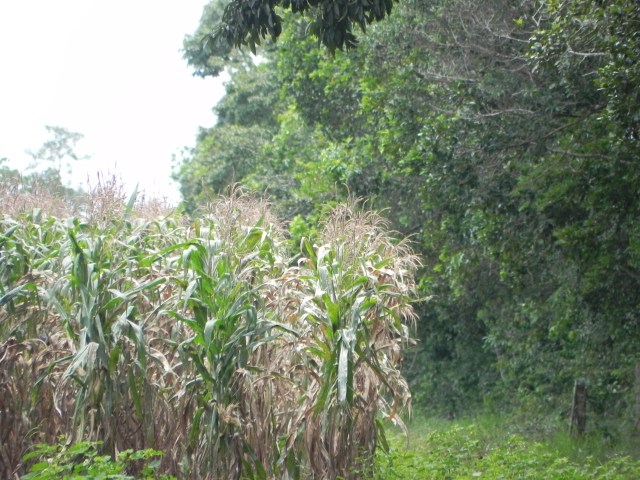
A maize crop next to a forest fragment in the study area.

One of the main problems of wildlife living close to human housing or settlements is the conflict generated but this closeness. One of the most complicated problems is crop-raiding or the use of crops by wild monkeys causing some loss for the people who depend on them. This is the topic of our post today.

In the study area and in general, in the region, crop-raiding is more commonly done by black-capped capuchins which sometimes is joined by squirrel monkeys. However, depending on the crop black-capped capuchins can be more destructive. That is one of the reasons why they are generally seen as a pest. Some of the crops in which they cause damage in the study area are citrus crops (mandarin and orange), maize (this is the reason for the local name in Spanish “maiceros”), banana, manioc, mango, avocado, and palm oil.

Although the economic cost of the damage caused by monkeys in the crops of this area has not been calculated, the people’s perception is that it is high. Therefore, they usually take measures to control the monkey’s damage. Some of these measures are as strong as killing some individuals or complete groups and others are less strong such as noises to repel them, or the use of dogs in the periphery of the crops.

One of the main reasons for monkeys to use crops as food sources is because the food inside of the forest fragments is scarce. And this is increased if the crop is planted close to the forest edge, giving them more accessibility to the crops with less risk, especially from predators.

This problem is common in all countries with monkeys’ populations living in close proximity with humans in rural and urban areas. Although in some of these places there are a series of strategies to deter monkeys to get close to the crop and produce damage, not all these measures work well. Some of the measures used to deter monkeys to crop-raiding are the use of dogs, a variety of devices to produce loud noises to scare the monkeys, the use of bees in the periphery of small orchards, and killing of problematic individuals. However, all these measures are used when the problem of crop-raiding is already happening and none of these measures prevent crop-raiding.

Some strategies that can reduce the impacts of crop-raiding, especially when the groups are not so used to feed on crops and didn’t depend on them for survival are:

1) reduce the selective logging inside of forest fragments close to crop plots

2) crop plots distance from forest fragments edges of more than 300 m

3) maintain the forest fragments quality by reducing natural product extraction from those forests

Although all these strategies tend to reduce crop-raiding from monkeys’ species, some of their skills can make crop-raiding reduction a challenge and a rotation of the deter measures has been proposed are successful in some places. More detailed information on the actual economic loss for people is still needing it in the study area although it had been done for primates in other countries and for other species of monkeys.

© Copyright Disclaimer. All pictures used on this web page are protected with copyrights to Xyomara Carretero-Pinzón. If you want to use any of these pictures, please leave a message on the website. Thank you.