
Monkey Forest Tales: The challenges of being woman in a man dominated area

The study area is in a rural area dominated by man. Although I had known incredibly strong women in this area the reality for most of them is that they are still subjugated to men, meaning they are only value by how good they are to have children, maintain a clean house and a happy husband. Not very different from other rural areas in Colombia and in the world.

Supervising undergrad student has been one of the more challenging experiences, not only because teaching what I know in the field is not always easy, but also because the area in which I work is one with challenging situations, especially for young women that leave their house for the first time.

When a woman from the city arrives to this area, they are usually seen as an intruder for the local women, they came to steal their man. For men, they are some kind of trophy, a new prey to hunt. To them, there is no reason for a woman to study monkeys, and even less, a reason to spend long hours in the forest following monkeys. That is just illogic to them.

This make all those women who came to study monkeys in this area very special ones, strong women who faced a lot of their own fears to finish their careers. Even if they don’t know, all of them had teach me a lot about strength, love and passion and I’m very proud of had learned from them, and I hope I had taught them a little bit about monkeys in return.

I want to thank them for their friendship over the years and the lessons that they teach me. This project has not been sustainable if it wasn’t for them and all the observations they did.

Most of my undergrad students has been woman, but I don’t want to disregard the contributions that male students have done to this project and the challenges that they faced by coming to this area. In an area dominated by man, male competition is high and that also affected male students coming from the city who had different ways of see and experience life.

Another challenge of being a woman in this area is that you sometimes had to face some dangerous situations just because you are woman and you spent long hours alone in the forest.

In few occasions I had to face encounters with illegal hunters. Although nothing happened is a situation that sometimes can go wrong.

In Colombia hunting is allowed legally only for subsistence and only to indigenous and afro-descendants communities in traditional land. Therefore, as I work in private land and there isn’t any indigenous communities in the area, all hunting is considered as illegal in this area.

Additionally, meeting a man with a gun (or without it) in the forest more than an hour from the farm house can be scary and it requires a lot of internal strength to just continue working in the field. Some of these encounters had led to sexual harassment from these guys towards me.

So, How I handle this? I had a bad temper and is easy to know that I’m angry, so that helps a bit, because I didn’t show any fear towards them. And help me make some limits clear to the man in the area. But I also had carried for years a machete (long knife) in my waist, a very visible weapon that shows them I’m not afraid to defend myself. Finally, I just try to avoid any kind of encounters.

I always alert when I’m in the forest, not only because I’m searching for monkeys but because If I hear human voices, I just avoid them, specially if I felt uneasy. I follow my instincts.

I shouldn’t need to do all this, and it should be safe to be in the field alone or with people, but unfortunately not always is like that. So, we still need to change the way our culture see woman and teach man that we are not things that can be taken whenever they want.

cropped-webpage1.jpg

© Copyright Disclaimer. All picture used in this web page are protected with copyrights to Xyomara Carretero-Pinzón. If you want to use any of these pictures, please leave a message in the website. Thank you.
Monkey Forest Tales: How many babies a squirrel monkey female has in her life? Chela’s story

As I mention at the beginning of these series of post, I’m going to share some of the observations and research questions that we are still trying to answer. Here is the first one.

Saimiri cassiquiarensis albigena (Colombian Llanos)

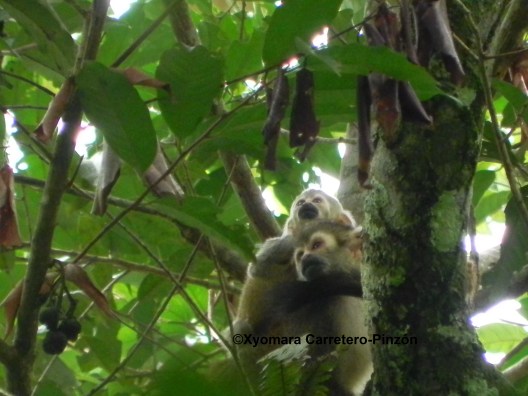
In August 2005, I first saw Chela, an adult female of Colombian squirrel monkey. Her gracile look and marked lines below her eyes, told me that she has more than six years (For a detailed description of how to determine age in wild squirrel monkeys see Mitchell 1990 dissertation).

A juvenile of one year and a baby from that year were moving all the time close to her, and spending all their resting time with her, eating close by and even taking some food from her hands. All these make me think that they were her babies from last and that year.

Squirrel monkeys gave birth to one baby every year. Every year between the end of December to the end of February, Colombian squirrel monkeys have babies. In the last 15 years since I had been observing her group, Chela had at least 13 babies.

Recognizing juveniles features in squirrel monkeys are difficult, even more to differentiate individuals, and they change rapidly from one year to the next. So, only few times I was able to follow Chelas’ babies to the juveniles age. Only in 8 cases I was certain that her babies made it to their first year.

But, how long a female like Chela can give birth? That is a question that is not always easy to answer for wild animals. It usually requires that you follow individual for long periods of time, almost their whole life and in the wild this can be a challenge.

For the last 15 years, Chela had given birth to one baby every year, until the end of January 2017, that year I discover that for the first time since I started to observe Chela, she didn’t have any babies on her back.

What happens with Chelas’ baby in 2017?

This observation leads me to think of three possibilities:

1) that it’s possible that females of squirrel monkeys after certain age will not produce any more babies, a menopausal phase as the one observed in killer whales, humans and other primates.

2) That Chelas’ baby in 2017 born death, or

3) Chelas’ baby was killed during the first weeks.

Although I’m not sure what of these options is the right answer. There is an open window to explore the first option in a wild group of Squirrel monkey that has been observed for the last 15 years with a frequency enough to discern possible patterns, especially from a female of which we can guess that already reach at least 21 years old and still looks very agile and healthy.

In 2018, it was not possible for me to visit the area during the birth season, therefore no data on Chela’s reproduction is available from that year. However, in the birth season of 2019, Chela was found again without a baby and in close proximity of a young female that not only had a baby from this year but also had a baby from last year. At some moments this young female was observed carrying both babies. Probably Chela’s daughter with her first two babies.

© Copyright Disclaimer. All picture used in this web page are protected with copyrights to Xyomara Carretero-Pinzón. If you want to use any of these pictures, please leave a message in the website. Thank you.
Monkey Forest Tales: Challenges of this project

In this post I want to share some of the challenges that I had faced over the past years to maintain this project. Some of the challenges to conduct a long-term project from my point of view are: 1) Build trust with the landowners; 2) Continuous presence in the area, and 2) funding. Here I will share with you what I had done to face these three challenges.

Unamas Enero 2011 074

1) Build trust with landowners

As I mentioned in my last post this project was supposed to be a six-month project in only one farm. Get access to only one farm and build a relationship with only one farmer can be easier than do it with many farmers.

So, ¿What help me to build trust with many landowners? My short answer is being there, constantly. Take the time to know them and listen them. Answer their questions and give them your honest opinion when they ask about the monkeys and if any of the activities, they were doing in their farms were or could affect the monkeys.

This is not always received well, but because I had been honest with them and had given them the option to discuss other alternatives, we were able to build trust and friendship between us.

Being a woman, in this case had giving me some advantage in this matter. Although this is an area dominated by man, being a woman give me the advantage of project an image of someone who can be trust, just for being woman. As well as someone who doesn’t look an economically advantaged. May be because of the cultural image that woman has in the area…

Despite my shy personality I had created good friends, not only with some of the landowners, but also with some of the workers in those farms. I’m grateful for the opportunity they had giving me to study monkeys in their properties and their support to this project and the conservation of the monkeys in this area.

These friendships not only had help me to continue with this project, but also had generated some behavioral change in some of the landowners and the workers with whom I had been in contact over the years. In another post I will talk a bit more about this.

2) Continuous presence in the area

Be present in an area can be a challenge as an individual, this can compete with other personal goals such studying, having a proper job or having a family. When I chose to study biology, I knew I won’t be rich, and money had never been a big problem for me. Never had much dreams of big job, houses or cars, so this wasn’t an issue for me.

I never pay much attention to have a family, monkeys become my family some years before. Although I always being open to have a family, especially if that means to continue doing what I love the most, being in the forest studying monkeys. I’m not concern or in a hurry to have one. So, this personal goal doesn’t compete with my passion to be in the forest and with the monkeys.

Studying and making a doctorate was one of my big goals since I was 20, so this was my personal goal that competed with my passion to continue with this project.

So, ¿How can I continue studying and still maintain a long-term project?

At the same time, I started this project, I also started my master and start supervising undergrad students. I did my master fieldwork at this area and that gave the opportunity to build not only more trust, but also to be continuously in the area for over a year. And supervising undergrad students prolong my presence in the area when I was studying in the city.

Additionally, I also made my doctorate fieldwork in the area, I was lucky enough to had a supervisor who support my crazy idea to do my fieldwork in Colombia while studying in Australia and this also give me a couple of extra years of presence in this area.

3) Funding

Probably one of the most difficult part of conducting an independent research, an even more a long-term research, is to fund it. Although I had some small grants over the years, most of my field trips has been cover with my own money and some help from the landowners, who didn’t charge me for accommodation or even food.

I guess I could be more active looking for money, but I still need to practice patience and communication skills. As well as managing rejection that not always is easy to accept. At least that is how it is for me.

I know this is not a conventional way to fund research and for some of the people who knows me, it doesn’t make sense my way of funding my research. But sometimes I found this is a more effective way than just wait until funds flow in to go to the field, even if that means to use my own money.

By this I not saying if you want to make a long-term project you will need to work to fund yourself. It’s just the way I have done it until know. Just don’t be afraid as I did, apply to a lot of funding grants and involve the local people in the process.

© Copyright Disclaimer. All picture used in this web page are protected with copyrights to Xyomara Carretero-Pinzón. If you want to use any of these pictures, please leave a message in the website. Thank you.
Monkey Forest Tales: How the Zocay Project started and growth

DSCN9619

In March 2004, I start a small project in which I would describe and count the monkey’s species present in a cattle ranch farm. I friend and colleague had introduced me to the landowner who was curious to know what monkeys where present in his farm. The idea was to estimate primate’s densities for a period of six months.

What I didn’t know at that moment was that this small project will become my long-term research project. A project that has lasted 15 years and have given me a lot of life lessons, hundreds of research questions, some good friends and a continuous strength to live the life that I dreamed despite many challenges and economic constraints.

After the first six month finished, farmers in the neighborhood started to ask if I can tell them which monkeys’ they have in their farms, and I started to visit other farms in the area and its forest.

In 2008, I had the fortune to make a small talk in town with farmers in the area to show them what my research has found and thanks to that the owner of a private reserve in the area allows me to start monitoring the monkeys’ population of what seems to be the largest forest fragment in the area (around 1100 ha).

Therefore, what it looks to be a six-month project to study monkeys’ densities evolved to a long-term project in which densities (how many animals are in a forest area) and group composition (how many of them are females, males (adults and babies)) is continuously monitored in at least seven forest fragments for the last 15 years.

In another post I will explore some of the challenges to maintain this long-term project, such as funding and the trust that need to be built with the landowners and local workers to be able to continue working as a woman in an area dominated by man.

© Copyright Disclaimer. All picture used in this web page are protected with copyrights to Xyomara Carretero-Pinzón. If you want to use any of these pictures, please leave a message in the website. Thank you.

Forest Monkey Tales

This section will contain short stories, mainly my own observations with some known information of the monkeys in the story. A new story will be published once every week.

Also, I will share some of the challenges that I had faced as a woman researcher in a male dominated area.

Other stories are about some of the questions I’m still trying to answer. Some other stories are lessons I learned from being an independent researcher for many years and the challenges to keep my project going while I travel and study abroad.

Most are my personal points of view of what have work for me and can work for others, although there are many ways in which you can do research without making the same decisions and mistakes that I had done.

Some stories will try to answer biological questions, but others are about my personal life and the way I see life and how I value mine. So please don’t take anything too personal as it is just one way of see and experience life and research.

Some will ask why I decide to tell these stories now. I don’t have an answer, I guess this idea has been in my mind for a while and I feel that may be sharing some of my observations and experiences in the field I can empower other women to do research and follow their passion even when situations don’t seem the right or easy ones.

© Copyright Disclaimer. All picture used in this web page are protected with copyrights to Xyomara Carretero-Pinzón. If you want to use any of these pictures, please leave a message in the website. Thank you.

SM Marzo 2012 041