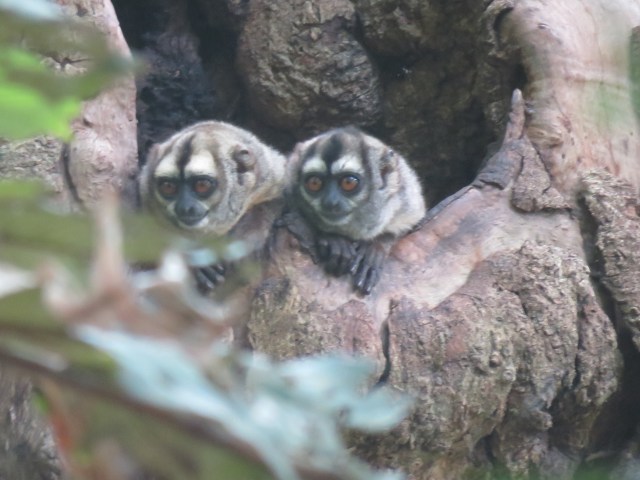

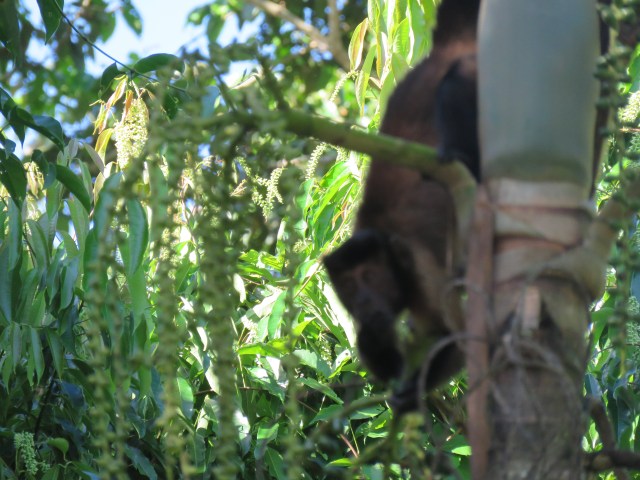


In today’s post, we continue with our series of publications resulting from our work in Zocay Project study area over the past 21 years. Today’s post is about a collaborative short note, my first publication, about an opportunistic event in which a black-capped capuchin group eat a carcass of a female Brumback night monkeys after they found it dead inside its nesting hole. The reason why we classify this event as an opportunistic consumption and not a predation event is because no hunting behavior was observed or hear from the capuchin monkeys’ group before we saw them eating the female Brumback night monkey. If you want to know more I invite you to read the short note here.
Sometimes when we are in the field following monkeys or doing surveys, we observe unusual behaviors, things that animals do occasionally, interactions with other species that are not common. All those observations are part of the natural history of each species and because they are rare in occurrence, therefore sometimes it becomes more difficult to study. The reason why I’m mentioning this is because we have the tendency to forget that those observations are also important to publish and that is the reason for short notes publications. I encourage you to publish those short notes and be more observant while you are doing fieldwork. We always should have a clear question and objectives in our projects but also need to register all those rare observations because those observations can be an indication of bigger changes in animal behavior, especially in fragmented landscapes.
Español: Una nota corta colaborativa de un evento oportunístico de los monos maiceros comiendo
En este blog, continuamos con nuestra serie de publicaciones resultado de nuestro trabajo en el área de estudio del Proyecto Zocay por los últimos 21 años. El blog de hoy es acerca de una nota colaborativa, mi primera publicación científica, acerca un evento oportunístico en el cual un grupo de maiceros comió el cuerpo de una hembra de mico nocturno llanero después de encontrarla muerta dentro de su nido. La razón de que clasificáramos este evento como un consumo oportunista en vez de un evento de predación debido a que no se observó ni escucho ningún comportamiento de cacería del grupo de maiceros antes de verlos comer el cuerpo de la hembra de mico nocturno muerta. Si usted quiere conocer más le invito a leer la nota corta aqui.
A veces cuando estamos en el campo siguiendo monos o haciendo censos, observamos comportamientos inusuales, cosas que los animales hacer ocasionalmente, interacciones con otras especies que no son comunes. Todas esas observaciones son parte de la historia natural de cada especie y debido a que ocurren rara vez, entonces a veces se vuelven más difíciles de estudiar. La razón de porque menciono esto es porque tenemos la tendencia de olvidar que estas observaciones también es importante publicarlas y es la razón de las publicaciones de las notas cortas. Los animo a que publiquen esas notas cortas y sean más observadores mientras están haciendo campo. Siempre debemos tener preguntas y objetivos claros en nuestros proyectos perno también necesitamos registrar todas esas observaciones raras porque esas observaciones pueden ser una indicación de cambios más grandes en el comportamiento animal, especialmente en paisajes fragmentados.
If you want to support our activities, please visit https://fineartamerica.com/art/xyomara+carretero or get in contact with us at xcarretero@gmail.com if you want to collaborate, donate or volunteer in our activities. You can also support our activities by buying our ornate titi monkeys stuff dolls https://www.instagram.com/p/Ctm_sEORvk8/?igshid=MzRlODBiNWFlZA== and our new journals in Amazon https://www.amazon.com/X-Carretero/dp/B0CWD1DBJM/ref=mp_s_a_1_1?© Copyright Disclaimer. All pictures used on this web page are protected with copyrights to Xyomara Carretero-Pinzón. If you want to use any of these pictures, please leave a message on the website or contact xcarretero@gmail.com
 zocayproject