
Monkey Forest Tales: A day with a mixed troop of Colombian squirrel monkey and black-capped capuchins

Today post is the first in a series of two post about interactions between primate species observed in the study area. This time we are going to join a common association between a group of Colombian squirrel monkeys (Saimiri cassiquiarensis albigena) and a group of black-capped capuchins (Sapajus apella). These species commonly make mixed troops, where groups of these two species eat and move together for several hours or days. The groups in our story live in a fragmented area with small fragments and live fences connecting them.

Our group of squirrel monkeys has 32 individuals: 4 males, 8 females, 3 sub adults, 10 juveniles of different age and 8 infants. And our group of black-capped capuchins has 6 individuals: one male, 2 females, 2 juveniles and one baby. They wake up early, when the sun was rising, around 5:30 am we start hearing squirrel monkey sound first, and from time to time you can hear a capuchin monkey sound too. They meet the day before close to the border of a forest fragment. They eat together in a big fig tree on a live fence and continue together to a small fragment, which they usually use to sleep. This fragment is connected to a bigger fragment by live fences full of fruit trees.

The new day start with some movements from the juveniles and females, from both species, they just start moving looking for some insects to catch, looking under dead and live leaves, removing some small branches, just searching. Babies were in their mothers back, a couple of them taking some milk from their mom, while they trying to catch some insects. All individuals from both species start eating fruits of several trees around the palms where they spend the night, others search for insects. Most of the capuchins on the top part of the trees, while the squirrel monkeys were eating in the lower branches and smaller trees. All babies are on the backs of their mothers now. It’s the beginning of April and the forest and live fences are full of fruits and there is more insects around because of the rain.

After a few minutes, capuchins start moving outside of the forest fragment and along the live fences, followed by squirrel monkeys. They were all more or less in a line, looking for fruits and insect while they were moving slowly. Two hours had passed when they reach the biggest fragment, individuals of both species disperse along the fragment edge, eating on small purple fruits from Miconia’s trees. After a while, capuchin and squirrel monkey juveniles start chasing between them, running and jumping from branch to branch. From time to time even a subadult male of squirrel monkey join the game. The game is simple, one start chasing the others, when one individual is catch, his tail is pulled and that individual start chasing the rest of the juveniles. There is a lot of screams from the juveniles playing around.

It’s almost midday and the air is hot; a soft wind came in from the forest edge. A capuchin male is resting in a wide branch groomed by a female with her baby in her chest, suckling some milk. Squirrel monkey females are grouped in a nearby tree on different branches, resting in pairs, while their babies move around them in an awkward way.

Around 2 pm, the squirrel monkey females start moving around searching for insects, some of the juveniles are still playing. Then the capuchin male start moving a bit faster, all his group follow him, while the squirrel monkeys seems to be trying to decide if they follow them or not. After a couple of minutes of doubt, squirrel monkeys start moving faster in the same direction that capuchins did. Suddenly, they stop, they found a group of big trees of Nispero and start eating dispersed between trees. There are some Mamito and Brosium trees too, individuals of both speies disperse between all trees, eating, all mixed. Some individuals are searching for insects, too. From time o time you can see a capuchin monkey or a squirrel monkey just looking at the sky and on the ground. They seems to be looking for any sign of danger. A big bird shadow is on the sky. A juvenile of squirrel monkey had saw it first and make a sound that alerts everyone. It’s false alarm, it was just a vulture playing with the wind currents, gliding.

Half an hour later, everyone start moving fast again. Jumping from one branch to the other. Occasionally one individual catch a spider. After a while they found a clump of Anime trees, it’s open red skin shows the sweet white pulp. Fruits are ready to be eaten. Females start eating them, while juveniles start playing again. A scream is hear and a couple of squirrel monkey females run towards the ground, they were chased by a capuchin female, who wanted to eat on their spot. A couple of subadult are searching for insects near to the ground. The group disperse to eat again. There are animals moving all around.

It’s around 5 pm and the movement starts again, slowly. They move, and eat some fruits and insects, not stopping, they have a direction again. Suddenly, they reach a part of the forest where a group of Unama palms are clumped, a place both species love to use as a dormitory. They probably will spend the night here. The first ones to enter are the females, they sit together, babies in the middle. Juveniles of both species are still playing together, chasing each other and screaming. Some squirrel monkey males and a capuchin male are still eating insects near to the top of a big tree. The sun is hiding and almost all movements stops. All capuchin monkeys in a couple of palms and squirrel monkeys in the remaining ones. They are ready to spend the night on those palms. It’s almost 6:30 pm and the sun is gone.

© Copyright Disclaimer. All picture used in this web page are protected with copyrights to Xyomara Carretero-Pinzón. If you want to use any of these pictures, please leave a message in the website. Thank you.


Monkey Forest Tales: A day in the life of a Red howler monkey


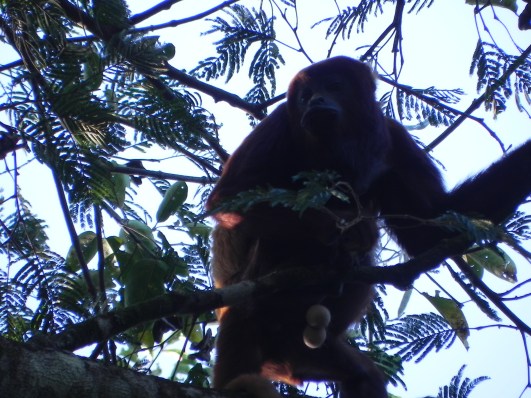
Unamas - SR Enero 2012 394Today post is the fifth and final post in the series of posts about a day in the life of a group of monkeys. This time we are going to join a group of red howler monkeys (Alouatta seniculus). Our red howler monkeys’ group is composed of 8 individuals, two adult males (an alpha and a beta), two adult females, one subadult female and a juvenile male and two babies, a male and a female. Red howler monkeys are big reddish monkeys which faces looks like both males and females had a beard. The reason for this is that in both sexes, although a bit more in males, the hyoids bone is large and it’s the reason for their loud and deep guttural vocalizations can be hear by kilometers.
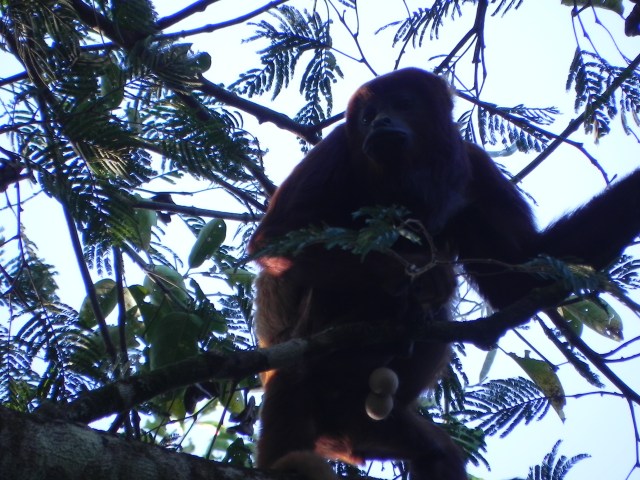
Our group started their day around 5:30 am with the males howling when the sunrise started. The females were feeding their babies but after a few minutes they join them. A couple of other groups were howling in the distance, answering our groups call. Juvenile and subadult were still sleepy when they started howling, but after an hour they both join. The howling lasted until 7:30 with the alpha male howling almost all the time and the rest of the group joining him from time to time.

Around 8 am the females start moving with their babies in their lower back, their movements fast, agile and silent from branch to branch, a few jumps but mostly like walking between branches. Suddenly, they stop in a tall tree, they start eating white flowers from a Platanote tree, this trees produces a white flower with sweet smell and big green fruits like plantain (that’s why is called Platanote in Spanish), those fruits dry and open and all the winged seed fly with the wind after a while. Then they move to and Anime tree and eat some young leaves, the whole group stay eating young leaves for a while, while the babies start playing to bite each other hanging from their tails.

They move for another hour or so, stopping to eat some fruits and some leaves from different trees until they reach a big tree of Avichure full of pink flowers. The whole tree crown was cover with flowers and only a few branches tips have some new leaves. Around 11:30 the juvenile and babies were moving playing around, chasing each other and then hanging and biting. The females rest together close to the alpha male. The beta male was eating at the farthest branch. It was time for a nap.

Slowly the babies when back to their mothers and drink some milk from them. It wasn’t until around 2 pm that females start eating some flowers again, the subadult females was grooming the alpha male and the babies were playing again.

The group start moving again around 2:30 pm, very fast with a clear direction, one after the other, first the oldest female, followed by the alpha male and the other females, then the juvenile and the beta male at the end, in a line. They stop in another Avichure tree this one had less flowers and more light green young leaves. This time the babies also tried a bit of leaves from their mothers’ mouths. After a while one female start grooming the male, her baby running around them, and from time to time pulling the males’ tail. It was almost four when they start to move again, slowly this time. They were moving towards a tall, big tree cover by vines and lianas. They dormitory for this night sleep. The first ones to sit down to sleep where the females, however, the babies were moving around making noises and jumping. Then the alpha male join them, very close to them. The juvenile and subadult where grooming a nearby branch. The beta male was the last to enter the tree and sit down in a different branch than the rest of the group. Around 5 pm no more movements were seen. The group was ready for the night sleep.

© Copyright Disclaimer. All picture used in this web page are protected with copyrights to Xyomara Carretero-Pinzón. If you want to use any of these pictures, please leave a message in the website. Thank you.

Unamas - SR Enero 2012 390

Monke Forest Tales: A day in the life of a Black-capped capuchin

San Martín Abril - Mayo 2011 104 (2)

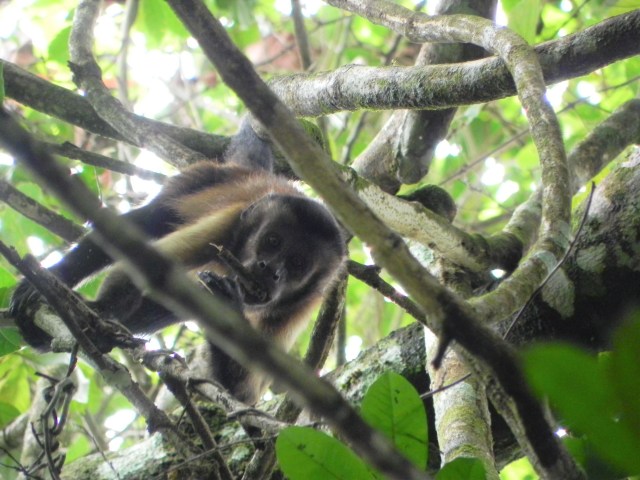
Today post is the fourth in the series of posts about a day in the life of a group of monkeys. This time we are going to join a group of black-capped capuchin monkeys (Sapajus apella). This black capped capuchin monkeys live in small group of 6 individuals, with one male, two females, two juveniles and one baby. They are medium sized monkeys with yellow coat and dark face, legs and tail, and very strong jaw.

Our group started their day around 6:00 am when the sunrise was over, it start with some movements from the juveniles and females, a female scratch her leg while her baby drink some milk from her and then, get back to her back when she moves. Juveniles start searching for insects, looking under dead and live leaves, breaking small branches and sending debris all around them.

Then, the group found a couple of Mamito trees with their big reddish pulp and start eating from them. The group disperse to eat, vocalizing to keep contact between them. The baby grab some pulp from his mom hand and taste it. They are still near to the big tree where they spend the night. After a while, they start moving slowly to other trees with small black fruits near to the edge of the forest. The forest is full of fruits and insects, the air is humid, the rainy season had started in the area.

After some hundreds of meters of relatively fast moving while eating insects, the group start to move slowly again. Juveniles start chasing between them, running and jumping from branch to branch. The baby join them after a while and they all hug and bite each other forming a small of arms and faces, screaming. The females are eating again some small yellow fruits from a nearby tree with wide branches. The juveniles stop their playing to join the adult and eat. The male is breaking some branches searching for insects, eating some cockroach and spiders hiding on dead leaves.

It’s almost noon and the adults stop moving. A female is grooming her baby sitting in a wide branch next to the males who is laying down with his leg hanging. The other females is a in another branch grooming a juvenile. After some quiet and calm minutes, the juveniles start playing again, chasing each other, while the adults are resting. The baby moves close to her mom, running a little bit and biting small branches nearby.  After a while, the juvenile join the adult and rest with them.

Around 2 pm, they start moving again. They move fast and with a clear direction. Suddenly they stop in an Anime tree to eat some fruits. Juveniles eat a bit there and start playing again. The group starts dispersing a bit, all looking for some insect and slowly moving towards the ground. They are close to the forest edge. Some individuals are searching for insects, others are eating small purple fruits, while the male look at the sky and on the ground. He is looking for any sign of danger. A big Caracara moves across the sky.

They are near to the ground, the juveniles and baby playing again, making a lot of noise and chasing each other on the ground, the rest of the group searching and eating insects and spiders in the nearby trees and on the ground. After a couple of hours of slow movements in the lower branches and close to the ground, the group start moving faster and in higher branches. It’s getting darker. The sky is cloudy, and a soft wind is moving the branches.

It’s around 5 pm and they slow down a bit, they are close to a group of Unama palms that they use as dormitory from time to time. They eat from some Anime and Nispero trees around. Juveniles searching for insects and eating some fruits too. Around movement starts again, slowly. They move, and eat some fruits and insects, not 5:45 only juveniles seems to be moving, jumping from one leave to the other, chasing each other, the baby playing with them. It’s almost 6:30 pm and the sun is gone. All movement had stopped, and only occasional sound can be hear. The group is resting.

© Copyright Disclaimer. All picture used in this web page are protected with copyrights to Xyomara Carretero-Pinzón. If you want to use any of these pictures, please leave a message in the website. Thank you.

Monkey Forest Tales: A day in the life of a Brumback’s night monkey

Aotus brumbacki (Colombian Llanos)Family
Brumback’s owl monkey (mono nocturno; Aotus brumbacki)

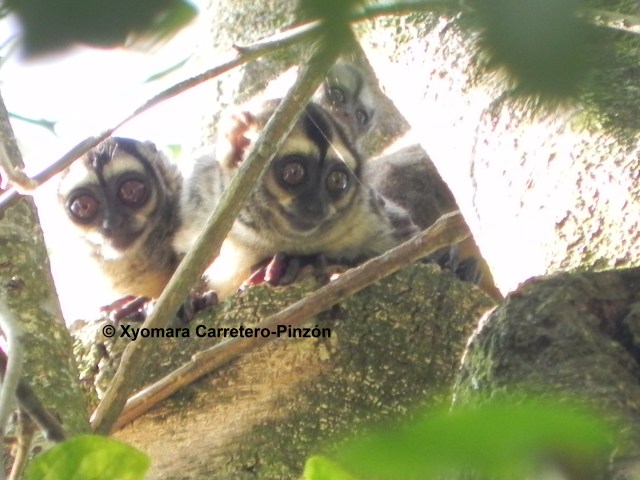
Today post is the third in the series of posts about a day in the life of a group of monkeys. This time we are going to join a group of Brumback’s night monkeys (Aotus brumbackii). They are small monkeys with big eyes that allows them to see in the dark. This night monkey lives in a small thin fragment full of palm trees in a swampy area. The group sleeps in a big old fig tree with a couple of deep holes that make it a cozy nest for our story family. The group is formed by a male, a female, a juvenile male of about two years and a small female baby of around three months

Our group started their activities around 5:30 pm. There are some movement in the nest. The male stick out his head on the nest hole looking around for any sign of movements in the branches around. Then, female and juvenile join him. The baby is in his father back and slowly moves to her mom’s to suck some milk from her before going back to her father. Night monkeys’ babies are taking care by their fathers and only go to their mother when they need to eat. The group starts moving around 6 pm, when the sunset is finishing. First the male and then the rest of his family move outside of the nest.

There is a fig tree just a couple of meters from their nest and it’s full of small reddish, sweet fruits. They move slowly toward it. This part of the forest is thin and very open, so their movements are agile and fast, but they stop continuously to look around for any sights of danger. They reach the fence and start to go down, they cross the small part of pasture that give them access to the fig tree, just 10 meters from the fence and go up very fast. The family disperse a little bit a start eating some fruits and occasionally a small insect. They spend around an hour there eating and moving on the fig tree branches catching small insects.

After a while they start moving again a big faster, they return to the forest fragment and their movements are fast and agile, they have a clear direction towards the other edge of the fragment. They cross the Moriche palms (Mauritia flexuosa palms) standing near to the stream crossing the fragment. Stop there for some minutes to eat some insects from the broad leaves of the palms, the juvenile male jumping and playing around while his little sister look him from his father back. The group reach the other side of the fragment where some trees with small back, round fruits are crumpled and start eating again.

It is almost 9 pm and the group start moving again towards the Moriche palms, once there, movements stop a bit and the parents sit to rest. The male showed his back to the female asking for grooming time, while the baby move around them, carefully. The juvenile male start grooming the baby. Suddenly, you can hear some guttural sounds, glup…glup…glup and the parents start looking around, an owl scream is hear nearby. The parents are in alert for a while repeating that guttural sound a bit longer. Then calm come back and grooming starts again. The juvenile male and his sister are playing, the baby jumping in her brothers’ back while his brother try to catch her. After a while no movement can be seen. The group is resting.

Around noon some movement start again, slowly towards an Anime tree, next to the Moriche palms, all the group is eating the small white pulp from the Anime. After a while, the male lay down on a wide branch and the female join him for another rest. The juvenile and baby join them this time.

Around 2:30 am they start moving again, they eat a bit more Anime fruits before leaving the tree. They move between Moriche palms searching for insects to catch. The male catching a big cricket at once and the baby taking some bit from his mouth. They are moving towards one of the forest edges again. The edge is a bit lower here and with dense vines. All group moves towards the ground and start searching and catching insects again. After a while, they start moving again towards a higher tree in the vicinity. They spend a few minutes grooming and then move again towards the nest they sleep last day. Their movement were slow, stopping in some Moriche palms to eat some insects, another Anime tree for more fruits and around 4 am for another small rest before stopping once more in the fig tree near to the nest. They spend around an hour there before moving to their nest. Around 5:30 all group was in the nest and only the father was looking out for any signs of danger nearby. The sun was rising in a blue sky. At 6:30 all movement had stopped, and all group member were hiding inside the nest.

© Copyright Disclaimer. All picture used in this web page are protected with copyrights to Xyomara Carretero-Pinzón. If you want to use any of these pictures, please leave a message in the website. Thank you.

Monkey Forest Tales: A day in the life of a Colombian squirrel monkey group

P1010498 (2)

Today post is the second in the series of posts about a day in the life of a group of monkeys. This time we are going to join a group of Colombian squirrel monkeys (Saimiri cassiquiarensis albigena). This squirrel monkeys live in large groups of 25 – 50 individuals, with several males, females and juveniles and immatures of different age. They are small monkeys with long, thin tails to help them balance when they jump. They have a gray body and while belly, their mouths are surrounded by a black patch that make they faces look like a mask of white and black face tones. Our group has 32 individuals: 4 males, 8 females, 3 sub adults, 10 juveniles of different age and 8 infants.

Our group started their day around 5:30 am when the sun was rising, it start with some movements from the juveniles and females, they just start moving looking for some insects to catch, looking under dead and live leaves, removing some small branches, just searching. Babies were in their mothers back, a couple of them taking some milk from their mom, while they trying to catch some insects.

All the group members start eating fruits of several trees around the palms where they spend the night, others search for insects. All babies are on the backs of their mothers. It’s the end of March and it’s finally starting to rain a little bit. Soon the forest will be full of fruits and more insects will be around.

Juveniles start chasing between them, running and jumping from branch to branch. The game is simple, one start chasing the others, when one individual is catch, his tail is pulled and that individual start chasing the rest of the juveniles. There is a lot of screams from the juveniles playing around. Then the females start moving a bit faster still searching for insects, they seems to have a direction, a couple of males are in the front with the females and the other males are in the back with the subadults, all males.

Finally, they stop, the group is in the border of the forest, some individuals are searching for insects, others are eating small purple fruits, and some are just looking at the sky and on the ground. They seems to be looking for any sign of danger. Nothing is on sight. They can move again.

Then, some of the males and females start going down, they are on the ground going outside of the forest to a big fig tree. The tree is full of small reddish fruits. All the group members are on the big fig tree, some of the males keep looking at the sky at the same time they are eating. A female scream, other female just reach her spot and claimed to be hers. A bit of chasing and then all come back to normal, just enjoying the sweet fig fruits. An hour have pass and it’s almost noon.

Some of the juveniles and males start moving again to the forest fragment. Crossing the small gap between the fig tree and the forest, around 100 m. Running on the ground. A couple of juveniles stay on the ground catching insects and playing around at the forest edge, hiding between some vines.

Then the females move back to the forest. Some of them, just relax, they lay down in pairs on the top, wide branches of a big tree, close to the forest edge. The air is hot, humid, the sun it’s in his highest point. Half an hour later, the whole group start moving fast again. Jumping from one branch to the other. Occasionally one individual catch a spider. After a while they found a clump of Anime trees, it’s open red skin shows the sweet white pulp. Fruits are ready to be eaten. Females start eating them, while juveniles start playing again. A couple of subadult are searching for insects near to the ground. The group disperse to eat. There are animals moving all around.

It’s around 5 pm and the movement starts again, slowly. They move, and eat some fruits and insects, not stopping, they have a direction again. Suddenly, they are in a thick part of the forest, surrounded by vines a couple of tall trees with vines seems to be the place to spend the night. The first ones to enter are the females, they sit together, babies in the middle. Juveniles are still playing, chasing each other and screaming. Some males are still eating insects near to the top of a big tree. The sun is hiding and almost all movements stops. They are ready to spend the night on those trees. It’s almost 6:30 pm and the sun is gone.

© Copyright Disclaimer. All picture used in this web page are protected with copyrights to Xyomara Carretero-Pinzón. If you want to use any of these pictures, please leave a message in the website. Thank you.

Monkey Forest Tales: A day in the life of a dusky titi monkey group

DSCN7634 (2)

This post and the next four are a series of posts about the life of a group of each of the species present in this area. Some of the stories are based on my own observations and others also include observations shared by my students over the years. Usually when I train a new student, one of the things I like to do is spend a couple of days following the group with them, is a way of train them and to know them and some of the stories here are based also on those days.

The first story is about a group of dusky titi monkeys (Plecturocebus ornatus), called locally, zocay (a beautiful name for a beautiful monkey, that is why I named my project after this species). Dusky titi monkeys are medium size monkeys with a fury look who lives in family groups, like us, with a mother, a father and their kids. The family in this story is composed of a father who is taking care of the youngest in the group. Fathers are in charge of babies in this specie of monkeys. They only pass the baby to the mother when they need to eat. Sometimes a sister or brother can also carry the baby for a few minutes, but mostly is the father who does it.

Our group wake up early today, around 5:45 am, and the father start his morning call while his baby was drinking some milk from his mother. A few minutes after, the mother join the father and they sing a duet. Signing lasted around half an hour, no other group answer their morning call today. While the parents where signing the two juveniles in the group, a female and a male where eating yellow fruits of Nispero, a fruit very common in the area with small seeds and a sweet taste.

The parents join the two juveniles who were eating Nispero for a couple of minutes and start moving. While they were moving towards some other fruit trees in the vicinity, the male juvenile, a bit older that his sister, just by two years, catch a cricket who was hiding in a dead leave.

Eating time lasted for another hour so, mostly in the same area, all eat a bit of fruits and from time to time some crickets and spiders. Then was time to move a bit more with agile jumps from branch to branch. After a couple of hundred meters the father stop again in a dense vine area near to the border of the fragment where they live. There were small purple fruits and a lot of small flies, spiders, crickets and other insects around to catch. They eat a bit more and then was time for the parents to rest. It was almost noon and the sun was high in the sky, the air was hot and dry.

The parent look for a wide branch in which the father lay dawn, hanging his legs and showing his back to the female for her to groom him. The baby move a bit far from his father, he was three months old and started to move on his own when his parents where resting. He approach his sister who was searching for insects. She stops her search to smell him and start grooming him.

The other juvenile, the male was close to the ground looking for insects and jumping from one branch to the other. After an hour or so all the group members were lying next to the father resting. It was nap time for the family.

Around 2 pm the mother started to move and search insects. The father take his baby on his back and start eating the purple fruits again. Slowly they start to move again toward the stream that cross the forest fragment in search of more fruits and insects while they were moving.

Around one hour after, they stop again and the juveniles start playing together, one chasing the other and back. The game was over after a half hour and then they groom each other. The parents were looking for insects all over, moving slowly from one tree to the next. The mother was carrying the baby who was taking some milk.

Around 4 pm, they start moving again towards a high tree with dense vines on top. They probably were going to spend the night there. But before entering the dense vines, they stop again in a couple of Nispero trees to eat a bit more. The two juveniles were the last to enter, they were chasing each other again, pulling their tails and running around, until a hawk scream make the run towards their parents. All were looking up where the hawk was flying, not moving so they don’t call the attention of the hawk.

After a while the hawk was gone and they spend a few more minute eating fruits and insects before going to sleep around 5:30 pm, where no more movements were observed, and all the family sit together to spend the night.

© Copyright Disclaimer. All picture used in this web page are protected with copyrights to Xyomara Carretero-Pinzón. If you want to use any of these pictures, please leave a message in the website. Thank you.

Mokey Forest Tales: How cattle rancher can increase connectivity in their farms through live fences?

DSCN9758

As I mention before the study area of this project include several cattle ranching farms. Some are large, other not so large and some are small. But all are important for the conservation of the biodiversity in this area, even the small ones.

More important and probably something that most landowners didn’t know is that even if they don’t have big forest fragments in their farms, every native tree and live fence that is in their properties can help to conserve and increase the survivorship of the wildlife in the region.

How? My observations as well as observations from other researchers have found that although isolated native trees and live fences probably are not enough to save big populations of any wildlife species. They can help these populations to disperse between forest fragments and find partners outside of their natal groups and families.

Traditionally, in this area cattle ranching was extensive but with time that changed and some of the traditional practices such as live fences, isolated trees and groups of native trees (forest patches of less than 1 ha) in the middle of pastures are some of the traditional practices that has been lost over the years. These landscape structures are very useful for wildlife.

Monkeys, birds, some insects, snakes, frogs and other variety of small, medium and large mammals use these landscape structures as stepping stones, temporary homes or just a more hidden routes to move between forest fragments in search of food, partners and other resources. Helping wildlife to avoid predation while dispersing.

Additional to these benefits for wildlife in areas with several months of dry season, these landscape structures are also important for livestock too. During the dry season when water is scarce, livestock losses a lot of weight not only as a consequence of less quality of the grasses but also because they are exposed to high temperatures specially at noon. Therefore, live fences and isolated natives’ trees not only provided services to the wildlife in the region but also give shadow to the livestock during those hours of high temperatures, helping them to regulate temperature and avoid losing more weight.

So, if you are a farmer, not matter where, just remember that every native tree, live fence, hedgerow you have in your property had a value to improve the survivorship of the wildlife in your region and to improve the wellbeing of your livestock.

© Copyright Disclaimer. All picture used in this web page are protected with copyrights to Xyomara Carretero-Pinzón. If you want to use any of these pictures, please leave a message in the website. Thank you.

DSCN9767

Monkey Forest Tales: Why black-capped capuchins move in big groups (> 10 individuals) in very fragmented areas?

SM Junio 2011 093

One of the things that I love more of this project is that every time I go to the field, I came back with more questions than answers. One of those questions that still I cannot answer and that sometimes make me wonder of what happens in at least part of my study area is why black capped capuchins move in big groups (> 10 individuals) in very fragmented areas?

Black-capped capuchins usually live in groups of 5 – 8 individuals in this area, with up to 2 adult males, several females (usually, 2 – 3) and their juveniles and infants. However, over the past 15 years I have seen groups of black-capped capuchins of up to 22 individuals moving together as a cohesive group.

Although this species of capuchins has been observed in groups of up to 19 individuals in continuous forest (Izawa 1990, a group of black capped capuchins that was feed with plantain and bananas for behavioral studies).

In fragmented areas where there is less food and more predators (including domestic dogs), black-capped capuchins groups usually are small (5 – 8 individuals). So, why are we observing these big groups sporadically.

At least for one of my observations I’m sure that big group (22 individuals) was the result of several groups (2 – 3 groups) moving together. This observation was made in a live fence on June of 2011, around noon.

All animals were moving from one live fence (a line of native trees left by the landowners to separate different pasture plots) to another by a 10 m gap, going down to the ground and up again on the other live fence. I was able not only to count them, but also to determine the composition of this big group (4 adult male, 4 adult female, 10 Juveniles, 4 Infants).

The area in which this observation happens is part of three black capped capuchin groups. However, I couldn’t determine the reason why these groups were moving together. There wasn’t any evidence of a very large availability of fruits that make this big group to remain together or any evidence from that month or the previous and following months that indicated the presence of any particular big predator.

The other observation was made in a forest fragment of 79 ha. In this case it was only one group with a high proportion of juveniles and infants (2 adult males, 5 adult females, 1 subadult male, 5 juveniles and 5 infants). And only this group seems to be living in this fragment despite its area.

There are two main theories of why monkeys live in big versus small groups. First as a strategy to reduce predation risk: if you are an individual in a big group then there are less probabilities that a predator focuses on you and catch you. Additionally, if you live in a big group there is more individuals looking for predators and therefore the time, I spend looking for predators (vigilance behavior) is reduced because I had help from other group members (Fragaszy et a. 2004).

Second, living in big groups can give you an advantage on your feeding strategy, because you have more individuals to help you find and defense those food resources (Fragaszy et al 2004). However, a research had found that for this particular species of capuchin monkeys in continuous areas, this is not true (Janson 1988).

Then why black-capped capuchins are found in this big groups in fragmented areas? We have observed 18 groups of different forest fragments with more than 9 individuals present in the study area. The answer to this question is not clear but probably both theories are playing a role here. Additionally, we don’t know if there are any factors influencing how well the capuchins in this area can disperse. We know that they can disperse using wire fences, living fences, and crossing pastures. Local people had reported this, and I had observed all three methods of dispersing in the area over the years.

We also observed predation attacks by domestic dogs, common caracaras and tayras towards juveniles from different groups in the study area. Most of them in living fences and small forest fragment. Moreover, we know that at this area there are cougar and jaguar, as well as other felines such as ocelots. We also know there are big prey birds such as crested eagle in the area.

So, it’s possible that in some cases young individuals decided to stay in their natal groups longer as a measure to reduce predation, although this could mean a reduced reproductive success for them and more competition for food (18 groups of different forest fragments with more than 9 individuals present in the study area).

References

Fragaszy D.M., Visalberghi E. and L.M. Fedigan 2004. The Complete Capuchin: the biology of the Genus Cebus. Cambridge University Press. Cambridge, UK.

Izawa K., 1990.  Social changes within a group of wild black-capped capuchins (Cebus apella) in Colombia (II). Field Studies of New World Monkeys, La Macarena, Colombia 3: 1- 5.

Janson 1988. Food competition in brown capuchin monkeys (Cebus apella): quantitative effects of group size and tree productivity. Behaviour 105: 53-76.

© Copyright Disclaimer. All picture used in this web page are protected with copyrights to Xyomara Carretero-Pinzón. If you want to use any of these pictures, please leave a message in the website. Thank you.

Monkey Forest Tales: Why is important to study monkeys?

Why do you study monkeys? Why is important to study them? These are some question that local people and family make me very often. Sometimes these questions have led to a very interesting discussion with local people. I usually start answering these questions with my personal reasons and then explaining why monkeys are important for the forest and therefore for them.

So, why I study monkeys? Because they save my life, they give me a reason to continue living and I fell in love with them. Also, they are charismatic animals so much like us and their babies are cute.

When I decided to study biology, it wasn’t because of the monkeys, it was because I want to dedicate my life to dolphins and whales… and for many years that was my main purpose. But when I enter to the university they start talking about a place, a forest to which you can go and spend a semester studying animals in the jungle…very exciting right!

Well, that was what I though and I decided I want to try, I want to go to that place and spend a semester studying a mammal (a fury animal that drinks milk like us). There were options to study monkeys (I can choose any of the seven species present in that area) or a big bird called curassow. So, I decided for monkeys, specifically for red howler monkeys, I studied the behavior of their babies during their first months of their life. And I fell in love with them.

But, why are monkeys important? Well, they are part of the forest and therefore they have a function in the forest that make that forest work properly. All the species in my study area consume fruits, some species consumed more than others, some of them consume big fruits with big seeds and others consumed small fruits with small seeds.

Every time they eat a fruit and their seeds pass through the monkeys’ digestive system, some of those seeds can pass for a chemical process that accelerate their germination. Therefore monkeys, as well as birds and bats are the farmers of the forest, they disperse the seeds of the fruits they consume.

Also, some monkeys have been called forest engineers, because during their movements in the forest searching for insects (crickets, months, cockroach, beetles), spiders and small lizards, birds and frogs they transform their environment and open new sites for other animals to arrive, and drops sticks and leaves to the ground where they will decomposed and became new nutrients for the trees in that forest.

And why is this important, because if we don’t have new plants in those forest, there will be a time that that forest disappear and without forest, we people, don’t have water.

In an area like the Colombian Llanos where dry season can last up to four months, sometimes without a single drop of water. The forest that remains around the streams are the only option for wild and domestic animals to find shadow and water during those dry months.

So, monkeys are an important part of this system and we need to protect them to protect the forest and water that help us to maintain life in this and other areas in the world.

Although I usually don’t mention this to the people in the area, they are also important because more than 75 % of the monkeys’ species around the world are disappearing for different causes such as deforestation, fragmentation, hunting, bushmeat, and illegal pet market. Another reason to study and protect them around the world!

© Copyright Disclaimer. All picture used in this web page are protected with copyrights to Xyomara Carretero-Pinzón. If you want to use any of these pictures, please leave a message in the website. Thank you.

Monkey Forest Tales: What happens with an adult male of red howler monkey after he is expulsed from his group?

Unamas - SR Enero 2012 390

In July of 2005, a student observed the change in dominance of two males in a group of red howler monkeys.

Red howler monkeys usually live in groups with one or two adult males and several females and their juveniles and infants. In general, the dominant male or alpha, is the one who reproduces, therefore the tension between males can produce fights and changes in male’s dominance over time.

Male’s dominance can be produced because an external male, usually a solitary male, or another male in the group challenge the alpha male. Some of these fights finish in body contact where the male who lose can be seriously injured. This was the case of the male in this story, we called him D.

Very little is known about those males that lose a dominance fight and are expulsed from their groups, injured. D lived in a small fragment where census survey was taken frequently, and he was usually seen during these surveys.

D was observed for four months after he was expulsed from his group, mainly in some areas of that group territory, but never in close proximity to the group. During the first days his left leg was injured, and he moves slowly and with difficulty. He has a cut in his face and leg. But he was still able to feed himself and move, which was good for his survival. After six months we couldn’t find him again and although his injuries were better, we couldn’t be sure if he survived, disperse to another fragment or died.

Other solitary males had been seen in the same fragment and other fragments we survey in the study area over the years (29 observations of solitary males in 15 years), mainly in good health and without scars, except by two adult males: one observed by a local worker, who found him crossing a pasture with a deep wound full of worms. And another adult male observed in a medium size fragment (114 ha) with slow movements and who looks sick or old at that moment.

Reference


© Copyright Disclaimer. All picture used in this web page are protected with copyrights to Xyomara Carretero-Pinzón. If you want to use any of these pictures, please leave a message in the website. Thank you.