
Monkey Forest Tales: What we have learned about Colombian squirrel monkeys over the past 15 years?

DSCN0167

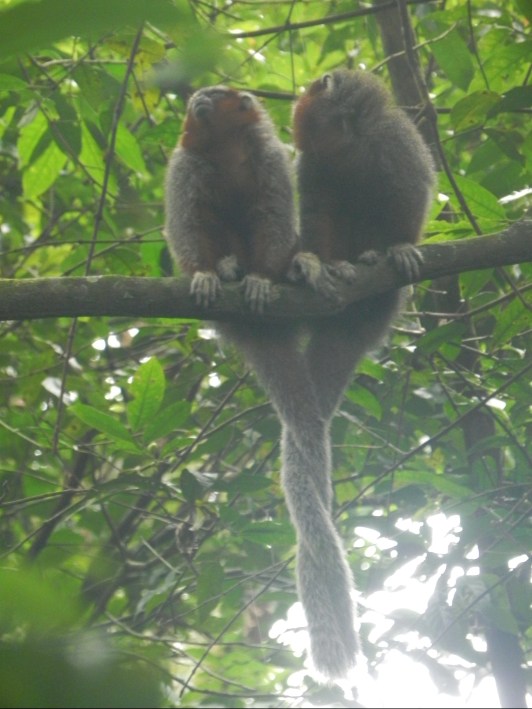
This is the second post of a series in which the findings of this project are presented. In this post, the findings for the Colombian squirrel monkeys are described. Colombian squirrel monkeys are one of the smallest primate species inhabiting the study area.

Most of the time when people see this species in continuous or fragmented areas, they have the impression that there are too many of them. The reality is that because these species live in bigger groups, it looks like there are many but it’s usually just one big group. This has led to the idea that there are common and not in danger of being extinct. However, their numbers are declining, and their habitat has been reduced and fragmented and this affects its survivorship. This is the reason why they are classified as near threatened (Carretero-Pinzon et al 2009, 2013).

Where do you find them and how many of them you will find depending on the amount of forest there are in the landscape. How many fruit trees and how high the forest canopy is, as well as the presence of living fences influence how many of these agile and sometimes noisy small monkeys you can find in fragmented landscapes (Carretero-Pinzon et al. 2017).

The fences made from a line of native trees used by local farmers to divide their pastures (living fences) as well as those trees find standing alone or in small groups in the middle of pastures are important sources of food, especially fruits. Also, living fences are used as part of home ranges (territories), using them to eat fruit, arthropods and to get access to flooded forest fragments in search of small frogs (Carretero-Pinzon & Defler 2018). They use living fences with variable height and also wire fences without any tree cover during their daily movements as well as when dispersing (Carretero-Pinzon et al 2010).

In fragmented landscapes areas where living fences and isolated trees are common usually support bigger groups (> 25 individuals; Carretero-Pinzon et al 2010). These landscape structures help them to survive in highly fragmented landscapes such as agricultural and urban landscapes. They can live in fragments of gallery forest, lowland forest and swamp forest (forest patches composed mainly of Mauritia flexuosa; Carretero-Pinzon & Defler 2018).

As I mentioned in another post, they live in big groups formed by several males, females and their offspring. But in fragmented areas group sizes are smaller than in continuous areas, with groups commonly having between 15 – 43 individuals (Carretero-Pinzon et al 2016). Most groups in continuous areas are of more than 50 individuals. Groups usually have several females (<6 in fragmented areas and > 8 in continuous areas), a couple of males (< 5 in fragmented areas and >6 in continuous areas, Carretero-Pinzon, unpublished data).

Also, in fragmented areas is common that you find subgroups of the same group eating and moving for just a few hours or up to two days apart, especially, in the months in which the fruit offer is reduced in the forest fragments. In continuous are on the contrary subdivision of groups is less common and n some areas is possible to see more than one group of squirrel monkeys eating and moving together (Carretero-Pinzon personal observations). Group territories (home ranges) in fragmented areas don’t overlap very often, while in continuous areas the overlapping can be of almost 50 % of their home ranges (Carretero-Pinzon et al 2016). In both cases there is not evidence of defense of territories and when two groups encounter there is not display of aggression associated with this defense (Carretero-Pinzon personal observations).

In continuous areas (big extensions of a forest), it is common to find solitary males and bachelor groups of only males that are also common in fragmented landscapes. It is also possible to find solitary males using small fragments (< 10 ha) as permanent home ranges for several years and making associations with groups of red howler monkeys. We are not sure if those males are old males just living their last years alone or if they are just dispersing males. However, we know of at least one solitary male who spends at least three years living in a small fragment (4 ha) for three years and then disappears from that fragment (Carretero-Pinzon unpublished data).

Colombian squirrel monkeys in the fragmented areas eat arthropods, fruits, and flowers, in more quantity than in continuous areas but always consuming more arthropods than fruits in both (Carretero-Pinzon et al 2016). The plant species they eat fruits vary in fragmented landscapes where more pioneer plants are used. These are plant species that grow faster and require more light to grow and are easily found in forest fragment edges (Carretero-Pinzon et al 2016).

Mixed troop formations with black-capped capuchins (Sapajus apella) are less frequent in fragmented landscapes compared with continuous areas as I mentioned in a previous post.

References

Carretero-Pinzon X., Defler TR. 2018. Primates and flooded forest in the Colombian Llanos. En: Barnett AA, Matsuda I, Nowak K (eds) Primates in flooded habitats: ecology and conservation, Cambridge University Press, Cambridge, UK.

Carretero-Pinzón, X., T.R. Defler, C.A. McAlpine & J.R. Rhodes. 2017. The influence of landscape relative to site and patch variables on primates distribution in Colombian Llanos. Landscape Ecology 32: 883-896.

Carretero-Pinzón, X., T.R. Defler & M. Ruíz-García. 2016. How does the Colombian squirrel monkey cope with habitat fragmentation? Strategies to survive in small fragments. En: Ruíz-García M, Shostell J.M. (eds). Phylogeny, molecular population genetics, evolutionary biology and Conservation of the Neotropical Primates. Nova Science Publisher Inc., New Yoork, USA. ID book 5975

Carretero-Pinzón, X., T.R. Defler & M. Ruíz-García. 2013. Conservation Status of Saimiri sciureus albigena, an endemic subspecies of squirrel monkeys. In: Especies de Primates Colombianos en Peligro de Extinción. Defler, T.R., Stevenson, P.R., Bueno M.L. & D.C. Guzman.

Carretero-Pinzón, X., T.R. Defler & M. Ruíz-García. 2010. Uso de cercas vivas como corredores biológicos por primates en los Llanos Orientales. In: Primatología en Colombia: avances al principio del milenio. Pereira-Bengoa, V., Stevenson P.R., Bueno M.L. & F. Nassar-Montoya. Fundación Universitaria San Martín. Bogotá, Colombia.

Carretero-Pinzón, X., M. Ruíz-García & T.R. Defler. 2009. The Taxonomy and Conservation Status of Saimiri sciureus albigena: a squirrel monkey endemic to Colombia. Primate Conservation 24: 1 – 6.

DSCN7638

© Copyright Disclaimer. All pictures used on this web page are protected with copyrights to Xyomara Carretero-Pinzón. If you want to use any of these pictures, please leave a message on the website. Thank you.
Monkey Forest Tales: What have we learned about primate community and biodiversity over the past 15 years?

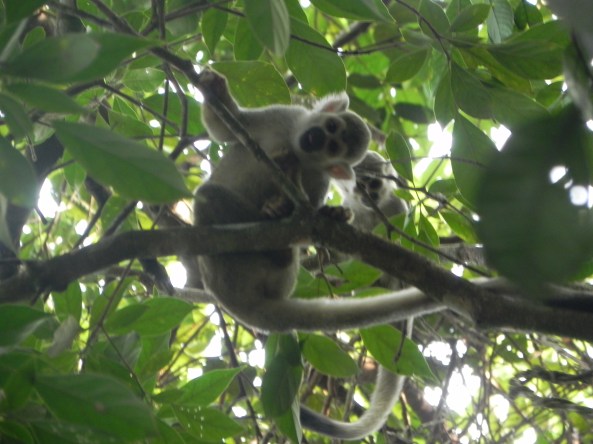
Today I start a series of six posts in which a summary of all the findings of this project is presented. In this first post, some of the findings related to the primate community and biodiversity of the study area, in general, are presented. The following five posts will present the specific findings related to each of the primate species studied in this project for the past 15 years.

As you may notice from the information on this website, the study area have a primate community composed of five species: red howler monkeys (Alouatta seniculus), black-capped capuchins (Sapajus apella), Colombian squirrel monkeys (Saimiri cassiquiarensis albigena), dusky titi monkey (Plecturocebus ornatus) and Brumback night monkey (Aotus brumbacki). Additionally, in the area is possible to see deer (Odocoileus virginianus), giant ant eaters (Myrmecophaga trydactila), river otters (Lontra longicaudis), armadillos (most commonly found Dasypus novemcinctus), squirrels (Sciureus granatensis), tamanduas (Tamandua tetradactyla), coatis (Nasua nasua), opossums (Didelphis marsupialis), hedgehogs (Coendu prehensil), tayras (Eira barbara) small felids and a wide variety of birds. Towards the east of the study area and inside of the bigger forest fragments tapirs (Tapirus terrestris), peccaries (Tayassu tajaccu), capybaras (Hydrochoerus hydrochaeris), at least three species of deer (Mazama gouazoubira, Mazama americana and Odocoileus virginianus), jaguar (Panthera onca) and cougars (Puma concolor) can also be found.

The most common primate species in the area are the red howler monkeys and the black-capped capuchins (Carretero-Pinzón et al. 2017). Although, in general, the primate community is composed of the five primate species mentioned above, all the big primate species (woolly monkeys (Lagothrix spp.) and spider monkeys (Ateles spp.)) has been extirpated from the area for more than 100 years according to local people and are found now only towards the Macarena and Tinigua National Parks, southeast of the study area.

For all primate species, the presence of the species in a forest fragment depends on the amount of forest surrounding a specific fragment (Carretero-Pinzón et al. 2017). Small fragments (less than 10 ha) are used mostly as a stop when primates species are dispersing between fragments in the study area. Except for red howler monkeys, who can live in these small fragments permanently.

The presence of living fences as well as isolated trees increases primate species movements between forest fragments. Living fences are used by all primate species not only for dispersion but also as part of their home ranges with the use of the living fences in a seasonal pattern to get access to additional fruit trees, arthropods and to get access to flooded forest fragments (Carretero-Pinzón et al 2010; Carretero-Pinzon & Defler 2018). Living fences are also used by tamandua, armadillos, squirrels, hedgehogs, coatis, snakes and a wide number of birds.

When forced all primate species in the study area can cross large extensions of pastures, with a recorded distance of up to 4 km for red howler monkeys and 3 km for dusky titi monkeys (Personal and local people observations). Giant anteaters are common on pastures and crossing secondary and tertiary roads in the study area in early morning hours or late in the afternoons. Occasional observations of white-lipped peccary herds in the eastern part of the study area had been reported by local people. The last report of a herd near to San Martin town by a local farmer was nearly ten years ago.

Small fragments (< 10 ha) are used as a temporal home of coati groups, who use fragments of different sizes and move through pastures and living fences. Other mammals, such as giant anteaters, deer, armadillos, hedgehog, opossum use these small fragments as a permanent home range. Farms in which we had observed more mammals are the ones with more living fences, isolated trees and small fragments (< 10 ha). All five primate species can live in fragments of gallery forest, lowland forest and swamp forest (forest patches composed mainly of Mauritia flexuosa; Carretero-Pinzon & Defler 2018).

Over the past 15 years, in some of the fragments that were fenced to reduce the cattle use of forest fragments, we have observed the regeneration of the underground vegetation. Also, in those fenced forest fragments we observed the return of coatis, squirrels, and guans, these animals were not observed during the first years of this project. An emergent problem for the biodiversity of the area is the increment of feral and domestic dogs in the area that hunts in groups inside the forest fragments.

References

Carretero-Pinzon X., Defler TR. 2018. Primates and flooded forest in the Colombian Llanos. En: Barnett AA, Matsuda I, Nowak K (eds) Primates in flooded habitats: ecology and conservation, Cambridge University Press, Cambridge, UK.

Carretero-Pinzón, X., T.R. Defler, C.A. McAlpine & J.R. Rhodes. 2017. The influence of landscape relative to site and patch variables on primates distribution in Colombian Llanos. Landscape Ecology 32: 883-896.

Carretero-Pinzón, X., T.R. Defler & M. Ruíz-García. 2010. Uso de cercas vivas como corredores biológicos por primates en los Llanos Orientales. In: Primatología en Colombia: avances al principio del milenio. Pereira-Bengoa, V., Stevenson P.R., Bueno M.L. & F. Nassar-Montoya. Fundación Universitaria San Martín. Bogotá, Colombia.

© Copyright Disclaimer. All picture used in this web page are protected with copyrights to Xyomara Carretero-Pinzón. If you want to use any of these pictures, please leave a message in the website. Thank you.


Monkey Forest Tales: How climate had change in the area? And other related questions

DSCN0159

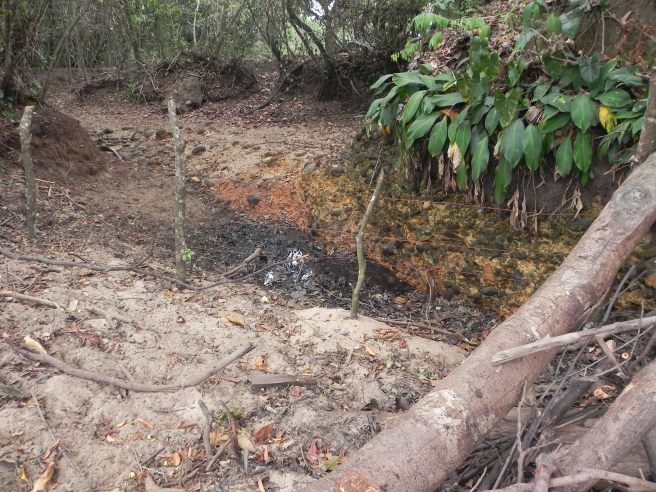
Dry season pod in February 2019.

Towards the end of February, 2019 we spend some days at the study area as we usually do, from time to time. However, this year I was specially surprise about the weather changes observed during this dry season. In the study area there is two main seasons: a dry season (usually from December – March) and a wet season (April – November). Usually on dry season the small stream that cross some of the forest fragments where we observe the monkeys dry out during some weeks between January and February, but not completely. You can find a couple of small pods in certain parts of the forest and near to the farmhouse. However, in 2019 only one of the permanent pods was still present. It wasn’t a properly pod, it was looking more like a muddy spot surrounded by dry sand from the dry stream bed.

In past years, specially 2005 we had seen the stream dried a lot, but those pods usually remains, and you could see birds as well as cattle and horses drinking there, not this year. But why this year the pods dried that much?

In past years, 2013 and 2014 there was a boom of petrol exploitation in the area. Seismic surveys were done near to almost all streams in the area in search of petrol. Although most of the people in town and cattle ranchers were mainly happy, some wasn’t. I remember specially a guy from one of farms we visited in 2014, who was complaining that he wasn’t agree with that, he had seen how after the petrol company finished their explorations in an area, all the streams were dry, it seems a family member of his had lost his land because it became so dried that nothing growth there. Can this be what is happening in this area now?

The area had a good phreatic level and is usual that most farms have their own well, even in the town houses. But this year even the small river crossing the town dried more than years before. And it’s not only about how dry all those streams were this year it was also about how much this year dry season lasted.

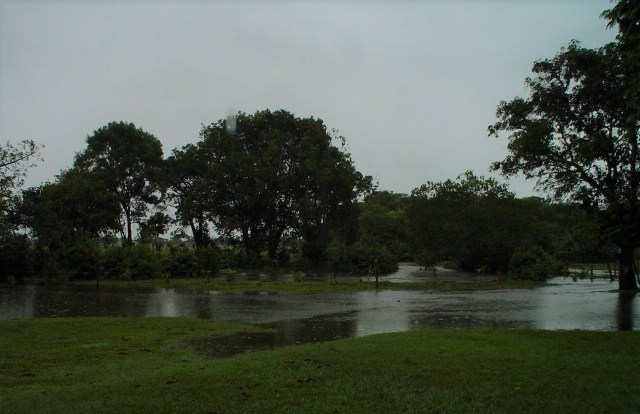
For the first time in 15 years, the rainy season properly started in May not April, as usual. In past years by the time Easter arrives, the stream near to the farmhouse usually had a lot of water and even some years it flood over the stream bank almost to the house. However, this year wasn’t even close to the stream bank. Some scarce rains had fallen towards the end of April but not enough to make the stream rise.

Can be this part of what climate change will produce in this area? If yes, farmers need to start adapting as this long dry season have a strong impact on their meat production and even the survivorship of their livestock.

Additional to this, what will be the effect on the forest fragment fruit production? that had its higher peak in this area in April. Although we found several trees producing fruits during our visit in May, it doesn’t seem as high as it was on other years, although we don’t have number to test this. How these changes will affect the primates on these forest fragments? and what can we do to mitigate these effects? Those are some of the questions that start rising now that changes in precipitation patterns are starting to arise. More detailed monitoring of precipitation patterns and even temperature changes are probably need it to see if new weather trend are emerging in this area and how humans and wildlife can adapt to those changes.

© Copyright Disclaimer. All picture used in this web page are protected with copyrights to Xyomara Carretero-Pinzón. If you want to use any of these pictures, please leave a message in the website. Thank you.

Sai Xyo 002 (2)

Farm stream flooded in Easter 2006.

Monkey Forest Tales: Other interactions between Colombian squirrel monkeys and other primates

Today post is the second in a series of two post about interactions between primate species observed in the study area. Over the years I have spent most of my time in the study area with Colombian squirrel monkeys (Saimiri cassiquiarensis albigena) than with any other primate species and during that time I have observed this species interacting with other primate species in the forest fragments in which they live. Most of these interactions have been friendly (affiliative behaviors). In this post I will describe some short interactions between squirrel monkeys and red howler monkeys (Alouatta seniculus), and dusky titi monkeys (Plecturocebus ornatus). In continuous areas interactions between these species are rare, except on big fig trees and in most cases both red howler monkeys and dusky titi monkeys leave the fig tree when the squirrel monkeys arrive.

Interactions with red howler monkeys: the first interaction I want to share is a play interaction between a juvenile male of red howler monkeys and a group of juveniles and subadults of squirrel monkey. Red howler monkeys were resting on a big tree, while squirrel monkeys were eating and searching insects around them, going around on the ground, some on the top of big trees, some on the middle branches and others on the lower branches. Most of the juveniles of squirrel monkeys were playing around, chasing each other. Then between the juvenile group of squirrel monkeys there were a juvenile red howler monkeys chasing them, there were not aggressive sound of any of the two species. The squirrel monkeys were chasing him and then he chase them in a playful way. Even with the howler going to the ground after them and then going back up when she saw me. The interaction last around 15 minutes and no aggression were seen between the two species.

The second interaction occur over several years in a small fragment (± 5 ha) where a group of howlers live and was joined by a solitary male for several years. Feeding, moving and even sleeping in the same tree that the red howler group were resting. The squirrel monkey was seen living with this group for several years after he disappear. The squirrel monkey male was rarely seen alone during those years. Most of the time this individual was observed alone, he was feeding on insects on the back of the forest fragments, a flooded area of the fragment with small trees and dense vines. A couple of years after another solitary male of squirrel monkey was seen again with that group of howler monkeys. Could this be a way to avoid predation for the squirrel monkey male? Why does squirrel monkeys remain alone for several years instead of be part of a bachelor group?

Interactions with dusky titi monkeys: Most of these interactions are short in duration as some of the dusky titi monkeys in the fragment seems to avoid the squirrel monkey groups. However, sometimes you can observe a couple of squirrel monkey females eating in the same big tree where a dusky titi monkey group is feeding. Most of these interactions occurs when the squirrel monkey group is moving and feeding at a slow pace, while the dusky titi monkeys are just feeding.

Dusty titi monkeys usually avoid squirrel monkey groups when those ones are joined by a capuchin monkey group, which dusky titi monkeys seems to avoid as much as possible in the study area. This avoidance is probably a product of the potential predation risk that capuchin monkeys represent for dusky titi monkey. There is one report of capuchin monkeys feeding on a red-bellied titi monkey (Callicebus moloch; Sampaio & Ferrari 2005) and they had also been observed consuming a Brumback nigh monkey in the study area (Aotus brumbacki; Carretero et al 2008).

References

Carretero-Pinzón X., Defler T.R. and Ferrari, S. F. 2008. Observation of Black-Capp ed Capuch ins (Cebus apella) Feeding on an Owl Monkey (Aotus brumbac ki) in the Colombian Llanos. Neotropical Primates 15(2): 62 – 63.

Sampaio, D. T. and Ferrari, S. F. 2005. Predation of an infant titi monkey (Callicebus moloch) by tufted capuchins (Cebus apella). Folia Primatologica 76:113– 115

© Copyright Disclaimer. All picture used in this web page are protected with copyrights to Xyomara Carretero-Pinzón. If you want to use any of these pictures, please leave a message in the website. Thank you.

Monkey Forest Tales: A day with a mixed troop of Colombian squirrel monkey and black-capped capuchins

Today post is the first in a series of two post about interactions between primate species observed in the study area. This time we are going to join a common association between a group of Colombian squirrel monkeys (Saimiri cassiquiarensis albigena) and a group of black-capped capuchins (Sapajus apella). These species commonly make mixed troops, where groups of these two species eat and move together for several hours or days. The groups in our story live in a fragmented area with small fragments and live fences connecting them.

Our group of squirrel monkeys has 32 individuals: 4 males, 8 females, 3 sub adults, 10 juveniles of different age and 8 infants. And our group of black-capped capuchins has 6 individuals: one male, 2 females, 2 juveniles and one baby. They wake up early, when the sun was rising, around 5:30 am we start hearing squirrel monkey sound first, and from time to time you can hear a capuchin monkey sound too. They meet the day before close to the border of a forest fragment. They eat together in a big fig tree on a live fence and continue together to a small fragment, which they usually use to sleep. This fragment is connected to a bigger fragment by live fences full of fruit trees.

The new day start with some movements from the juveniles and females, from both species, they just start moving looking for some insects to catch, looking under dead and live leaves, removing some small branches, just searching. Babies were in their mothers back, a couple of them taking some milk from their mom, while they trying to catch some insects. All individuals from both species start eating fruits of several trees around the palms where they spend the night, others search for insects. Most of the capuchins on the top part of the trees, while the squirrel monkeys were eating in the lower branches and smaller trees. All babies are on the backs of their mothers now. It’s the beginning of April and the forest and live fences are full of fruits and there is more insects around because of the rain.

After a few minutes, capuchins start moving outside of the forest fragment and along the live fences, followed by squirrel monkeys. They were all more or less in a line, looking for fruits and insect while they were moving slowly. Two hours had passed when they reach the biggest fragment, individuals of both species disperse along the fragment edge, eating on small purple fruits from Miconia’s trees. After a while, capuchin and squirrel monkey juveniles start chasing between them, running and jumping from branch to branch. From time to time even a subadult male of squirrel monkey join the game. The game is simple, one start chasing the others, when one individual is catch, his tail is pulled and that individual start chasing the rest of the juveniles. There is a lot of screams from the juveniles playing around.

It’s almost midday and the air is hot; a soft wind came in from the forest edge. A capuchin male is resting in a wide branch groomed by a female with her baby in her chest, suckling some milk. Squirrel monkey females are grouped in a nearby tree on different branches, resting in pairs, while their babies move around them in an awkward way.

Around 2 pm, the squirrel monkey females start moving around searching for insects, some of the juveniles are still playing. Then the capuchin male start moving a bit faster, all his group follow him, while the squirrel monkeys seems to be trying to decide if they follow them or not. After a couple of minutes of doubt, squirrel monkeys start moving faster in the same direction that capuchins did. Suddenly, they stop, they found a group of big trees of Nispero and start eating dispersed between trees. There are some Mamito and Brosium trees too, individuals of both speies disperse between all trees, eating, all mixed. Some individuals are searching for insects, too. From time o time you can see a capuchin monkey or a squirrel monkey just looking at the sky and on the ground. They seems to be looking for any sign of danger. A big bird shadow is on the sky. A juvenile of squirrel monkey had saw it first and make a sound that alerts everyone. It’s false alarm, it was just a vulture playing with the wind currents, gliding.

Half an hour later, everyone start moving fast again. Jumping from one branch to the other. Occasionally one individual catch a spider. After a while they found a clump of Anime trees, it’s open red skin shows the sweet white pulp. Fruits are ready to be eaten. Females start eating them, while juveniles start playing again. A scream is hear and a couple of squirrel monkey females run towards the ground, they were chased by a capuchin female, who wanted to eat on their spot. A couple of subadult are searching for insects near to the ground. The group disperse to eat again. There are animals moving all around.

It’s around 5 pm and the movement starts again, slowly. They move, and eat some fruits and insects, not stopping, they have a direction again. Suddenly, they reach a part of the forest where a group of Unama palms are clumped, a place both species love to use as a dormitory. They probably will spend the night here. The first ones to enter are the females, they sit together, babies in the middle. Juveniles of both species are still playing together, chasing each other and screaming. Some squirrel monkey males and a capuchin male are still eating insects near to the top of a big tree. The sun is hiding and almost all movements stops. All capuchin monkeys in a couple of palms and squirrel monkeys in the remaining ones. They are ready to spend the night on those palms. It’s almost 6:30 pm and the sun is gone.

© Copyright Disclaimer. All picture used in this web page are protected with copyrights to Xyomara Carretero-Pinzón. If you want to use any of these pictures, please leave a message in the website. Thank you.


Monkey Forest Tales: A day in the life of a Red howler monkey


Unamas - SR Enero 2012 394Today post is the fifth and final post in the series of posts about a day in the life of a group of monkeys. This time we are going to join a group of red howler monkeys (Alouatta seniculus). Our red howler monkeys’ group is composed of 8 individuals, two adult males (an alpha and a beta), two adult females, one subadult female and a juvenile male and two babies, a male and a female. Red howler monkeys are big reddish monkeys which faces looks like both males and females had a beard. The reason for this is that in both sexes, although a bit more in males, the hyoids bone is large and it’s the reason for their loud and deep guttural vocalizations can be hear by kilometers.
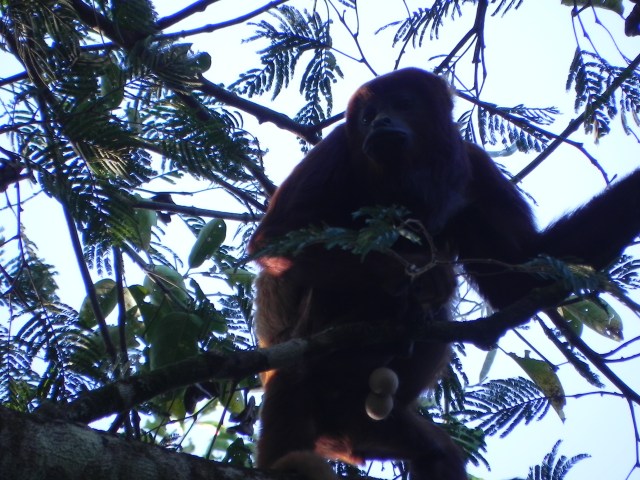
Our group started their day around 5:30 am with the males howling when the sunrise started. The females were feeding their babies but after a few minutes they join them. A couple of other groups were howling in the distance, answering our groups call. Juvenile and subadult were still sleepy when they started howling, but after an hour they both join. The howling lasted until 7:30 with the alpha male howling almost all the time and the rest of the group joining him from time to time.

Around 8 am the females start moving with their babies in their lower back, their movements fast, agile and silent from branch to branch, a few jumps but mostly like walking between branches. Suddenly, they stop in a tall tree, they start eating white flowers from a Platanote tree, this trees produces a white flower with sweet smell and big green fruits like plantain (that’s why is called Platanote in Spanish), those fruits dry and open and all the winged seed fly with the wind after a while. Then they move to and Anime tree and eat some young leaves, the whole group stay eating young leaves for a while, while the babies start playing to bite each other hanging from their tails.

They move for another hour or so, stopping to eat some fruits and some leaves from different trees until they reach a big tree of Avichure full of pink flowers. The whole tree crown was cover with flowers and only a few branches tips have some new leaves. Around 11:30 the juvenile and babies were moving playing around, chasing each other and then hanging and biting. The females rest together close to the alpha male. The beta male was eating at the farthest branch. It was time for a nap.

Slowly the babies when back to their mothers and drink some milk from them. It wasn’t until around 2 pm that females start eating some flowers again, the subadult females was grooming the alpha male and the babies were playing again.

The group start moving again around 2:30 pm, very fast with a clear direction, one after the other, first the oldest female, followed by the alpha male and the other females, then the juvenile and the beta male at the end, in a line. They stop in another Avichure tree this one had less flowers and more light green young leaves. This time the babies also tried a bit of leaves from their mothers’ mouths. After a while one female start grooming the male, her baby running around them, and from time to time pulling the males’ tail. It was almost four when they start to move again, slowly this time. They were moving towards a tall, big tree cover by vines and lianas. They dormitory for this night sleep. The first ones to sit down to sleep where the females, however, the babies were moving around making noises and jumping. Then the alpha male join them, very close to them. The juvenile and subadult where grooming a nearby branch. The beta male was the last to enter the tree and sit down in a different branch than the rest of the group. Around 5 pm no more movements were seen. The group was ready for the night sleep.

© Copyright Disclaimer. All picture used in this web page are protected with copyrights to Xyomara Carretero-Pinzón. If you want to use any of these pictures, please leave a message in the website. Thank you.

Unamas - SR Enero 2012 390

Monke Forest Tales: A day in the life of a Black-capped capuchin

San Martín Abril - Mayo 2011 104 (2)

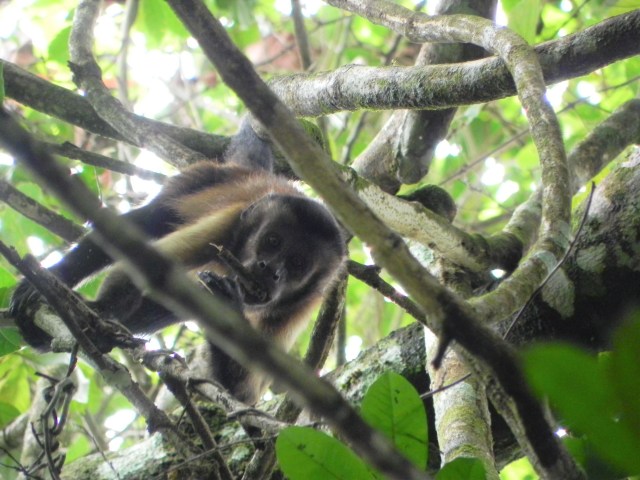
Today post is the fourth in the series of posts about a day in the life of a group of monkeys. This time we are going to join a group of black-capped capuchin monkeys (Sapajus apella). This black capped capuchin monkeys live in small group of 6 individuals, with one male, two females, two juveniles and one baby. They are medium sized monkeys with yellow coat and dark face, legs and tail, and very strong jaw.

Our group started their day around 6:00 am when the sunrise was over, it start with some movements from the juveniles and females, a female scratch her leg while her baby drink some milk from her and then, get back to her back when she moves. Juveniles start searching for insects, looking under dead and live leaves, breaking small branches and sending debris all around them.

Then, the group found a couple of Mamito trees with their big reddish pulp and start eating from them. The group disperse to eat, vocalizing to keep contact between them. The baby grab some pulp from his mom hand and taste it. They are still near to the big tree where they spend the night. After a while, they start moving slowly to other trees with small black fruits near to the edge of the forest. The forest is full of fruits and insects, the air is humid, the rainy season had started in the area.

After some hundreds of meters of relatively fast moving while eating insects, the group start to move slowly again. Juveniles start chasing between them, running and jumping from branch to branch. The baby join them after a while and they all hug and bite each other forming a small of arms and faces, screaming. The females are eating again some small yellow fruits from a nearby tree with wide branches. The juveniles stop their playing to join the adult and eat. The male is breaking some branches searching for insects, eating some cockroach and spiders hiding on dead leaves.

It’s almost noon and the adults stop moving. A female is grooming her baby sitting in a wide branch next to the males who is laying down with his leg hanging. The other females is a in another branch grooming a juvenile. After some quiet and calm minutes, the juveniles start playing again, chasing each other, while the adults are resting. The baby moves close to her mom, running a little bit and biting small branches nearby.  After a while, the juvenile join the adult and rest with them.

Around 2 pm, they start moving again. They move fast and with a clear direction. Suddenly they stop in an Anime tree to eat some fruits. Juveniles eat a bit there and start playing again. The group starts dispersing a bit, all looking for some insect and slowly moving towards the ground. They are close to the forest edge. Some individuals are searching for insects, others are eating small purple fruits, while the male look at the sky and on the ground. He is looking for any sign of danger. A big Caracara moves across the sky.

They are near to the ground, the juveniles and baby playing again, making a lot of noise and chasing each other on the ground, the rest of the group searching and eating insects and spiders in the nearby trees and on the ground. After a couple of hours of slow movements in the lower branches and close to the ground, the group start moving faster and in higher branches. It’s getting darker. The sky is cloudy, and a soft wind is moving the branches.

It’s around 5 pm and they slow down a bit, they are close to a group of Unama palms that they use as dormitory from time to time. They eat from some Anime and Nispero trees around. Juveniles searching for insects and eating some fruits too. Around movement starts again, slowly. They move, and eat some fruits and insects, not 5:45 only juveniles seems to be moving, jumping from one leave to the other, chasing each other, the baby playing with them. It’s almost 6:30 pm and the sun is gone. All movement had stopped, and only occasional sound can be hear. The group is resting.

© Copyright Disclaimer. All picture used in this web page are protected with copyrights to Xyomara Carretero-Pinzón. If you want to use any of these pictures, please leave a message in the website. Thank you.

Monkey Forest Tales: A day in the life of a Brumback’s night monkey

Aotus brumbacki (Colombian Llanos)Family
Brumback’s owl monkey (mono nocturno; Aotus brumbacki)

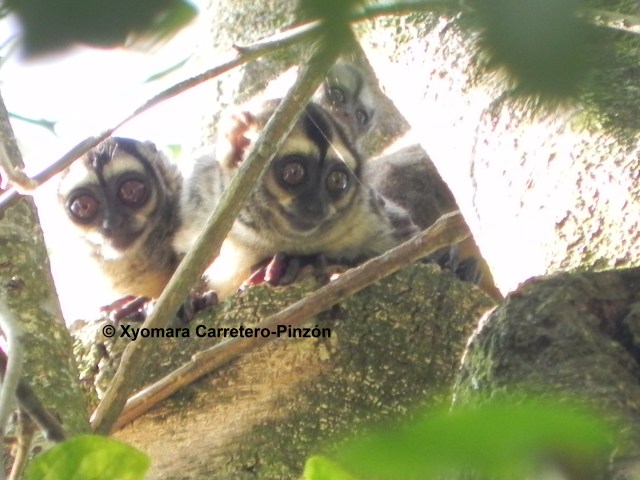
Today post is the third in the series of posts about a day in the life of a group of monkeys. This time we are going to join a group of Brumback’s night monkeys (Aotus brumbackii). They are small monkeys with big eyes that allows them to see in the dark. This night monkey lives in a small thin fragment full of palm trees in a swampy area. The group sleeps in a big old fig tree with a couple of deep holes that make it a cozy nest for our story family. The group is formed by a male, a female, a juvenile male of about two years and a small female baby of around three months

Our group started their activities around 5:30 pm. There are some movement in the nest. The male stick out his head on the nest hole looking around for any sign of movements in the branches around. Then, female and juvenile join him. The baby is in his father back and slowly moves to her mom’s to suck some milk from her before going back to her father. Night monkeys’ babies are taking care by their fathers and only go to their mother when they need to eat. The group starts moving around 6 pm, when the sunset is finishing. First the male and then the rest of his family move outside of the nest.

There is a fig tree just a couple of meters from their nest and it’s full of small reddish, sweet fruits. They move slowly toward it. This part of the forest is thin and very open, so their movements are agile and fast, but they stop continuously to look around for any sights of danger. They reach the fence and start to go down, they cross the small part of pasture that give them access to the fig tree, just 10 meters from the fence and go up very fast. The family disperse a little bit a start eating some fruits and occasionally a small insect. They spend around an hour there eating and moving on the fig tree branches catching small insects.

After a while they start moving again a big faster, they return to the forest fragment and their movements are fast and agile, they have a clear direction towards the other edge of the fragment. They cross the Moriche palms (Mauritia flexuosa palms) standing near to the stream crossing the fragment. Stop there for some minutes to eat some insects from the broad leaves of the palms, the juvenile male jumping and playing around while his little sister look him from his father back. The group reach the other side of the fragment where some trees with small back, round fruits are crumpled and start eating again.

It is almost 9 pm and the group start moving again towards the Moriche palms, once there, movements stop a bit and the parents sit to rest. The male showed his back to the female asking for grooming time, while the baby move around them, carefully. The juvenile male start grooming the baby. Suddenly, you can hear some guttural sounds, glup…glup…glup and the parents start looking around, an owl scream is hear nearby. The parents are in alert for a while repeating that guttural sound a bit longer. Then calm come back and grooming starts again. The juvenile male and his sister are playing, the baby jumping in her brothers’ back while his brother try to catch her. After a while no movement can be seen. The group is resting.

Around noon some movement start again, slowly towards an Anime tree, next to the Moriche palms, all the group is eating the small white pulp from the Anime. After a while, the male lay down on a wide branch and the female join him for another rest. The juvenile and baby join them this time.

Around 2:30 am they start moving again, they eat a bit more Anime fruits before leaving the tree. They move between Moriche palms searching for insects to catch. The male catching a big cricket at once and the baby taking some bit from his mouth. They are moving towards one of the forest edges again. The edge is a bit lower here and with dense vines. All group moves towards the ground and start searching and catching insects again. After a while, they start moving again towards a higher tree in the vicinity. They spend a few minutes grooming and then move again towards the nest they sleep last day. Their movement were slow, stopping in some Moriche palms to eat some insects, another Anime tree for more fruits and around 4 am for another small rest before stopping once more in the fig tree near to the nest. They spend around an hour there before moving to their nest. Around 5:30 all group was in the nest and only the father was looking out for any signs of danger nearby. The sun was rising in a blue sky. At 6:30 all movement had stopped, and all group member were hiding inside the nest.

© Copyright Disclaimer. All picture used in this web page are protected with copyrights to Xyomara Carretero-Pinzón. If you want to use any of these pictures, please leave a message in the website. Thank you.

Monkey Forest Tales: A day in the life of a Colombian squirrel monkey group

P1010498 (2)

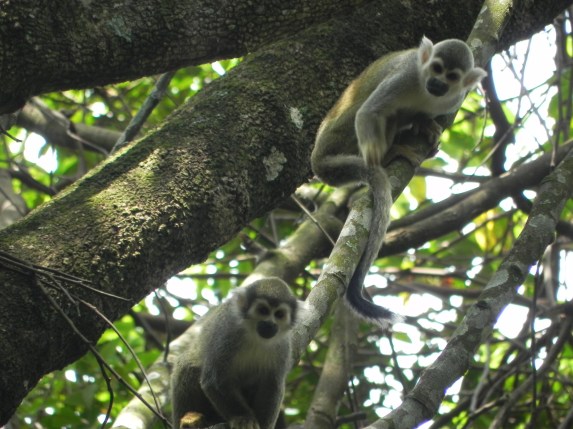
Today post is the second in the series of posts about a day in the life of a group of monkeys. This time we are going to join a group of Colombian squirrel monkeys (Saimiri cassiquiarensis albigena). This squirrel monkeys live in large groups of 25 – 50 individuals, with several males, females and juveniles and immatures of different age. They are small monkeys with long, thin tails to help them balance when they jump. They have a gray body and while belly, their mouths are surrounded by a black patch that make they faces look like a mask of white and black face tones. Our group has 32 individuals: 4 males, 8 females, 3 sub adults, 10 juveniles of different age and 8 infants.

Our group started their day around 5:30 am when the sun was rising, it start with some movements from the juveniles and females, they just start moving looking for some insects to catch, looking under dead and live leaves, removing some small branches, just searching. Babies were in their mothers back, a couple of them taking some milk from their mom, while they trying to catch some insects.

All the group members start eating fruits of several trees around the palms where they spend the night, others search for insects. All babies are on the backs of their mothers. It’s the end of March and it’s finally starting to rain a little bit. Soon the forest will be full of fruits and more insects will be around.

Juveniles start chasing between them, running and jumping from branch to branch. The game is simple, one start chasing the others, when one individual is catch, his tail is pulled and that individual start chasing the rest of the juveniles. There is a lot of screams from the juveniles playing around. Then the females start moving a bit faster still searching for insects, they seems to have a direction, a couple of males are in the front with the females and the other males are in the back with the subadults, all males.

Finally, they stop, the group is in the border of the forest, some individuals are searching for insects, others are eating small purple fruits, and some are just looking at the sky and on the ground. They seems to be looking for any sign of danger. Nothing is on sight. They can move again.

Then, some of the males and females start going down, they are on the ground going outside of the forest to a big fig tree. The tree is full of small reddish fruits. All the group members are on the big fig tree, some of the males keep looking at the sky at the same time they are eating. A female scream, other female just reach her spot and claimed to be hers. A bit of chasing and then all come back to normal, just enjoying the sweet fig fruits. An hour have pass and it’s almost noon.

Some of the juveniles and males start moving again to the forest fragment. Crossing the small gap between the fig tree and the forest, around 100 m. Running on the ground. A couple of juveniles stay on the ground catching insects and playing around at the forest edge, hiding between some vines.

Then the females move back to the forest. Some of them, just relax, they lay down in pairs on the top, wide branches of a big tree, close to the forest edge. The air is hot, humid, the sun it’s in his highest point. Half an hour later, the whole group start moving fast again. Jumping from one branch to the other. Occasionally one individual catch a spider. After a while they found a clump of Anime trees, it’s open red skin shows the sweet white pulp. Fruits are ready to be eaten. Females start eating them, while juveniles start playing again. A couple of subadult are searching for insects near to the ground. The group disperse to eat. There are animals moving all around.

It’s around 5 pm and the movement starts again, slowly. They move, and eat some fruits and insects, not stopping, they have a direction again. Suddenly, they are in a thick part of the forest, surrounded by vines a couple of tall trees with vines seems to be the place to spend the night. The first ones to enter are the females, they sit together, babies in the middle. Juveniles are still playing, chasing each other and screaming. Some males are still eating insects near to the top of a big tree. The sun is hiding and almost all movements stops. They are ready to spend the night on those trees. It’s almost 6:30 pm and the sun is gone.

© Copyright Disclaimer. All picture used in this web page are protected with copyrights to Xyomara Carretero-Pinzón. If you want to use any of these pictures, please leave a message in the website. Thank you.

Monkey Forest Tales: A day in the life of a dusky titi monkey group

DSCN7634 (2)

This post and the next four are a series of posts about the life of a group of each of the species present in this area. Some of the stories are based on my own observations and others also include observations shared by my students over the years. Usually when I train a new student, one of the things I like to do is spend a couple of days following the group with them, is a way of train them and to know them and some of the stories here are based also on those days.

The first story is about a group of dusky titi monkeys (Plecturocebus ornatus), called locally, zocay (a beautiful name for a beautiful monkey, that is why I named my project after this species). Dusky titi monkeys are medium size monkeys with a fury look who lives in family groups, like us, with a mother, a father and their kids. The family in this story is composed of a father who is taking care of the youngest in the group. Fathers are in charge of babies in this specie of monkeys. They only pass the baby to the mother when they need to eat. Sometimes a sister or brother can also carry the baby for a few minutes, but mostly is the father who does it.

Our group wake up early today, around 5:45 am, and the father start his morning call while his baby was drinking some milk from his mother. A few minutes after, the mother join the father and they sing a duet. Signing lasted around half an hour, no other group answer their morning call today. While the parents where signing the two juveniles in the group, a female and a male where eating yellow fruits of Nispero, a fruit very common in the area with small seeds and a sweet taste.

The parents join the two juveniles who were eating Nispero for a couple of minutes and start moving. While they were moving towards some other fruit trees in the vicinity, the male juvenile, a bit older that his sister, just by two years, catch a cricket who was hiding in a dead leave.

Eating time lasted for another hour so, mostly in the same area, all eat a bit of fruits and from time to time some crickets and spiders. Then was time to move a bit more with agile jumps from branch to branch. After a couple of hundred meters the father stop again in a dense vine area near to the border of the fragment where they live. There were small purple fruits and a lot of small flies, spiders, crickets and other insects around to catch. They eat a bit more and then was time for the parents to rest. It was almost noon and the sun was high in the sky, the air was hot and dry.

The parent look for a wide branch in which the father lay dawn, hanging his legs and showing his back to the female for her to groom him. The baby move a bit far from his father, he was three months old and started to move on his own when his parents where resting. He approach his sister who was searching for insects. She stops her search to smell him and start grooming him.

The other juvenile, the male was close to the ground looking for insects and jumping from one branch to the other. After an hour or so all the group members were lying next to the father resting. It was nap time for the family.

Around 2 pm the mother started to move and search insects. The father take his baby on his back and start eating the purple fruits again. Slowly they start to move again toward the stream that cross the forest fragment in search of more fruits and insects while they were moving.

Around one hour after, they stop again and the juveniles start playing together, one chasing the other and back. The game was over after a half hour and then they groom each other. The parents were looking for insects all over, moving slowly from one tree to the next. The mother was carrying the baby who was taking some milk.

Around 4 pm, they start moving again towards a high tree with dense vines on top. They probably were going to spend the night there. But before entering the dense vines, they stop again in a couple of Nispero trees to eat a bit more. The two juveniles were the last to enter, they were chasing each other again, pulling their tails and running around, until a hawk scream make the run towards their parents. All were looking up where the hawk was flying, not moving so they don’t call the attention of the hawk.

After a while the hawk was gone and they spend a few more minute eating fruits and insects before going to sleep around 5:30 pm, where no more movements were observed, and all the family sit together to spend the night.

© Copyright Disclaimer. All picture used in this web page are protected with copyrights to Xyomara Carretero-Pinzón. If you want to use any of these pictures, please leave a message in the website. Thank you.