
Monkey Forest Tales: Why some forest has more primates than others?

Over the years I have the opportunity to visit many forests in Colombia and around the world, some of them with many primate species and some without any primate species (like Eucalyptus forest in Australia). So, in today’s post we are going to talk about what make a forest to have more primates than others?

Presence of primates in a forest depends of many factors that goes from historical factors to factors related with the availability of resources (i.e. food, nests, partners) present in those forest. Let’s start with the historical factors…

If we talk in a long-time scale, several thousands of years, presence of primate in a forest depends on the origin of that primate and if that forest had the conditions for those primates species to have originated or dispersed to that forest in ancient years. But if we talk of historical factors but I a small time scale, several years or even a several decades, then presence of a particular primate species depends not only on the original conditions of the forest that allows that primate species to live there but also all the human activities, such as hunting and deforestation of that forest that also influence the presence of those primate species.

For a primate species to live in a forest conditions such as climate, presence of food resources (fruits, insects, nectar, leaves) from the species they like to eat, other individuals of the same species (i.e. potential partners) and potential places to nest need to be present.

Also, some forest has more monkeys species than other because the species living in that forest have different specializations. For example, some of them eat more insects and other eat more fruits, while other eat more leaves. Or some like to move more on the top of the big trees while other like to move closer to the ground or in the middle of the tree forest. Therefore, the food resources in the forest can be used by different species at different heights and that allows many species living in the same forest. Also come species are more active during the day while others prefer the night.

For example, in the study area there are five monkey species, but all of them doesn’t move all the time at the same height, also some of them eat more fruits like dusky titi monkeys, or more leaves like red howler monkeys, while others eat more insects and spiders like black-capped capuchins and Colombian squirrel monkeys. And, some other prefer to be active at night like the Brumback night monkeys.

Sometimes, especially in fragmented areas, monkeys didn’t find all the resources they need in a particular forest fragment, then they have to move to another fragment, so in fragmented areas or areas closer to where we live some forest had lost all or some of the monkeys species that used to live there because the food is not enough or because we had killed them until they disappear…

So, part of the questions we have in Zocay Project are related to understand why some forest fragments have all five monkey species present while others don’t. Up to know our results shows that its depends on how much food resources there is and how big the trees are, but also how many living fences and other forest fragments are nearby. However, these fragments are in continuous change because of our activities so many things can happen that influence which monkeys we can find and for how long living in a particular forest fragment…

© Copyright Disclaimer. All pictures used on this web page are protected with copyrights to Xyomara Carretero-Pinzón. If you want to use any of these pictures, please leave a message on the website. Thank you.
Monkey Forest Tales: Some thoughts about domestic dogs and cats

Although we love our pets, specially dogs and cats, we cannot forget that they came from predator ancestors, who use to hunt in pacts in the case of dogs or alone in the case of cats. Therefore, they still have in their genes that instinct to hunt even if we tamed.
Today post we are going to talk about domestic dogs and cats effects at the study area. In past months there was an article about the effect of domestic cats on Australian fauna and the results were just terrible for wildlife, from birds, lizards, frogs and small mammals. Although there is not that kind of information for Colombia, for sure there is an effect on domestic dogs and cats.
At the study site, the effects on the wildlife are not clear. There is dogs and cats at every farm and palm oil plantation in the study area. They move around freely and through all farms without any restrictions. Around houses cats hunt small birds, preying on nest and small birds learning to fly, small rodents and rats.
At the forest fragments, live fences and wire fences dogs attacks monkeys, tamanduas, coatis and other mammals. At cattle pastures dogs also attacks giant ant eaters and sometimes other domestic animals, like goats.
Over the past 16 years, we have witness at least two confirmed successful dog attacks, both on black-capped capuchins (Sapajus apella). At least three more unsuccessful attempts were witness on Colombian squirrel monkeys (Saimiri cassiquiarensis albigena). There has been local people reports on dog attacks on red howler monkeys, especially when they move on the ground through pastures from one fragment to another.
In the past two years local workers from one of the farms with which we work reported a group of at least four dogs from a near palm oil plantation hunting in the forest fragment where we have been monitoring monkeys for more than a decade.
Although we will need a more detailed information of how domestic dogs are affecting the wildlife in the area, at least we know the presence and probably the freedom with which we are handling our domestic dogs and cats is affecting the wildlife living in highly fragmented areas.
© Copyright Disclaimer. All pictures used on this web page are protected with copyrights to Xyomara Carretero-Pinzón. If you want to use any of these pictures, please leave a message on the website. Thank you.

Monkey Forest Tales: Back in the field: how it is working at night?

Today’s post I’m going to explore a question a colleague makes to me a few days before I went to the field, ¿Are you scare when you work at night? But first, let’s explain why sometimes we have to work at night.

As you have notice from this website, at the study area there is nocturnal species, Brumback’s night monkey, a small size monkey who make all its activities during the night. They sleep during the day in hollow trees or very high trees cover with lots of lianas and vines and they search for food and move around during the night.

To be able to know how they live, how many they are and in which forest fragments we can find them, sometimes we need to go out at night and search for them. Although we have not been so successful as in other places to follow them at night, we have been able to count them and find out some of the forest fragments in which they live in the study area.

My first nocturnal monkey counts weren’t in the study area, they were in the Amazon, in large areas of continuous forest, where there is also big wild cat such as cougars and jaguars around at night. So, in those days, specially at the beginning yes, I usually was scare while doing my work at night. I was always with an indigenous who knows the forest a lot and who was good at recognizing many animal sounds and smells.

At night, you can rely on your vision as much as you do during the day so you learn to recognize the sounds of nocturnal animals, and sometimes the sounds of some diurnal animals that you encounter sleeping during night walks. For example, during this last fieldwork we were working in one of the fragments in the study area, one that I never walked before at night, and we found a small group of coatis sleeping in a high tree, near to the stream. I had never encounter them at night before and never paid attention to the noises they do, so at the beginning it was difficult to know what they were, we just saw small bright green eyes, until we can use our binoculars and see their long nose and fluffy banded tail.

At the study area, usually is not that scary to work at night as it was in the Amazon, because the forest are smaller and I have walk them for so many years I can recognize parts of some of those forest fragments even with poor light. My main concern in the study area is to meet a person during night work, that is why we usually do night work only in farms where we make sure the landowners and farm workers know that we are there.

We sometimes found snakes that usually leave you a bit shaken, but don’t attack you. In the bigger forest fragments in the area sometimes we hear or found tracks of jaguar or cougar but never met them face to face. Not in this area, although I met the in the Amazon and in Macarena (a bit southern from the study area)…

So, the answer to my colleague’s question is yes and no, depending on where I’m working at night…

© Copyright Disclaimer. All pictures used on this web page are protected with copyrights to Xyomara Carretero-Pinzón. If you want to use any of these pictures, please leave a message on the website. Thank you.
Monkey Forest Tales: Why counting monkeys in the same place over many years?

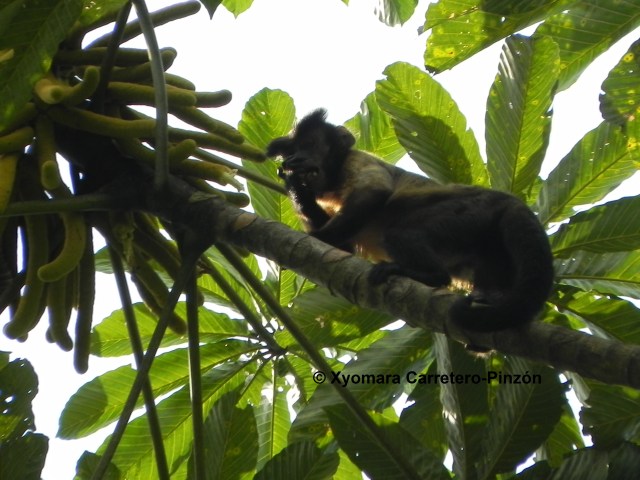
Colombian squirrel monkeys (titi o fraile; Saimiri cassiquiarensis albigena)

In past days when talking with local people, from farm workers to landowners, we were asked several times why we are counting the monkeys year after year? What is the purpose of that? In today’s post, we are going to answer these questions.
Like us monkeys live for several decades, therefore like us every year there are many events happening in their lives, there are some babies born, some old animals die, some accidents can happens that kill some individuals, there are also some disease that also kill or make some individuals more prone to be kill or eaten by other animals.
So when we visit a forest fragment to count individuals, we register every event and observation that can indicate the health state of an individual. We also register every individual we found, their sex and approximated age. All data collected during a year is used to compare it with previous years data and that information give us information about how the population is in each fragment.
As the monkeys in the study area lives for more than 30 years, if we only visit the fragments one year we cannot say much about how the population is doing, we need to sample for more than one decade to know what is happening.
For example, thanks to the sampling we have done since 2004, we know the deaths of some males of Colombian squirrel and red howler monkeys in the area. We also have learned that some old females of Colombian squirrel monkeys seems to stop reproducing after certain age.
This information also help us now that for now the population of all the species we have been monitoring since 2004 in the study area is stable and not decrease despite the habitat fragmentation present in the area. However, 16 years is still not so long time if we have in mind that monkeys species in the study area lives around 30 years or more. So we still need to continue monitoring these populations for at least two more decades…
© Copyright Disclaimer. All pictures used on this web page are protected with copyrights to Xyomara Carretero-Pinzón. If you want to use any of these pictures, please leave a message on the website. Thank you.
Monkey Forest Tales: How monkeys move?

On some past post I have talk about where monkeys move, but we have not talked about how they move and by this we mean if they are quadrupedal (i.e. move like dogs and cats) or bipedal (i.e. move like us), or they move leaping (i.e. jumping from tree to tree) or by using the suspensory behavior (i.e. climbing a tree).
Well, primates in general use all these forms of locomotion (movement) and some species use one or more of these locomotion forms during their lives depending on their activities. For example, quadrupedal locomotion is used by monkeys in two forms: arboreal quadrupedal movement, when they walk on their four limbs on big trees branches and terrestrial quadrupedal locomotion when they walk on their four limbs on the ground in search of food. Some used both forms of quadrupedal movements because they use both trees and the ground during their search for food and other activities.
In the study area, black-capped capuchins and Colombian squirrel monkeys use all forms of locomotion depending on the activities they are doing (see video, below). For example, when foraging for insects and spiders on the ground they use terrestrial quadrupedal movements, but they also can move bipedal for a couple of minutes if they are carrying some heavy fruits with their hands or to have a better look on the ground in search of insects. They both also use leaping to move between trees and even some times they use the suspensory behavior to climb to the top of big trees or to be able to cross gaps between tree tops that there are not so far apart.
Red howler monkeys are masters on the use of suspensory behavior to reach flowers on the thinner branches of some trees or to reach fruits from trees that may not support their weight to they use their body weight on stronger branches to reach those fruits. They also move using arboreal quadrupedalism on big trees with wide branches and sometime leap between branches during their long-distance movements.
Dusky titi monkeys and Brumback night monkeys use more arboreal quadrupedalism and leaping on their movements in search of fruits and when moving fast on the forest canopy. Dusky titi monkeys sometimes also use terrestrial quadrupedal movement when searching for insects on the ground. We didn’t see Brumback night monkeys on the ground yet, but they use leaping and fast arboreal quadrupedalism to avoid us as much as they can.
How monkeys move is an important part of how we describe what monkeys do during their activities and it explain some modifications in primates’ bodies as well as particular behaviors.
© Copyright Disclaimer. All pictures used on this web page are protected with copyrights to Xyomara Carretero-Pinzón. If you want to use any of these pictures, please leave a message on the website. Thank you.
Monkey Forest Tales: Thinking about fires and some recent news

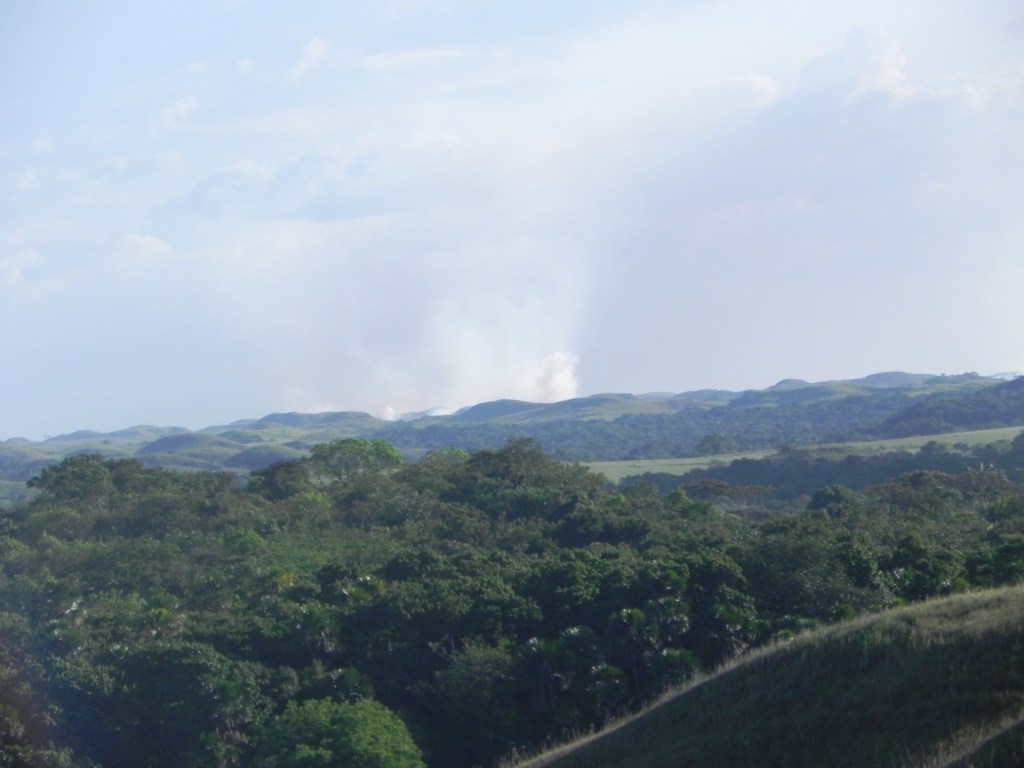
During past weeks there were some devastating news about fires in northern Argentina that reached a field station, Estación Biológica Corrientes in San Cayetano Provincial Park, Corrientes, Argentina (more information here). At this field station a population of black and gold howler monkeys that has been studied over 30 years was partially decimated by fires.

The reason why I bring this story to this blog is because those fires were started as part of a periodic practice that it is also done in the study area, during the dry season (December to March). When I hear the news, not only I felt a deep sadness for the people and the monkeys but it also reminds me of the next dry season approaching to my study area and the fragility of some of the forest fragments in which we work.

Fires has been used in the study area to regrowth pastures and it has been a long time traditional practice in the natural savannas in the Orinoquian region, however sometimes those fires get out of control and enter to the forest burning complete forest fragments and all that live inside them. Local people practice of burning garbage close to forest edge also increase the risk of wildfires destroying forest fragments in the area during the dry season.

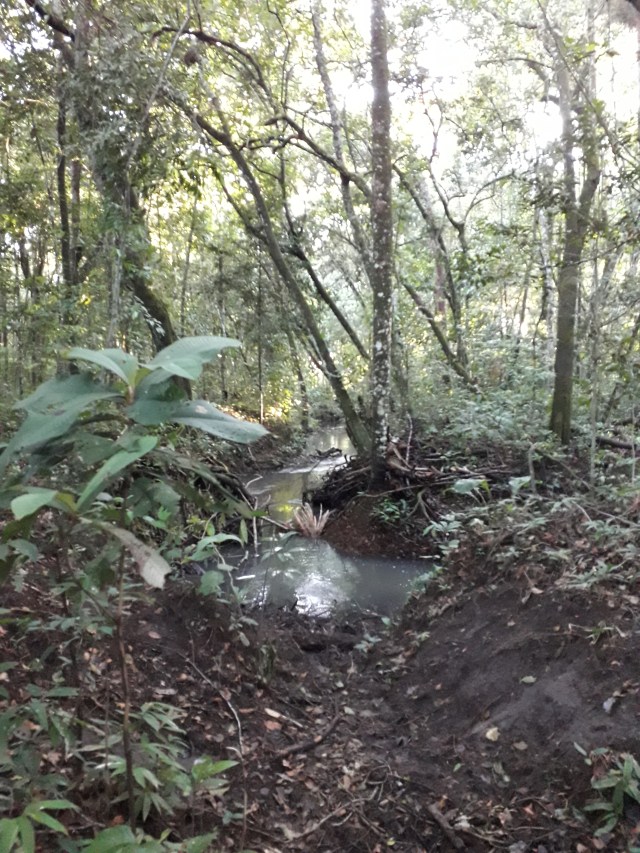
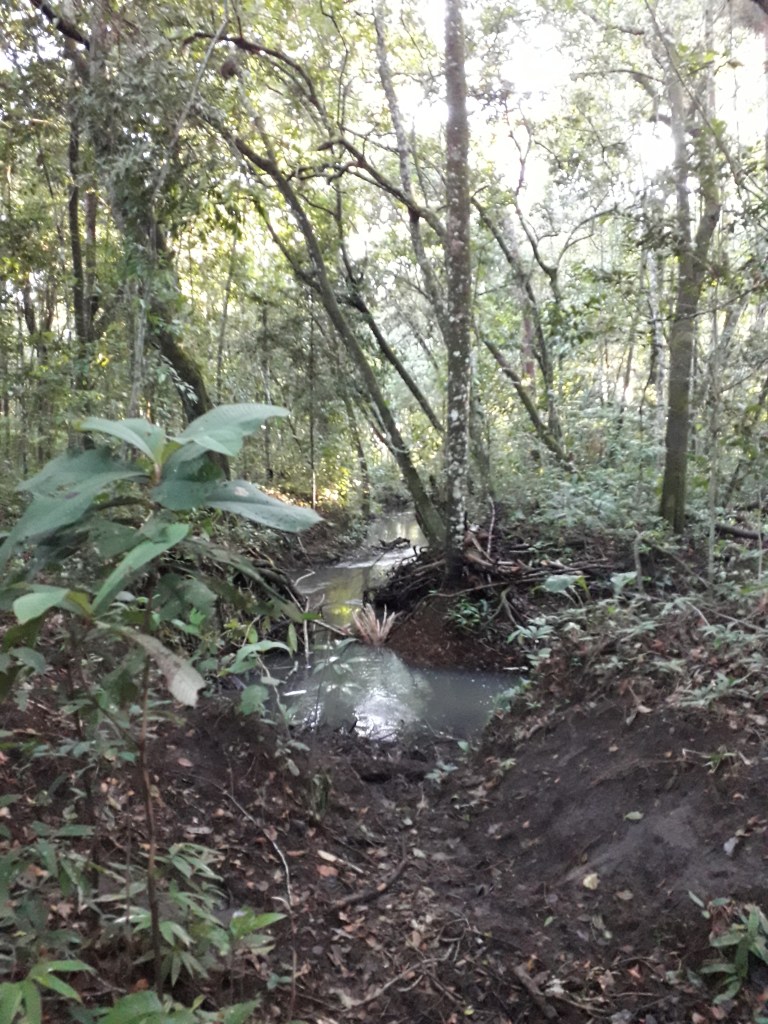
Some of the traditional practices in the region that have been used for long time and seems to have worked, except on very dry months, it’s a deep ditch in the border of forest edges or areas were they want the fires to stop. Mostly this has been effective, the problem is when there is wind and it is very dry, the fire jump and sometimes catches dry fallen leaves that starts a fire inside of the forest.

These practices combined with the continues reduction of forest fragments that make the seasonal streams get dryer every year are becoming a real threat to the forest and all the animals who live in there, in the whole region. More regeneration and planting native trees can improve both, controlling the fires and keeping the water flow in those seasonal streams. As well as prepare and improve fire practices that need to be restricted in very dry months.

© Copyright Disclaimer. All pictures used on this web page are protected with copyrights to Xyomara Carretero-Pinzón. If you want to use any of these pictures, please leave a message on the website. Thank you.
Monkey Forest Tales: How monkeys communicate?

During my last visit to the field, I had the opportunity of taking some city kids to the forest to learn about monkeys (kids from the landowners). During this visit we talk about the monkeys, their forest and how they live. During our talks, I asked some of the kids what other questions they have about the monkeys, what they would like to know about them. One of the questions that one of the kids asked is how monkeys communicate. So, in today’s post we are going to explore the different ways monkeys have to communicate between them.

As many other animals, monkeys use their senses to communicate, sometimes combining smell, sound, contact and visual clues. Some species use one or several at the same time. For example, the nocturnal monkeys use more scents and sound to communicate more than visual clues because they move in a dark environment at night.

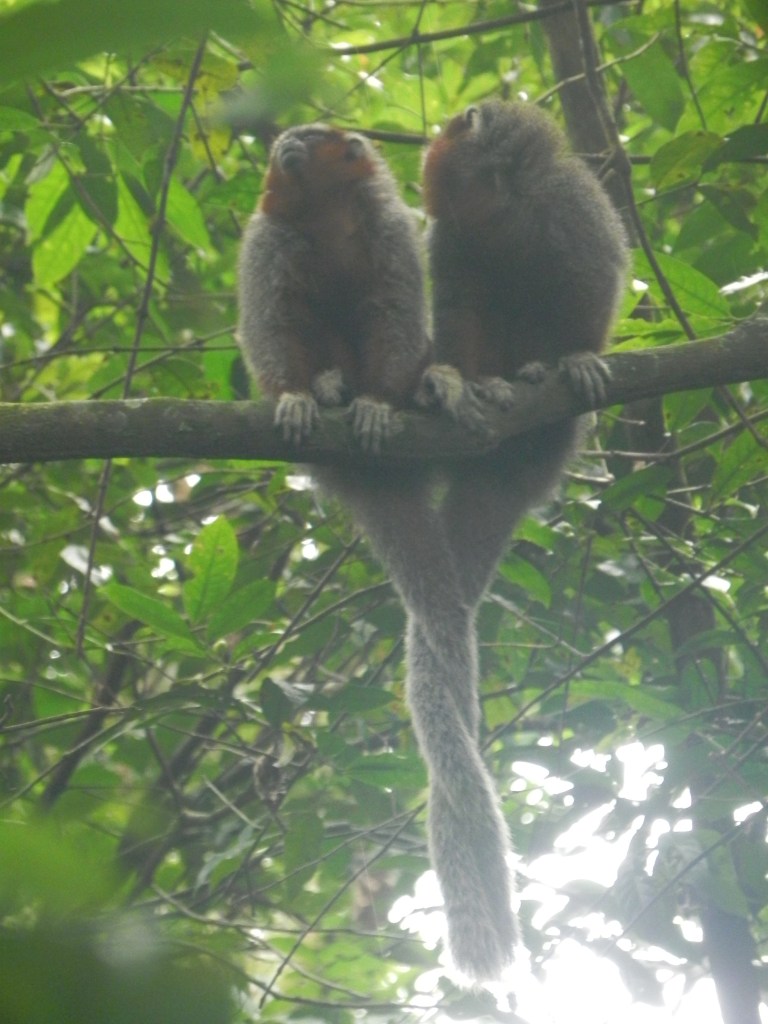
Colombian squirrel monkeys, red howler monkeys, dusky titi monkeys and black-capped capuchins use a combination of sounds, visual displays, and scents to communicate between them and between groups.

Red howler and dusky titi monkeys emit loud sounds in the early mornings to tell other groups where they are. Those same sounds are also produced to tell solitary males or other groups that they are too close, and they need to move to another area because they are in their territory.

Black-capped capuchins emit different sounds to tell the other member of their groups that they see a possible danger. They even have different sounds for bird predators (e.g., eagles) or terrestrial predators (e.g. snakes, jaguar and other wild cats) and these sounds are also recognized by individuals of Colombian squirrel monkeys, because they sometimes form mixed groups of the two species.

Males of red howler, dusky titi, Colombian squirrel monkeys sometimes rub their neck on some branches to mark them. Scent are used also to detect when the females are ready to copulate.

All monkeys in the study area use grooming not only to clean their fur from ticks and other parasites. But also, to reinforce the relationships between members in the group. Dusky titi monkeys additionally twine their tails to reinforce their bond as a family, couple during resting. 

© Copyright Disclaimer. All pictures used on this web page are protected with copyrights to Xyomara Carretero-Pinzón. If you want to use any of these pictures, please leave a message on the website. Thank you.
Monkey Forest Tales: Notes from the field

I’m writing today’s post from the field. After almost 8 months without being in the field is just an incredible feeling to be here and being able to breath this air. Although I don’t live so far and still get some glimpses of rural life despite being in a city. The joy I felt the moment I get back to the farm where this project started is something I can hardly describe.
And it is even more incredible the feeling of looking at monkey’s groups that I learn to know for the last 16 years. Going back to the field after all these months of inactivity was challenging physical and in some ways emotionally.
We get some good and not so good news this time. Let’s start with the goods…. New babies were observed in red howler monkey’s groups, in two groups, and three groups of black-capped capuchins, all born during the pandemics. A big group of coatis was also observed with babies also born during the pandemics. Chela, my favorite Colombian squirrel monkey female is still around with a juvenile going behind her, probably a baby from a few years back. Babies born in February from Colombian squirrel monkeys and dusky titi monkeys are growing well and healthy. And lastly but not least people are doing good and healthy in the farms despite the pandemics.
Now let’s talk about the not so good news…one of the red howler groups had a high infestation of botflies, especially the older juveniles, but also the adults. Although it is possible to see this kind of parasites in red howlers, in all the years I had been looking at red howler monkeys in fragmented and continuous forest, I had not seen so many group members with botflies.
The highest infestations of botflies that I had seen were in forest fragments in near proximity to cattle ranching and palm oil plantations. Although both situations are present in the forest fragment in which the group is found, the cows doesn’t have botflies at the moment and the palm oil plantation is not that close to the fragment. It is separated by two big pasture plots. Another possible explanation can be related to a decrease in their immune system response due to poor habitat quality.
Despite being October the second month with highest fruit productivity in that forest fragment, this year the forest fruit production seems to be delayed, fruits are just starting to be available. Another possible factor that can be playing a role is the fact that, it is a big group (ten individuals), which can increase competence and affect more older juveniles than the youngers and other members of the group in terms of access to food resources. However a more detailed observations are needed to understand this particular pattern. Hopefully the group will survive without any loss…at least I had never seen a red howler monkey die from botflies and let’s hope this won’t be the case…
For now we are able to start again our monitoring of monkeys in the study area and we keep a close eye on the red howler monkey’s group with botfly infestation. Hopefully next month we will be able to go again to make surveys and some of our students will be back in the field looking at these incredible resilient animals that always put a smile in my face…
© Copyright Disclaimer. All pictures used on this web page are protected with copyrights to Xyomara Carretero-Pinzón. If you want to use any of these pictures, please leave a message on the website. Thank you.
Monkeys Forest Tales: Talking about some scientific terms: Hotspots

In today’s post, we are going to talk about another scientific term that people outside science and the media use often. This term is hotspots. It is referred to an area where there is a concentration of something, animals, plants, diseases, culture, etc. As this is a blog related with the natural world, we are going to talk only about biodiversity hotspots.
In the world, there are several biodiversity hotspots such Indonesia in Asia, the Congo basin in Africa, the Atlantic forest in Brazil among others. Areas or countries considered hotspots are also areas with high concentration of endemism (see more about endemism here)
In Colombia, we had several hotspots in terms of areas with high diversity of species such Choco and the Amazonian piedmont in Putumayo, where there is a high diversity of plants and animals. These areas are of high importance for the country and highly threatened by human activities.
In Meta, the department where this project is focus, the area around Serrania de la Macarena is a hotspot of plants and animals, because in this area the fauna and flora of three regions meet. This area had plants and animals from the Andean, Orinoquian and Amazonian regions, making it an important place for the biodiversity of Colombia.
The diversity of altitudes, topography and weather of Colombia also influence the high concentration of biodiversity present in the country and that is the reason of why Colombia is also considered a hotspot in terms of biodiversity.
© Copyright Disclaimer. All pictures used on this web page are protected with copyrights to Xyomara Carretero-Pinzón. If you want to use any of these pictures, please leave a message on the website. Thank you.

Monkey Forest Tales: Talking about some scientific terms: Endemism

In past days while talking with people outside of the scientific circle, I found myself explaining some terms that are used in media and even in some policy documents not always consulted with a person with a scientific background. So, in today’s post and next post you will find some explanations and examples of the terms: endemism and hotspots that you probably had hear.
Let’s start with endemism that is a biological term used to describe a living things (bacteria, fungi, virus, plants, and animals) which are only found in a restricted area, usually limited by certain conditions which can include limits of temperature, altitude and relative humidity. But what that mean? It means that those specific organisms are not found in any other place. This can be a mountain, a specific type of forest in a remote area, an specific ecosystem or country or even a continent.
An example from the study area is the dusky titi monkey, they only live in a small area of Colombia. You can only find them in an area of around 60.000 km2, an area bigger than Switzerland.
One of the reasons this terms is important and most of the species that are endemics are in risk of extinction is that its reduced distribution area make them more sensible to disappear once the habitat in which they are found is destroyed.
Colombia is a country with a high number of endemic species, 14 % of the known species in Colombia are endemic. Most of them threatened by deforestation due to human activities such as road construction, agriculture, cattle ranching, petrol exploitation, and mining.
Not all endemic species in Colombia are found in protected areas and some are currently found in fragmented landscapes. In the case of the dusky titi monkeys, they are only found in two National Parks, Tinigua and La Macarena, both with high deforestation.
Outside of the National Parks dusky titi monkeys are found in forest fragments surrounded by pastures, palm oil plantations, crops, and urbanizations. Therefore, in order to conserve this species, we need to learn how to manage the landscapes in which they survive outside of National Parks and conserve the populations inside the National Parks.
© Copyright Disclaimer. All pictures used on this web page are protected with copyrights to Xyomara Carretero-Pinzón. If you want to use any of these pictures, please leave a message on the website. Thank you.