
Monkey Forest Tales: Life from the perspective of a dusky titi monkey baby, first 6 months

SM Junio 2011 282

In today’s post, I am going to explore how is the life of a small baby monkey of a dusky titi monkey…
I’m what humans called a dusky titi monkey, a small fluffy monkey living in a forest of Colombia. My life started a windy night of the dry season. My mom was hiding in a very dense shrub with lots of vines around us, it was a bit dark when I get out. My mom takes me from the middle of her legs and clean me with her tongue. Once I was clean she put me in father’s back close to his neck, where I can hang very tight to his fur and put my tail around his arm. I’m very small and my father’s fur hides me because my tiny body is always very close to my dad’s neck.
The first weeks of my life I spend them in my father’s neck and only got o my mom when she feeds me. My dad takes care of me, cleans my fur, keeps me warm, and takes me with him, everywhere. My mom came close and sleep close to as every night. She also cleans my fur and gives me my milk every time I ask her. My days pass as I drink milk from my mom’s armpit and sleep in my dad’s back most of the day. There are no other babies in the group, but I have another brother that sometimes clean my fur and play with me when our parents are restin..
Two months had passed since I born and now I move around in my dad’s back when he is not moving, sometimes I even explore a bit farther when he is resting, walkin,g and jumping in the nearby branches. I usually play with my bother. We jump, ru,n and bite each other.
I had four months now, I still move on my dad’s back, but sometimes hestartst moving ahead and I have to cry so heremembersr that I’m still here and need to be carried by him. Sometimes I can also climb in my brothers back but not too often, he doesn’t like it much. I started to try some of the fruits my dad is eating, I like to bite everything but it doesn’t always taste nice. Most ofthey time I spend exploring and playing with my brother. My mom stillgivese me milk from time to time. My legs are skinny and not always strong enough to carry me. I’m clumsy…
Now I have six months, I move alone except in some places where the branches are so apar from each other, and I’m scared to jump. My dad helps me on those places, he let me climb on his back and I cross with him, but then he always wants me to go alone again, and we fight, he bites me. I eat on my own now, but some times I also drink milk from my mom. I eat almost everything I can catch and sometimes steal some insects and fruits from my dad’s hand. Most of the time I’m playing, jumping and running with my brother.
We sleep all together in the same branch and my parents, brother and I,  all intertwine our tails together, this makes us feel together overnight and keep us warm, and together. I’m a healthy six-month baby of dusky titi monkey.
© Copyright Disclaimer. All pictures used on this web page are protected with copyrights to Xyomara Carretero-Pinzón. If you want to use any of these pictures, please leave a message on the website. Thank you.
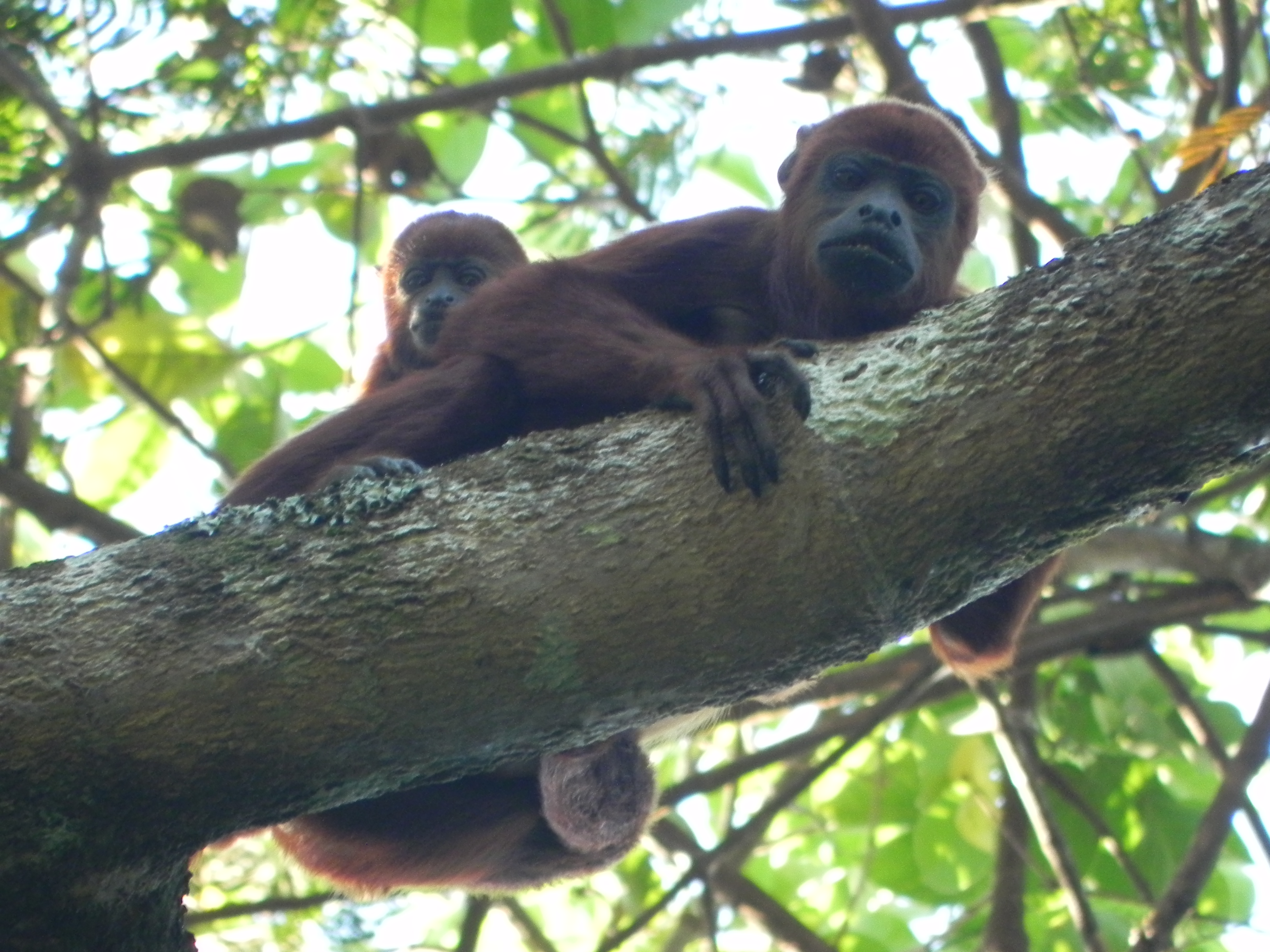
Monkey Forest Tales: Life from the perspective of a Red howler monkey baby, first 8 months

IUnamas - SR Enero 2012 394In today’s post, I am going to explore how is the life of a small baby monkey of Red howler monkey…
I’m what humans called a red howler monkey, a large reddish monkey living in a fragmented forest of Colombia. My life started in the early morning of the first days of the rainy season. My mom was is a high wide branch of a fig tree a bit separated from other females of the group when I get out. My mom takes me from the middle of her legs and cleanses me with her tongue, she eats my placenta and cleans me carefully. Once I was clean she put me in her belly close to her armpit, where I can hang very tight to her fur and put my tail around her arm. I had my eyes closed most of the time and I’m very tiny compared with my mom’s body.
The first weeks of my life I spend them in my mother’s belly or armpit and slowing moving towards the lower part of her back, close to her tail. My days pass as I drink milk from my mom’s armpit and sleep while she keeps moving around. She continuously moves around and other females and member of the groups come close to sniff me and sometimes try to grab me for a better look, but my mom never let them get me too long. There are another baby bigger than me, which mom is always close to mine, some times he came and try to play with me, but I’m too small to play.
Two months had passed since I born and now I move around in my mom’s back when she is resting, sometimes I even explore a bit farther, walking and jumping in the nearby branches. I started to play with the other baby. We jump, run, and bite each other, sometimes hanging from our tail only. My tail is like another limb for me and it seems to be as strong as my arms and legs. A couple of times we play close to the big male and he even let us pull his tail, I’m not sure if he is my dad but he is always near to my mom and my the other baby mom and seems to tolerate us when we are playing…until we get to noise for him and he just more to a farther branch.
I had four months now, I still move on my mother’s back, but sometimes she starts moving ahead and I have to cry so she remembers that I’m still here and need to be carried by her. I started to try some of the fruits and leaves my mom is eating, I like to bite leaves everything from her mouth. Most of the time I spend exploring and playing with the other baby and a male juvenile had joined us. My legs are skinny and not always strong enough to carry me. I’m clumsy.
I started to move between some close trees or branches in the same tree but sometimes they are very far from each other and when I cry, my mom, uses a part of her body to make a bridge so I can cross on my own…
Now I have six months, I still move on my mom’s back when the group is moving very fast but sometimes I move alone. I try to use branches that are close to each other making an easy path but, now my mom and sometimes other females and the juvenile in my group help me cross distant branches making bridges with their bodies so I can cross those gaps. Mostly is my mom and sometimes she also let me just cross until I get to her back and she carry me the rest of the time. I eat on my own now, but some times I also drink milk from my mom. I eat almost everything I can reach and sometimes I steal some fruits from my mom’s hand. Most of the time I’m playing, jumping, and running with the other baby and juvenile, we love to hang from our tails and bite to each other.
I’m now eight months old, I move and eat alone all the time, my mom doesn’t make any more bridges for me to cross any gaps between branches I just have to figure out were to go that is easier for me to cross. I still spend lots of time playing with the other baby and juvenile, but now we are all bigger. We still love to play to hang with our tails and bite each other. We also love to chase each other when our moms are resting. Our father and the other male tolerate us but always move to a quieter branch when we get too noisy playing. We sometimes join our parents when they howl against another group.
© Copyright Disclaimer. All pictures used on this web page are protected with copyrights to Xyomara Carretero-Pinzón. If you want to use any of these pictures, please leave a message on the website. Thank you.
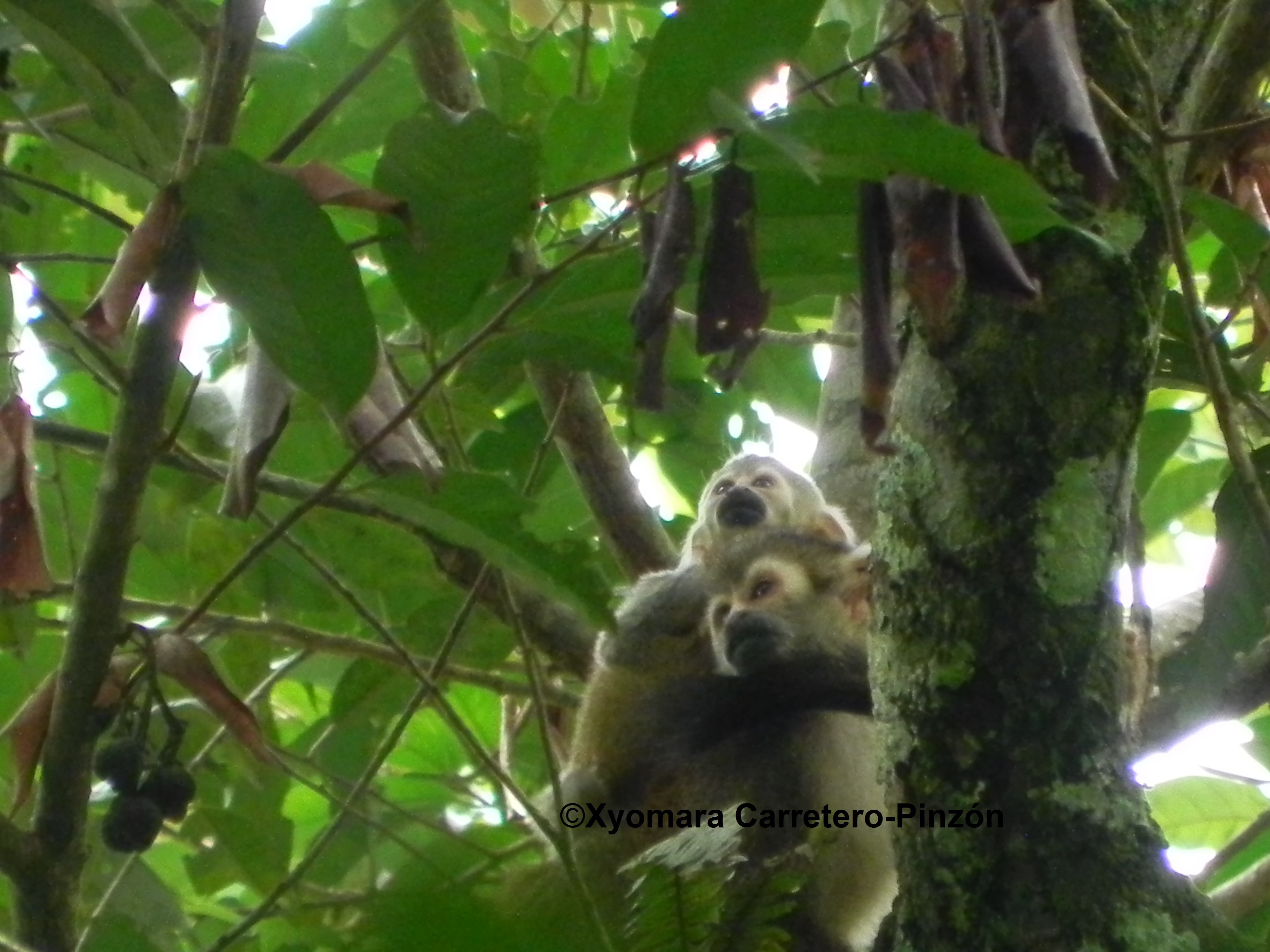
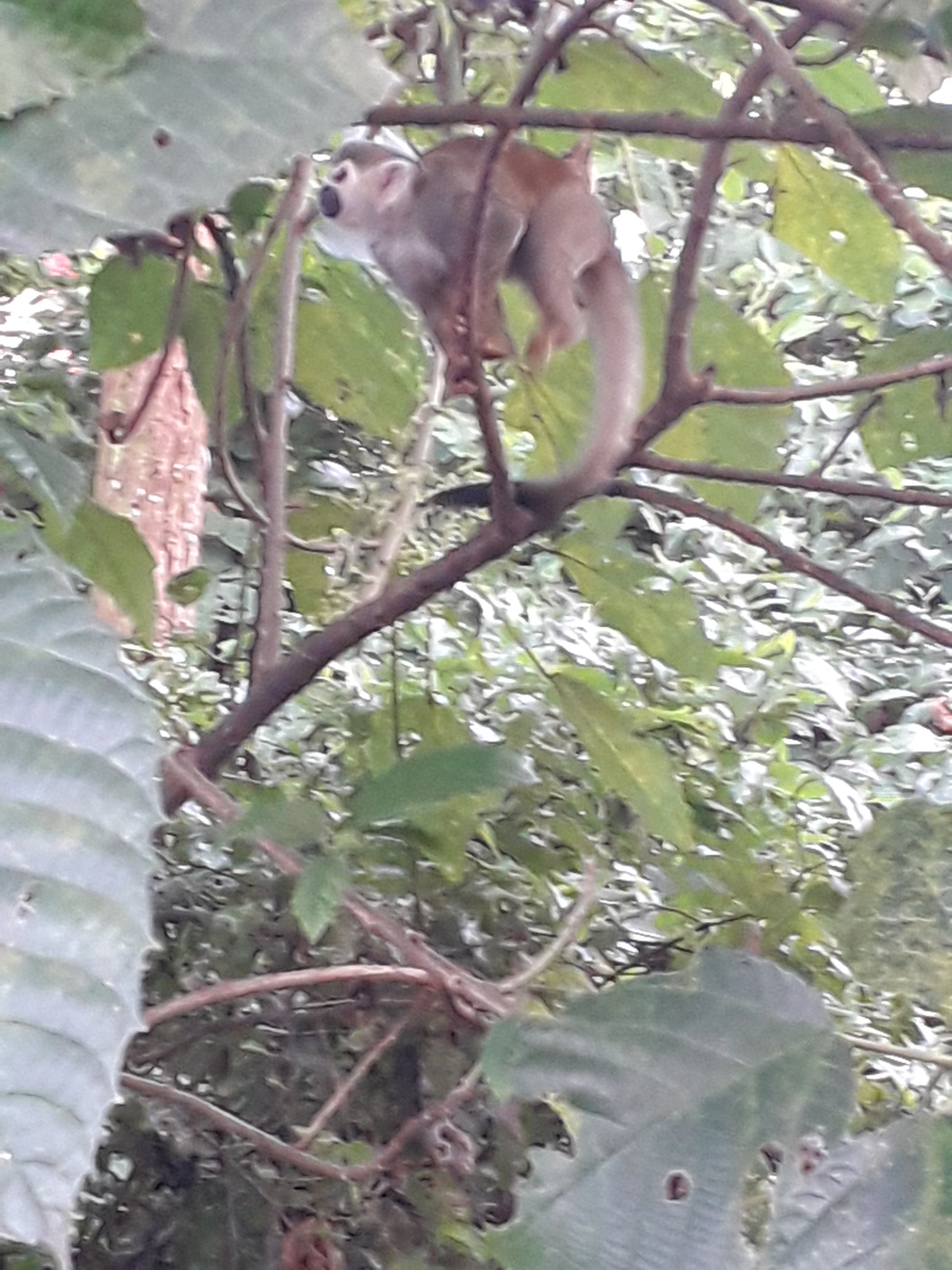
Monkey Forest Tales: Life from the perspective of a Colombian squirrel monkey baby, first 6 months

Saimiri cassiquiarensis albigena (Colombian Llanos)

In today’s post, I am going to explore how is the life of a small baby monkey Colombian squirrel monkey…
I’m what humans called a Colombian squirrel monkey, a small, very agile monkey living in a forest of Colombia. My life started when on a windy afternoon of the dry season. My mom was hiding in a very dense shrub with lots of vines around us, it was a bit dark when I get out. My mom takes me from the middle of her legs and cleanse me with her tongue. Once I was clean she put me in her back close to her neck, where I can hang very tight to her fur and put my tail around her arm. I had a big head and my tiny body is always very close to my mom’s back.
In the first weeks of my life, I spend most of the time in my mother’s back very close to her neck and slowly moving towards the lower part of her back. My days pass as I drink milk from my mom’s armpit and sleep in her back most of the day. She continuously moves around and other females and new babies some times came close to us to rest and eat. I had a brother who sniffs my body and tries to drink milk from my mom from time to time, but she always pulls him away.
Two months had passed since I born and now I move around in my mom’s back when she is not moving, sometimes I even explore a bit farther when she is resting, walking, and jumping in the nearby branches. I usually play with other babies from my age and some others a bit bigger than me. We jump, run, and bite each other, sometimes we roll all over, especially when we are on the ground and our moms are catching insects.
I had four months now, I still move on my mother’s back, but sometimes she starts moving ahead and I have to cry so she remembers that I’m still here and need to be carried by her. I started to try some of the fruits my mom is eating, I like to bite leaves and branches but it doesn’t taste nice. Most of the time I spend exploring and playing with other babies and juveniles. My legs are skinny and not always strong enough to carry me. I’m clumsy.
Now I have six months, I move alone except in some places where the branches are so apart from that I’m scared to jump. My mom helps me in those places, she let me climb on her back and I cross with her, but then she always wants me to go alone again and we fight, she bites me. I eat on my own now, but some times I also drink milk from my mom. I eat almost everything I can catch and sometimes steal some insects and fruits from my mom’s hand. Most of the time I’m playing, jumping and running with all the other babies and juveniles, we are so many, sometimes we make teams and pursue each other.
When it rains my mom always covers me and shares her warm. During heavy rains, all moms and babies get together forming a ball of fur with all of us, babies in the middle so we don’t get too wet and cold. I’m a healthy six-month baby of the Colombian squirrel monkey.
© Copyright Disclaimer. All pictures used on this web page are protected with copyrights to Xyomara Carretero-Pinzón. If you want to use any of these pictures, please leave a message on the website. Thank you.
Monkey Forest Tales: Importance of fig trees for monkeys fragmented landscapes

La Marly Enero 2012 192

Following a related topic from last week, today’s post is about the importance of fig trees for monkeys in fragmented areas such as the study area. Fig trees have been called keystone species, because they produce fruits any time during a year, and usually out of the fruit production peak in many forests, providing fruit to many frugivorous species (e.g. birds, bats, monkeys, and other mammals) when no other fruits are available.
In fragmented areas, and especially in the study area, fig trees are very important for primates and other animals as a source of fruits. Fig trees are found inside the forest fragments, in living feces, isolated trees in the middle of the pastures, and in the forest fragments edges. Some species of fig trees produce large amounts of small fruits that last over several days providing an incredible source of food for many animals.
In the study area, all monkeys species consume fig trees fruits when they are available. Black-capped capuchins, Colombian squirrel monkeys, and red howler monkeys even cross small distances on the ground to reach fig trees with fruits, putting them at risk of predation from domestic dogs and raptors.
In the study area, only black-capped capuchins and Colombian squirrel monkeys had been observed eating together in the same fig tree. However, in continuous areas and larger fragments (> 500 ha) in the study region and in the Amazon up to four species of monkeys had been observed eating in the same tree. Although it’s not so frequent, usually different species used the same fig tree at different times.
When more than two species are eating in the same tree sometimes you can see a division of the area in which each species eat, with bigger species such as red howler, woolly monkeys or spider monkeys in the upper parts of the canopy and medium and smaller monkeys in the lower part or on the ground feeding from fallen fruits.
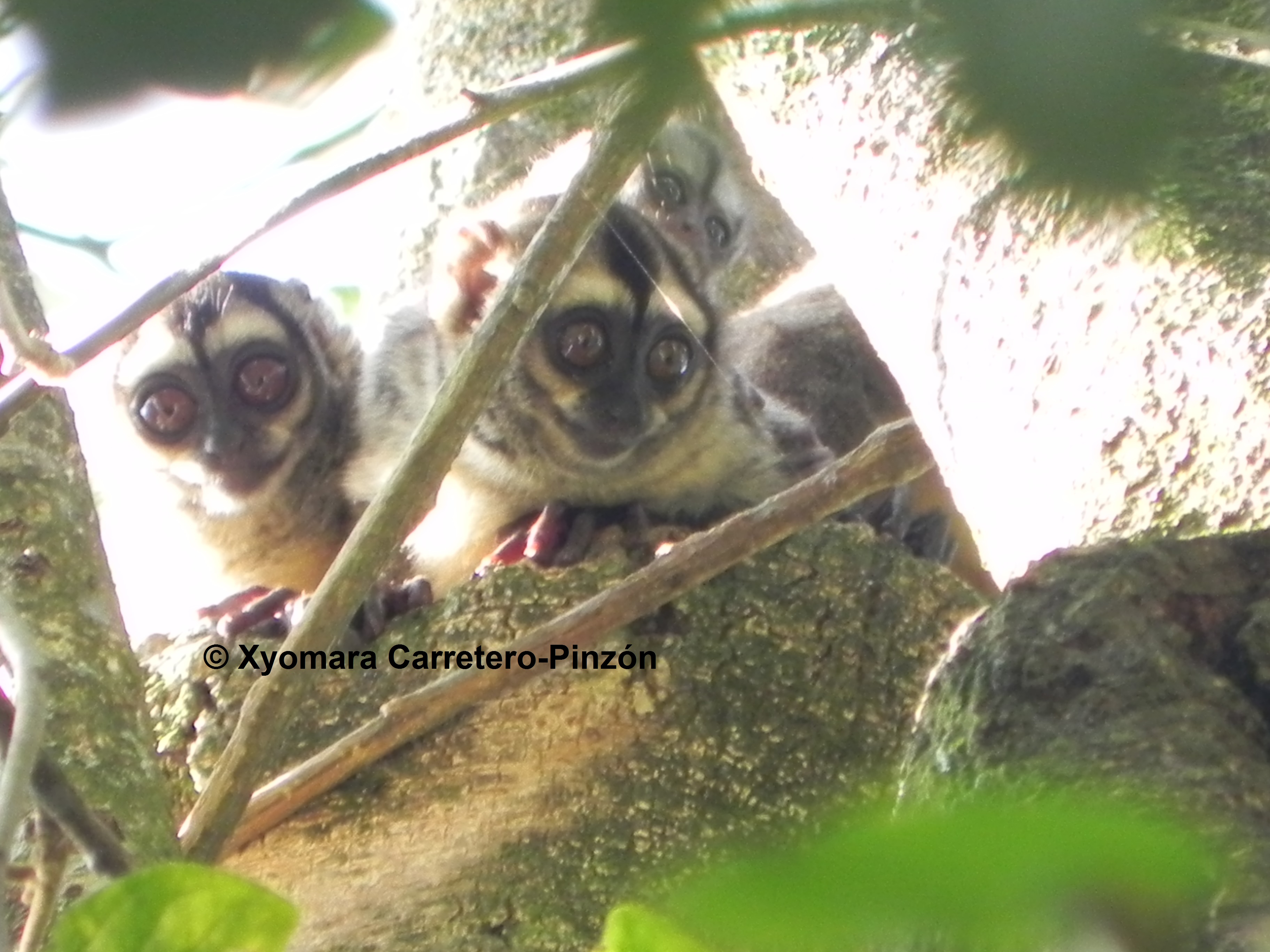
Fig trees are also used by nocturnal monkeys which sometimes share the fig tree with a common opossum in the study area. Other animals commonly seen during fig trees fruit production are toucans and parrots. So in fragmented areas, the same as in continuous areas fig trees became keystone species important for the survivorship of many frugivorous animals during the low fruit production season.
© Copyright Disclaimer. All pictures used on this web page are protected with copyrights to Xyomara Carretero-Pinzón. If you want to use any of these pictures, please leave a message on the website. Thank you.

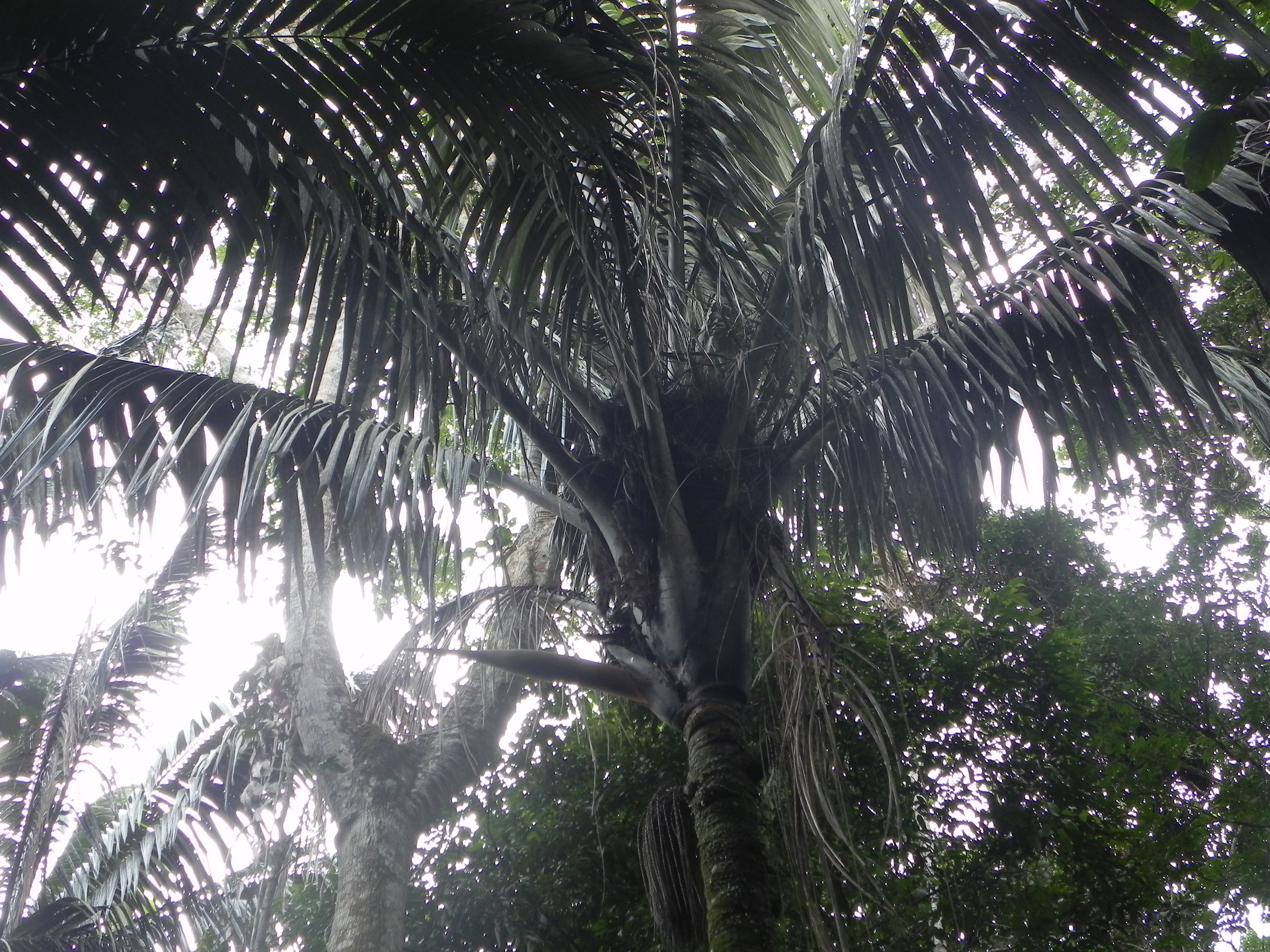
Monkey Forest Tales: Importance of palms for primates in the study area

DSCN7699

Some weeks ago, someone from the region ask me if palms we’re important for primates. The short answer is yes they are important. Therefore, in today’s post, we are going to talk about the importance of palms for monkeys in the study area.
Colombia is one of the countries with more diversity of palms in the world. This makes palms an important source of resources for monkeys and other fauna such as birds, reptiles, frogs, and other mammals. Palms are used as nesting sites, as a source to search for insects and spiders, as a perch or a place to rest during the daily activities, and food. Fruits and flowers of many palm species are used by parrots, monkeys, and other mammals as food.
One feature common to most of palm fruits is a hard seed which contain oil, sometimes covered by a hard shell (epicarp), which make it difficult to break and the contains not always available for all animals.
For example, black-capped capuchins display an interesting behavior to open the nuts of cumare (Astrocaryum chambira), a tall palm species which trunk is covered by thorns, with a medium size nut of hard shell, which have a coconut inside rich in oil and when it is unripe it contains water. Black-capped capuchins get to the palm fruits very carefully from other trees around the cumare palm and then with their strong teeth take one nut from the cluster. One they have it, they move to a nearby trees with wide branches and start knocking the fruit using most of their bodies (Izawa 1979). Mostly the adult males are the ones that can open most of the palm fruits, juveniles imitate them but not always are successful.
Cumare palms were once a very common palm in the study area, however they have been cut from most of the forests and pastures because the cattle used to get hurt by its thorns, according to local people living in the area over 30 years.
Palms are used by monkeys as nesting sites or as food or to search insects and spiders. For example palms like moriche (Mauritia flexuosa) and unamas or milpeso (Oenocarpus bataua) are used as nesting sites for Brumbacks night monkeys (Aotus brumbackii), black-capped capuchins (Sapajus apella) and Colombian squirrel monkeys (Saimiri cassiquiarensis albigena). This palms are also used as food. All these monkeys used them to eat its flowers and its ripe and unripe fruits.
Other palms such as pona (Iriarthea exhorriza), asai (Euterpe oleracea) and cumare (Astrocarium chambira) are used only for their fruits for all monkey species in the study area, including the dusky titi monkey and the red howler monkeys. In the study area palms such as asai, unama and moriche are still common and very important for the local fauna, including monkeys.
Izawa, K. 1979. Food and feeding behavior of wild black-capped capuchin (Cebus apella). Primates 21: 57-76.
© Copyright Disclaimer. All pictures used on this web page are protected with copyrights to Xyomara Carretero-Pinzón. If you want to use any of these pictures, please leave a message on the website. Thank you.

Monkey Forest Tales: Some reflections about “colonialism in science” related to this project

Unamas Enero 2011 074

In today’s post, I want to talk about something that has been in my mind for a couple of days. Recently, an article talking about colonialism in science, makes me reflect on how this project has been conducted over the years. The article talked about how research projects in many countries in Asia, Africa, and Latin America are leaded by people from developed countries who come to all these countries to do research and pay none or very poor attention to training local people to collect and lead research on their own wildlife.
Although in Colombia, our war history has stopped many foreign researchers to work in the country, my own professional and training history working with monkeys came from foreign researchers coming to Colombia to research and train Colombians to study monkeys.
However, although I am a national of the country where I do research, I came from a different region, and most of the students I had over the years came from different regions until recently, that I started to collaborate with a regional university. So despite being a national there is still some kind of colonialism thinking in the way we accept and train people to do a research between regions inside of Colombia.
The reasons why this happens don’t seem too clear for me, except that the students I trained are the ones who had shown an interest in monkeys even if they are not from the region where we were working. However, this can also be influenced by less interest or encouragement in regional universities to study the local wildlife.
In addition, although in the last years there is more interest in Colombia to study monkeys, especially the ones in a more critical situation, there is still a lot of emphasis in schools to talk about animals that are from other parts of the world such as tigers, or pandas, or elephants and lions, than talking about the animals we have in our country. Something I think it has to do with a colonialism way to teach science even at primary and high school levels.
So, even if we don’t want to admit it, I think we encourage in some way the colonialism thinking in the way we teach science and train our students. Probably we need to be more aware of this and encourage students from regional universities to be trained in the study of local fauna. As well as incentives the biology programs in regional universities.

© Copyright Disclaimer. All pictures used on this web page are protected with copyrights to Xyomara Carretero-Pinzón. If you want to use any of these pictures, please leave a message on the website. Thank you.

Monkey Forest Tales: How the COVID-19 is affecting this project?

DSCN0167

I apologize for missing last week’s post. As it is happening to most of all due to COVID-19 some of my priorities changed a bit. In today’s post, I want to talk about how the pandemic had impacted this project. As mentioned in previous posts, this is a project run not only with personal funds but also limited to a few people. Most people working at the moment in the project are undergraduate students, therefore with the limited movement allowed to us due to our national lockdown, most of their projects are stopped.
Additionally, I am also not allowed to travel, so data collection for our long term monitoring of monkey populations in the study area is also stopped. As our last field trip was in February, we were allowed to count the new babies from this year’s season of Colombian squirrel monkeys and dusky titi monkeys. However, since then, there has not been any data collected in the study area. Apart from local people reports in some farms, where the monkeys have been seen near to the houses in May.
As part of the goals of this project for 2020, we started some monitoring of Colombian squirrel monkeys in Villavicencio city, the biggest city in the region, and although with difficulty because of the movement restriction we have at the moment, some data collected on some groups with less periodicity that we used to do in San Martin area.
At the beginning of this project, back in 2004 -2005, I tried to train some local younger people as field assistants, teaching them basic data collection techniques, however as time passes and with the continuous changing of workers in the farms where this project is focused, people trained moved to other farms at the beginning and to other towns later, making more difficult to have locals as field assistants.
So, with the situation we are living at the moment it seems even more important for us to start implementing a more effective way to collect our long term monitoring data to allow us to continue to monitor monkeys populations despite the limitations we are facing at the moment.
In addition to the concerns related to our restrictions at the moment to collect data, there are the possibility that our travelling to the study area can affect the local people and monkeys due to the virus spread. COVID-19 is a virus that has the ability to move across species and therefore it is a potential risk for monkey populations in the study area and in all natural habitats where they live. So although we want to continue with our project and long term monitoring of monkeys, for now our activities are limited and constrained to anecdotal data.

© Copyright Disclaimer. All pictures used on this web page are protected with copyrights to Xyomara Carretero-Pinzón. If you want to use any of these pictures, please leave a message on the website. Thank you.

Monkey Forest Tales: What is the impact of wild animal consumption on wildlife and humans?

DSCN9767

We had been hearing a lot about how the current pandemic was originated from the consumption of wild animals. In our last post we talk about the reasons for people to use and consume animal parts. So in today’s post we are going to talk about how that have different impacts on wildlife and humans.
The impact that hunting wild animals for consumption had on those animal populations depend on different factors influenced by the behavior and biology of those animals. For example, hunting monkeys for consumption or to use some of its parts had a high impact on their populations. The reason for this high impact is because most monkey’s species had a very low reproduction rate, this means they have babies not every year. This is specially true for medium and large monkeys, which have babies every three up to six years, depending on the species. In animals like rats or capybaras and other rodents which reproduce more often, it’s impact can be less strong.
This practice also affects people because when we eat other animals, wild and/ or domestic we had the probability to get some of the parasite, bacteria and viruses that they usually have. That is one of the reasons for all the regulations that domestic animals production had to comply with.
Those regulations are not in place for wild animal consumption and the conditions in which these animals are kept and traded increase the risk of contamination between animals of the same and other species as a recent study showed (Huong et all. 2020). Data from this study showed that the amount and prevalence of viruses, specifically coronavirus, such as the one causing the current pandemic, increases through the supply chain that market wild animals for human consumption in Vietnam and which present similar conditions to wildlife markets in South America, where multiple species are kept together in crowded and poor hygienic conditions.
Huong, N.Q. et al. 2020.Coronavirus testing indicates transmission risk increases along wildlife supply chains for human consumption in Viet Nam, 2013-2014. Doi: https://doi.org/10.1101/2020.06.05.098590
© Copyright Disclaimer. All pictures used on this web page are protected with copyrights to Xyomara Carretero-Pinzón. If you want to use any of these pictures, please leave a message on the website. Thank you.

Monkey Forest Tales: Some reasons for wild animal consumption: tradition, status and cultural beliefs

Today’s post is about some of the reasons for people’s use and consumption of wild animals. Since we appear on earth our diet had depended on animals and plants. We change our animal consumption habits depending on where we live and how we live.
So for example, people in the Amazon depend on forest and river species to support their protein consumption, while in some parts of Africa, people depend on savanna’s animals to eat or Aboriginal people in Australia depended traditionally on kangaroos to survive. Since the beginning of agriculture and livestock animal domestication, our consumption habits had changed. Sometimes restricted by cultural beliefs and religious constraints.
However, in many parts of the world, there is still a high number of wild animals consumed for different reasons. Some are consumed because culturally people believe those animals give them some mystical powers or protect them from diseases and bad spirits or because it gives them some status. Sometimes there is a combination of some or all of them.
In the study area, there is a combination of tradition and cultural beliefs that motivates the consumption of wild animals by local people. Traditionally there are some animals typical from the region that have been consumed just because it’s tradition and a typical dish in the region, despite the long history of cattle ranching in the area since colonial times.

Some parts of animals are used as remedies against tropical diseases such as malaria. There is still a belief that if you used the hyoids bone from red howler monkeys you can be cured of malaria. Another local belief rooted in the macho culture of the area is that some preparation with the penis bone from a male coati can cure you of erectile dysfunction.

Some other animals are consumed because their meat is tasty, like armadillos, tapirs, caiman, deer,  capybaras, and peccaries. All of them were common in the study area, and now are less common and illegally hunted. And in some ways, there are considered a delicacy for some locals.
Although monkeys in the study area are not heavily hunted for consumption, the pet trade is a higher threat, there is still a lot of work to do in this topic.

Although it is difficult to change people’s habits and beliefs, education and in some cases some of the traditional taboos and seasonal bans could be used to reduce the illegal consumption of wild animals in the area. Although monkeys in the study area are not heavily hunted for consumption, the pet trade is a higher threat, there is still a lot of work to do in this topic
© Copyright Disclaimer. All pictures used on this web page are protected with copyrights to Xyomara Carretero-Pinzón. If you want to use any of these pictures, please leave a message on the website. Thank you

Monkeys Forest Tales: A bit of history from the area

Today’s post is about a bit of the history of the study area and San Martin town. San Martin town is one of the oldest towns in the region. It was established in 1585 and it was a center for cattle ranching activities since then. Located in the Camoa’s river banks, this small town has a privileged position which make it an area of high diversity.
It’s main economic activities, cattle ranching, palm oil plantations (since 1970’s approximately) and more recently petrol exploration are the main threats to it’s biodiversity.
Santa Rosa farm, the center area of this project, was a compulsory stop for cattle ranchers transporting cattle from the serranias (natural savanna’s in the Eastern part of the town) towards the commercial centers since the colony period. Although this farm had a long history of cattle ranching and human exploration of forest resources, since the beginning of this project there has been a change in the management of their forest towards a better preservation of it’s natural resources.
The story of cattle ranching in the area had left a mark in the landscape and continue to impact it’s forest fragments today. A common practice in the area is to allow the entrance of cattle and horses to the gallery forest to roam and drink water. The main forest fragments that remains in the area are gallery forest. This practice had lead to forest fragments with poor understory, only few of the seedlings grow to be adult trees as cattle use them as food or to rubber their backs.
This impact is also seen in forest fragments of lowland rain forest near to the main small rivers in the area, such as the Camoa, Cumaral and Chunaipo, which are the tributaries of the Meta river in it’s source. The areas that has been deforested now are covered with introduced pastures such as Brachiaria spp. And more recently had been replaced by palm oil.
The other area in which this project was developed (2008 – 2019), is a natural reserve in which larger relicts of lowland rain forest and gallery forest persisted due to the visionary management of their owners who had protected big forest fragments that still conserve the original fauna of the region. These big areas of forest seems to be functioning as source population of many mammal species that otherwise will be locally extinct. Some examples of this is the persistence of tapirs, jaguars, cougars and the two peccaries, white-lipped and collared peccaries. Both species are abundant in this area. Although the white-lipped peccary used to roam around the town square, they have not reached the town since more than a decade ago, according to local people.
Despite the long history of human activities in this area the biodiversity present still maintain populations that seems to be stable, at least for some primates. However, the changes brought by palm oil plantations and petrol exploration, which increase the arrival of people from other regions with other cultural values and habits. This new arrivals can increase the pressures for the local fauna. An awareness and education program, as well as a continuous monitoring of the deforestation process in the area are important steps in the area to increase the probabilities to persist for the fauna in the area.
© Copyright Disclaimer. All pictures used on this web page are protected with copyrights to Xyomara Carretero-Pinzón. If you want to use any of these pictures, please leave a message on the website. Thank you.