

Monkey Forest Tales: Why monkeys hide?

Over the past days while talking with my mother, she asks me why monkeys hide? It not exactly that monkeys hide, is just that somedays when you are looking for monkeys in the forest you aren’t luck enough to see them not just that they hide on purpose so you cannot see them…or maybe yes (I always wonder…)
When you follow monkeys or even when you just go primate watching (monkeys sighting as you do with birds) there is always a possibility that you don’t see those monkeys you are looking for. Why? Well sometimes you just pass under them without seeing them, some other times, no matter how much you walk you just cannot find them.
They are not hiding on purpose, they just continue with their lives and although some species have more cryptic behavior than others, those cryptic behaviors have been used to avoid predators or to find quite places to rest during day or nighttime. The thing with observing wildlife in their habitats is that you sometimes can see them but other times not and that is also part of the fun of being in wild habitats.
When studying monkeys this can be frustrating as well as rewarding at the same time, it all depends on how persistent you are at looking for the monkeys you are studying. When I started, over 26 years ago, I spent hours looking for the red howler monkeys I used to study, sometimes I found them, but they just move a little bit and I lost them. To find them again a few hours later just a few meters from the place where I saw them in the first time. But that also happens 10 years later while I was studying Colombian squirrel monkeys in the study area of this project and I used to walk several kilometers a day to finally found my study group at down close to the house where I was staying…
When studying monkeys in fragmented areas, you may think that seeing the monkeys is easier because of the small forest areas, they don’t have many places to hide, but the true is that even on those small forest fragment they always find tall trees where they can climb to rest on the sun or small areas full of vines and lianas so thick they can hide from any curious human.
In areas where they are hunted they climb tall trees and run as fast as they can every time they see a human approaching or stay very still and quiet in tall trees covered by vines and lianas which protect them from any predator, including us.
So, if you ever visit a forest, not matter if it is a big or small forest and you are looking for monkeys, to study them or just to enjoy seeing them, don’t get discourage if you don’t see them the first time, is part of the fun of looking monkeys in their habitat. And if you are lucky enough you not only will see them but also will spent some amazing time discovering all the wonderful behaviors they have while living their daily lives. Studying monkeys is a privilege that live give you and I have being blessed enough to spent some of the most amazing days of my live looking at those wonderful creatures that shares the world with us and hope you have the opportunity to do it someday too…
© Copyright Disclaimer. All pictures used on this web page are protected with copyrights to Xyomara Carretero-Pinzón. If you want to use any of these pictures, please leave a message on the website. Thank you.
Monkey Forest Tales: Monkeys strategies to survive in the study area

In today’s post we are going to discuss some of monkeys strategies to survive in the fragmented study area. Each monkey species responds in different ways to the transformation of their habitat as well as how to use the new habitats surrounding them.
For example, in the study area dusty titi monkeys responds differently depending on how big are the forest fragments in which they live, how much people live around and how big are the pastures or crops present in the area. Also, their use of living fences during their daily activities varies according to the variables explained before. So in areas with small (10 – 50 ha) and medium (50 – 100 ha) forest fragments they use living fences occasionally and mainly to move from one fragment to another, while in areas closer to towns and tiny fragments (less than 10 ha) they use living fences and isolated trees more often and even during the day they rest and groom while in those living fences.
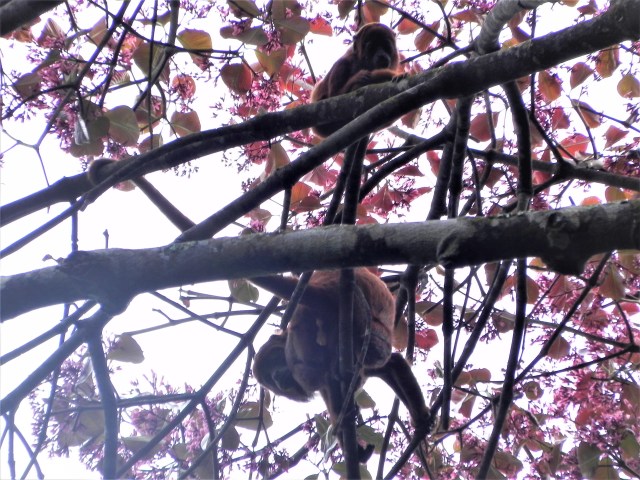
Red howler monkeys, Colombian squirrel monkeys and black-capped capuchins are more flexible and use crops, isolates trees, living fences, small fragments and in some cases even house roofs as part of their territories and in some cases this is why they become a problem in some areas.
Those differences are related with each monkeys species behavior and ecology. So, what can we do to improve their probabilities to survive in those fragmented – productive areas. First and probably the most important action any landowner can do is to protect forest areas, especially those around water courses that not only allows monkeys, but other wildlife to survive but also provides services to their crops and domestic animals, such as water and pollinators.
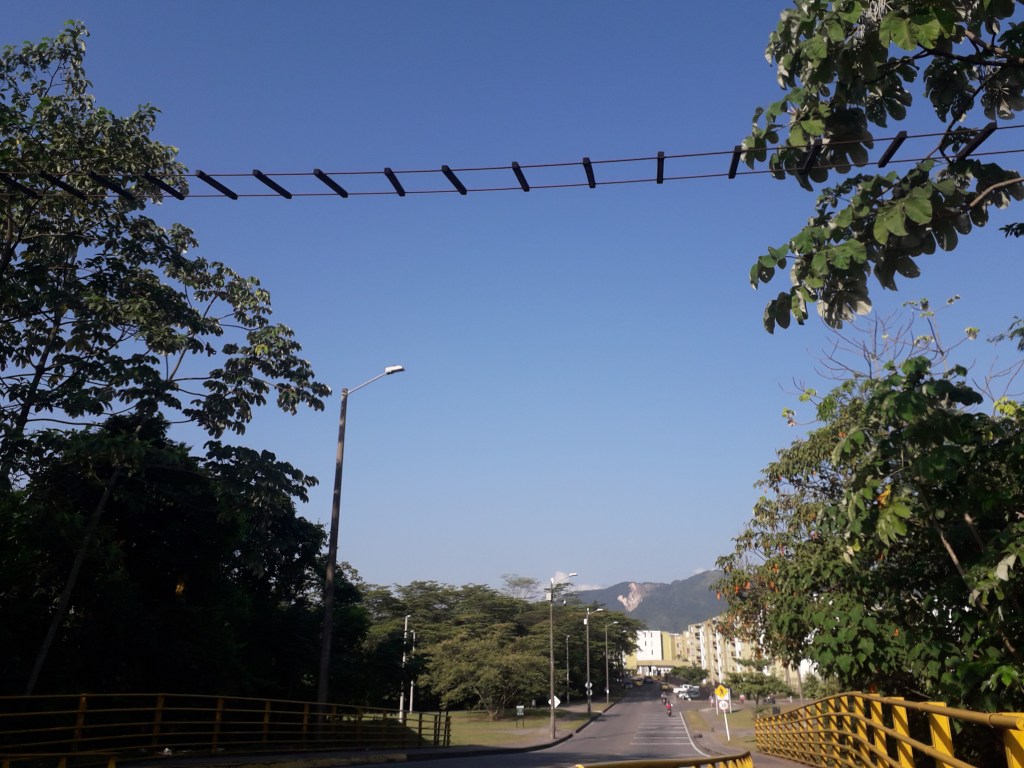
As we have mentioned before, presence of living fences and isolated trees are important to improve connectivity of forest fragments in agricultural areas. In urban areas is important to not only allow animals, including monkeys, to access natural vegetation present in those areas, usually around water courses, but also provide canopy bridges and other wildlife passes. In the study area, canopy bridges are important species on tertiary and secondary roads. However, most of the canopy bridges observes in some areas of the study area of these project doesn´t seems to consider basic features of the animal such as size and weight.
A preliminary analysis done for the study area of this project and some of the towns nearby have shown that up to know abundance of all diurnal species depend mainly on how big the forest fragments are and how far those fragments are from towns and cities combined (Carretero-Pinzón, 2016). This is an important point when planning conservation areas for all the monkeys species present in the study area and give some basic guidance on how land use (crops, roads, infrastructure can be planned) in a way that doesn’t interrupt and degrade more the already degraded areas present in the study area.
Carretero-Pinzón, 2016. Conservation planning for primate communities in rapidly transforming landscapes. Doctorate Thesis. The University of Queensland.
© Copyright Disclaimer. All pictures used on this web page are protected with copyrights to Xyomara Carretero-Pinzón. If you want to use any of these pictures, please leave a message on the website. Thank you

Monkeys Forest Tales: Challenges of counting monkeys?

Today’s post we are going to discuss some challenges of counting monkeys in different types of forest. Counting monkeys is an important part of understanding the demographics and conservation status of monkeys populations, especially when you do it several times at several places. This information can give you information about what is happening with a monkey population in one moment and through several years. It is also valid for other animals, but as this is a monkey blog we will focus on monkeys.
When counting monkeys some challenges are present that have to do with the terrain in which you are counting them, other issues comes from some specific behavioral features from the species you are looking at and some other issues comes from the observer experience…
Let’s start with the challenges that are associated with the terrain. Usually when counting monkeys, we relied basically on our vision and sometimes hearing to find the monkeys. Therefore, visibility is an important factor that influence how easily we can see the monkeys and count them. Also, counting monkeys in flooded areas is different than in terra firme, or mountain areas. Depending on how rough the terrain is, accessibility to some part of forest are different and that influence the number of monkeys we encounter and how easily we can count them.
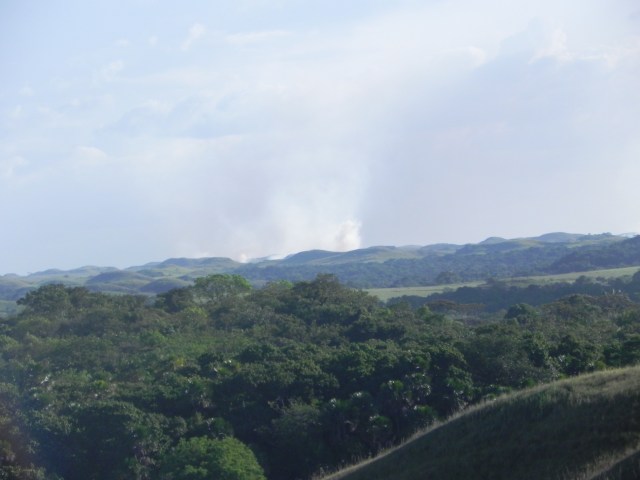
For example, in the study area, fragments towards the Serrania (Southeast of San Martin town) are located in small hills, with some streams surrounded by deep falls due to erosion. So, you have to be careful not to fall and break an ankle. Other fragments are located in swamp areas where walking is difficult and during rainy season sometimes impossible to walk. In the Amazon, on the other hand, during rainy season some areas are only accessible by canoe. Each one represents a different challenge in terms of how you move and design you study to count monkeys.
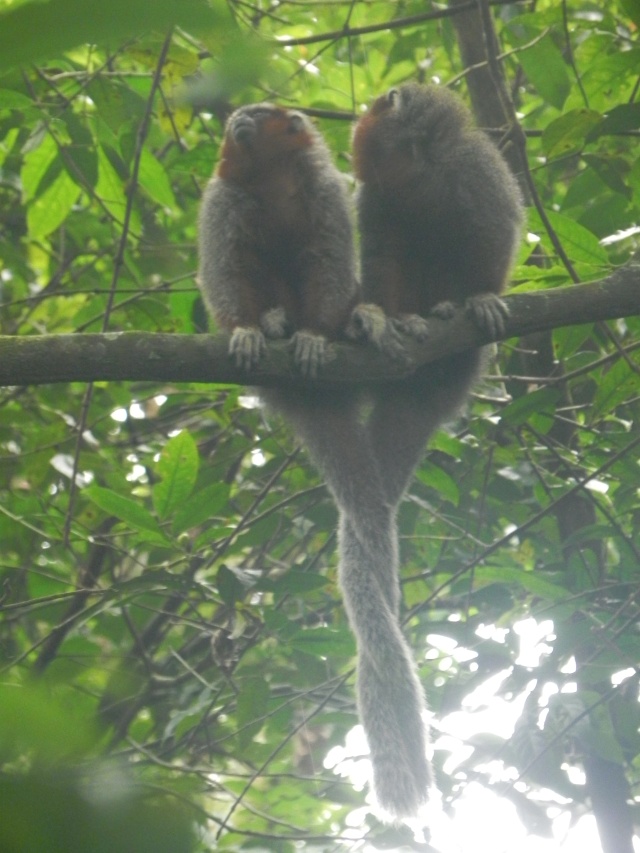
Other challenges are associated with specific behavioral features from the species you are trying to count. For example, there are some species like dusky titi monkeys who have a cryptic behavior. They hide when they see people, especially in areas where there is high human activity. Therefore, counting them sometimes require visiting the same forest fragment several times to corroborate the number of individuals. In the Amazon other species of titi monkeys and tamarins take advantage of thick understory as well as very tall trees (more than 25 m of height) which reduce your visibility to hide and make counting of these species more challenging. However, patience is always our best friend when working counting monkeys.
Finally, another common challenge of counting monkeys is related with observer experience. At the beginning, it is always good to count monkeys with another observer: hunters, indigenous and local people are always great to learn how monkeys sound and to learn clues that help you identify monkey’s species. Hunters, indigenous and people who live close to forest or in the forest have their eyes and ears adapted to forest sounds and that is always helpful when counting monkeys, especially at night and in big forest. Observers with many years of experience usually develop more sensible eyes and ears to detect monkeys, but it will require time, persistence and patience.
So, as you see counting monkeys can be challenging but always fun, you just need to be patience and persistence and you will see them and be able to count them…
© Copyright Disclaimer. All pictures used on this web page are protected with copyrights to Xyomara Carretero-Pinzón. If you want to use any of these pictures, please leave a message on the website. Thank you.
Monkey Forest Tales: What Zocay Project had teach me personally?

Today’s post is again a personal one. When you are coordinating a research project there are many personal lesson learned not only from the animals/ ecosystems/ landscapes you study, but also from the students/ volunteers/ interns/ colleagues and local people with who you work with…
You not only learn about how to solve logistical and funding problems, you also learn what are your limits, became more flexible and tolerant with yourself and others. As Zocay Project is located on private farms, you also need to learn how to communicate with local people, farm workers and landowners, who not always have all the same education and shared interest.
Students, volunteers and interns teach you about your own limits, how to teach one to one, something that now I found more rewarding from a personal perspective, and how to deal with different personalities. It also teach you what past experiences you had are more important for your personal and professional growth and which of those you will like your students experience and which ones you can advise them to avoid, when they hear your advice.
Probably one the more challenging learnings of having a field research, and one that you learn when you design, implement and executes a research project in the field and/ or in a laboratory, is to manage the logistics and funding of your project.
A field research implies coordinating food, accommodations, transport (international, national, regional and/ or local), health insurance (at least for yourself), and in some cases permits and visa for you and your team. All that logistics is time consuming and sometimes undervalued when you are designing and implementing your research. So you also learn skills like time, money, staff and organization management, even if you are not aware that you are learning how to do this. This are some skills that you can transfer later if you don’t follow the academia path and you prefer to go for an industry, NGO or government job.
Although designing and implementing your own long-term research project is not for all and it is not easy to do, it is rewarding and an amazing learning process. So if you will like to do it, just remember to be patient, especially with yourself, and keep going despite the challenges and sometimes problems…
© Copyright Disclaimer. All pictures used on this web page are protected with copyrights to Xyomara Carretero-Pinzón. If you want to use any of these pictures, please leave a message on the website. Thank you.

Monkey Forest Tales: For how long is Zocay Project going to last?

In today’s post I’m going to be more personal to talk about a question I get from so many people over the years, including family, friends and landowners…For how long is Zocay Project going to last?
As many answers in life, the answer will depend on many factors. For sure I will be looking for monkeys and visiting places to see monkeys until my body and health allow me to do it. Zocay Project on the other hand, will depends in some ways on the wiliness of the landowners and their families to allow me to visit their farms and see the monkeys found in their forests.
While preparing a talk last week for the Woman and Girls in Science Day, I looked at my past experiences finding resources to study and to get Zocay Project running and although I never get a big funding for the project, I did have some funding for small parts of this project, as well as funding for my studies.
Keeping a long term project means a lot of money, effort and sometimes long hours of brainstorming not only for project ideas that can keep the funding running but also time to spend with landowners explaining those ideas and finding common grounds and topics that can be useful for them as well as the project, and more important finding solutions to conflicts that can occur because of the close proximity in which monkeys are living with human activities.
So, one of the things I realize while preparing that talk was that not only I had spent a lot of resources and energy putting this project as a priority in my life, but I also had spent a lot of time. For a couple of years I had been thinking about some kind of retirement for me and although I know for sure I will never going to stop looking for places to see monkeys, sometimes I wonder if it is time to close this part of my life that Zocay Project started almost 16 years ago… But then, a question rises of what else can I do? I cannot imagine my live without monkeys in it and all the question that they always generate on my mind…So, for now Zocay project will continue at least for this year and hopefully I will find the energy to continue for more years to come
© Copyright Disclaimer. All pictures used on this web page are protected with copyrights to Xyomara Carretero-Pinzón. If you want to use any of these pictures, please leave a message on the website. Thank you.
Monkeys Forest Tales: Celebrating Woman and Girls Day in Science!

Yesterday we celebrate Woman and Girls Day in Science worldwide and to celebrate this day we want to remember, celebrate and recognize the effort and great work of all the wonderful women who had been part of this project over the years. Although not all of them continue doing science today without their effort to finish their internships, undergraduate projects and friendship this project wouldn’t last more than a few years, so THAK YOU!
Being a woman in science is a challenge, one that usually includes many sacrifices: long hours in the field and in front of our computers, discomfort by mosquitoes, mites and ticks biting our bodies, several months and sometimes years far from our families, and sometimes bullying and sexual harassment. However, it is rewarding, every time we saw one of our women students graduate as well as every time that we have the opportunity to share and witness some of the rare behaviors monkeys do in their habitats, we felt rewarded by all those long hours and discomfort.
Over the years, we had the opportunity to work with many great women and learn from them. We also had the opportunity to share with many girls from the study area, most of them only can study up to high school, but their passion and interest for nature and life inspire us every day. To all of them thank you for your inspiration, friendship, support and great work towards monkey conservation.
In my personal professional path, I mostly had man supervisors, a pattern that I only discover a few years ago probably because in my country most of the professors I had during my career were man. However, during this journey of being a woman in science, I had the opportunity to work, collaborate and share with many amazing women of several cultures working towards the conservation of many species around the world. To all of them thank you for sharing your experiences with me as those experiences make me a better person and scientist today.
It is part of our purpose in Zocay Project to continue supporting in any way possible women and girls who are interested in working in science and of course with monkeys, so if you are a girl or woman interested on working with monkeys in Colombia, especially in the Llanos, please contact us and we for sure try to guide you as much as possible. Happy Woman and Girls in Science Day!!

© Copyright Disclaimer. All pictures used on this web page are protected with copyrights to Xyomara Carretero-Pinzón. If you want to use any of these pictures, please leave a message on the website. Thank you.
Forest Monkey Tales: Notes from the field: baby’s season

MOULTRIE DIGITAL GAME CAMERA

It is the beginning of the year again and with it a new baby’s season for Colombian squirrel monkeys and dusky titi monkeys. Counting all new babies during the first months every year has become one of our happiest times in the field. And this year is not an exception.
Dry season this year in the study area continue and the stream continue drying. There are still some ponds were birds and mammals met. The forest floor is covered with dry leaves and the wind blows all day making the monkeys sightings more difficult. Yellow, green, and brown colors from leaves are combined with yellow and purple colors of Jacaranda and Bototo flowers. A few fruits cover the forest canopies.
This year, we counted less babies from both species than last year although it can be that births are just a bit delayed this year. Some of our observations of trees with fruits over the past months have showed a delayed pattern in fruit production for some trees used by monkeys. This delayed pattern can be related with slight changes on rain amount from past year. However, it is always exciting to see new babies and to confirm that some of last year babies are still alive and growing.
Our monitoring of monkeys use of water reservoirs used for cattle have shown that at least the Colombian squirrel monkey use those water reservoirs to drink water during the dry months, despite of some water ponds still present on the stream crossing the forest.
Probably one of the surprising findings of other mammals using and crossing the life fence where the water resources we are monitoring are located is the presence of the cryptic crab-eating racoon (Procyon cancrivorous) as well as ocelot (Felis pardalis). Those water sources are also used by some yellow-headed and crested caracara and Spin’x guans.
As the dry season progress, we continue to monitor water reservoirs and monkeys’ groups. A couple of black-capped capuchin babies had grown and seems to progress with good health. Red howler monkeys continues with some botflies although this seem to not had affected their health.
© Copyright Disclaimer. All pictures used on this web page are protected with copyrights to Xyomara Carretero-Pinzón. If you want to use any of these pictures, please leave a message on the website. Thank you.

Monkey Forest Tales: What I should study to be a primatologist?

Spending time in the field with kids usually lead you to some interesting questions along the way. One of those came from a small girl who was interested to know what you study to dedicate your life to study monkeys? Well the answer is it depends.
Monkey studies came from different areas of knowledge from psychology to anthropology to biology to ecology to behavior and veterinary. So, people studying monkeys sometimes came from different disciplines and depending on the discipline the tools they use to study monkeys are different.
Most of the initial schools who started the primatology in the 40’s came from psychology and anthropology school, and some also were from medical school. The beginning on monkeys studies came from peoples questions about how human society started and how early humans use to live.
More recently, most people working with primates in general (monkeys, lemurs and apes) study biology, veterinary or anthropology, some also study psychology or medicine. Then they choose the field and type of questions they want to answer.
In my case I study biology, make a master with emphasis in ecology and then, and mostly because of the zocay project context, made a doctorate in landscape ecology. When zocay project was started, most of my experience was the study of monkeys behavior in very large forest. But as zocay project is in a fragmented area surrounded by productive activities, my interest shifted to understand the bigger picture, which means how the monkeys adapt and manage the effects of fragmentation and human activities near their habitats.
Monkeys studies can be done in the forest, in laboratories and in zoos. You can study their behavior (how they interact between them and with other species), their ecology (how they relate with their environment), their genetics (how different they are and who is the father of each baby) and their health (how to improve their health and how to manage their diseases).
So, if you want study monkeys you can choose one of different careers. But the more important part is that you have the passion, perseverance and patience to study them. Studying monkeys is a challenging but rewarding career that can take you to explore amazing places and discovering exciting moments surrounded by some of the most amazing creatures that live in this planet.
© Copyright Disclaimer. All pictures used on this web page are protected with copyrights to Xyomara Carretero-Pinzón. If you want to use any of these pictures, please leave a message on the website. Thank you.

Monkey Forest Tales: How monkeys sleep?

A common question asked by kids in the study area is how monkeys sleep? So, in today’s post we are going to talk about sleeping in monkeys. Most species of monkeys don’t build nest as chimpanzees, gorillas or orangutans do. But some of them like all species of nocturnal monkeys (including the Brumback’s night monkeys from the study area) used hollow trees and palms, as well as dense liana and vine areas on tall trees to sleep overnight.
All the other monkeys sleep on big wide branches of tall trees, Guadua forest (Guadua angustifolia patches), dense liana and vine areas on tall tree, palms. More terrestrial monkeys such as macaques can also use cliffs and rocky areas to sleep overnight.
In the study area black- capped capuchins and Colombian squirrel monkeys love to sleep on palms where several individuals sit together on the leaves base to sleep. Red howler monkeys use wide branches from big trees to sleep with females, juveniles and infants sleep together and the males sleep alone in nearby branches. Dusky titi monkeys sleep in dense liana and vine areas on tall trees with their tails intertwined.
Babies usually sleep on their mothers chest when there are small and when they are bigger the sit next to them for sleeping. Males usually sleep a bit separated from the other members of the group in nearby branches. Depending on the group size, monkeys can sleep all in the same tree or in very large groups they can use several big trees or palms to sleep.
Most diurnal species don’t make any noise or movement overnight. However, black-capped capuchins and squirrel monkeys can move inside the sleeping trees or palms and even sometimes move to nearby trees, especially in full moon nights. Sometimes you can hear vocalizations of these two species during the night.
Most species of monkeys sleep around 12 hours, from dusk to dawn, but in cold days some species can sleep a bit longer in the morning. For example, on cool mornings can stay on their sleeping sites until 8 or 9 o’clock in the morning before moving to eat. Also, some monkeys go to sleep earlier than others. For example, dusky titi monkeys and red howler monkeys usually enter their sleeping trees around 4 or 5 o’clock in the afternoon, while black capped monkeys and squirrel monkeys won’t go to sleep until 6 o’clock or a bit later depending on the sunset time.
Additionally, during the day all monkeys in the study area have nap times around noon when the sun is high and is hotter. For those nap times monkeys usually choose big trees with wide branches where they can lay down in groups or alone.
© Copyright Disclaimer. All pictures used on this web page are protected with copyrights to Xyomara Carretero-Pinzón. If you want to use any of these pictures, please leave a message on the website. Thank you.

Monkey Forest Tales: How monkeys take care of their parasites?

A few days ago while I was in the field, I was looking at some red howler monkeys who have some botflies on their necks. While observing them I notice a male “sucking” a females botfly on her neck. He was licking her open swollen skin. Not sure if the botfly was still in the female’s neck but it seems it already fly out.
Although I have seen botflies red howlers in many places, it seems recently they are having more than before. Local people said that it is related to an increase of palm oil plantations in the area, but probably we’ll need more data to say that. It can be that combined with a lower quality habitat product of the habitat deforestation and fragmentation too.
This observation lead me to another question that I thought would be interesting to talk about: how monkeys take care of their external parasites. Well, I’m sure you have seen many pictures and videos of monkeys grooming themselves or other individuals. Grooming is not only a way for monkeys, and in general for social animals, to reinforce our social relationships. It is also used to extract external parasites and death cell from the skin. While grooming monkeys remove mites, ticks and other external parasites that can live in their skin, including botflies.
Also, some field observations in wild capuchin monkeys have showed that they also rub some plant on their skin as a repellent apparently to reduce mosquito bites, similar to what we do when we apply a chemical repellent on our skin for the same reason.
Internal parasites are another story. There are some theories of the use of soil as a way to eliminate internal parasites from howler monkeys, spider monkeys and woolly monkeys we usually visit salt lick sites, however there are other possible explanations such as the use of soil to reduce toxins found in monkeys food such as leaves. In chimps there has been reports of the use of some plants as possible laxatives that help them to reduce their internal parasites.
Although not definitive answer has been found yet to these questions the increased closeness between monkeys (or apes) to humans due to deforestation and fragmentation is increasing the range of parasites that can be found on both. Careful monitoring on this issue is important for monkeys and human health.
© Copyright Disclaimer. All pictures used on this web page are protected with copyrights to Xyomara Carretero-Pinzón. If you want to use any of these pictures, please leave a message on the website. Thank you.