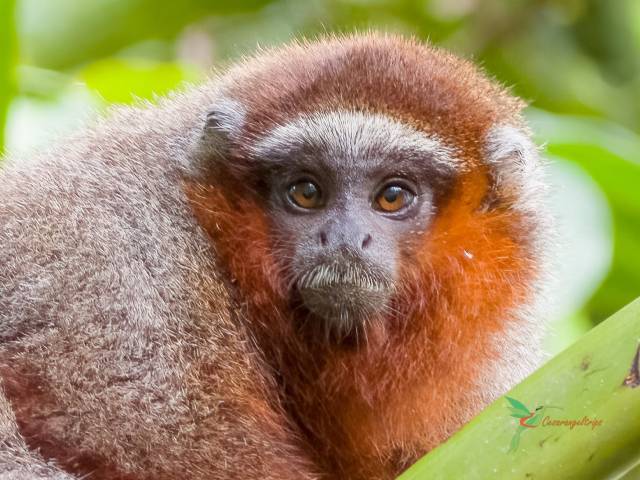
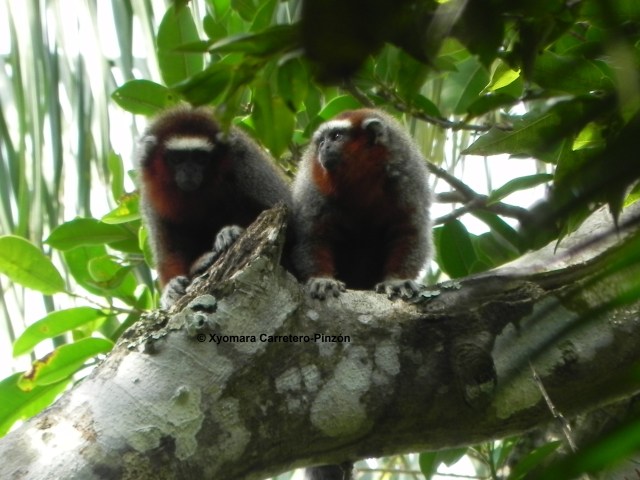
In today’s post, we are going to talk about our recent publication on ornate titi monkeys (Plecturocebus ornatus). As some of you may remember from several posts from last year, we were reviewing the geographic distribution of the endemic ornate titi monkeys. This new paper presents all our results on these samplings. You can find the article here. There are three main results from this paper that I want to highlight:
A change in the northern limit of the distribution. Ornate titi monkeys currently are only found up to Río Guacavia, therefore its distribution is mainly in Meta department.
It´s altitudinal limit is still up to 500 m a.s.l
I suggested a change in its conservation status from Vulnerable to Endangered under criteria A4c: the estimated and inferred population reduction due to continuous deforestation within its distribution
Some of the main recommendations from this study are:
Efforts to protect riparian forest in private reserves and cattle ranching areas would benefit the connectivity inside the species’ range.
More connectivity is necessary in some parts in the center of its range, where cattle ranching is one of the main activities.
Living fences can increase connectivity of forest fragments remaining in cattle ranching areas
Efforts to create management plans for regional and municipal protected areas where P. ornatus need to be done
Other strategies such as silvopastoral practices in cattle ranching areas can also improve connectivity in these landscapes.
In the southern part of its range, efforts are needed to focus on protecting the two national parks, Tinigua and Sierra de La Macarena, which are suffering the highest deforestation rate in the country
Connectivity and sustainable activities in the surrounding areas of the national parks should be prioritized
More effective control of deforestation around Tinigua and Sierra de La Macarena national parks should be implemented
Economic alternatives including regenerative tourism, primate-watching and environmentally friendly agricultural practices would provide opportunities to conserve areas surrounding Tinigua and Sierra de La Macarena national parks and private nature reserves in other parts of the range of P. ornatus.
Although it was not mentioned in the paper, I want to highlight that it is important to increase the general public awareness about the importance of this endemic species in the department of Meta. Therefore, Zocay Project started in October an education activity that consist on an education tent called “El Zocay y sus amigos” (The ornate titi monkey and its friends”) in which games and mask painting is done with kids during town festivals, We started in Acacias, thanks to the support of the promotion and sustainable development secretary from Acacias mayor office, with the support of the biologist Yesid Rojas. We hope we can take this activity to another towns in the department in the following months and during the next year.
Español: Una publicación reciente: nueva información sobre la distribución geográfica y estado de conservación del mono zocay
En el blog de hoy vamos a hablar sobre nuestra más reciente publicación sobre el mono zocay (Plecturocebus ornatus). Como algunos de ustedes pueden recordar de varios blogs del año pasado, estabamos revisando la distribución geográfica del mono zocay, mico endémico colombiano. Este nuevo artículo muestra los resultados de esos muestreos. Pueden encontrar el articulo aca. Hay tres resultados principales de este artículo que quiero resaltar:
Un cambio en el límite norte de la distribución. El mono zocay actualmente solo se encuentra hasta el Río Guacavia, por lo que su distribución es principalmente en el departamento del Meta.
Su límite altitudinal aún es 500 m sobre el nivel del mar
Sugerí un cambio en su estado de conservación de Vulnerable a En Peligro bajo el criterio A4c: reducción estimada e inferida de la población debido a continúa deforestación dentro de su distribución
Algunas de las principales recomendaciones de este estudio son:
Los esfuerzos para proteger los bosques riparios en reservas privadas y áreas ganaderas pueden beneficiar la conectividad dentro del rango de distribución de la especie.
Más conectividad es necesaria en algunas partes del centro del rango de distribución, donde la ganadería es una de las principales actividades económicas.
Las cercas vivas pueden incrementar la conectividad de los fragmentos de bosque que quedan en las zonas ganaderas
Se deben hacer esfuerzos para crear planes de manejo para las áreas protegidas a nivel municipal y regional donde P. ornatus esta presente
Otras estrategias como prácticas silvopastoriles en zonas ganaderas también pueden mejorar la conectividad en estos paisajes.
En la parte sur del rango de distribución, los esfuerzos se deben enfocar en proteger los dos parques nacionales, Tinigua y Sierra de La Macarena, que están sufriendo las tasas de deforestación más altas del país
Conectividad y actividades sostenibles en las áreas alrededor de los parques deben ser priorizadas
Control más efectivo de la deforestación alrededor de los parques nacionales Tinigua y Sierra de La Macarena debe ser implementado
Alternativas económicas incluyendo turismo regenerativo, observación de primates y prácticas agrícolas ambientalmente amigables pueden proporcionar oportunidades para conservar áreas alrededor de los parques nacionales Tinigua y Sierra de La Macarena y en reservas privadas en otras partes del rango de P. ornatus.
Aunque no fue mencionado en el artículo, quiero resaltar que es importante incrementar el conocimiento del público general acerca de la importancia de esta especie endémica en el departamento del Meta. Por lo que el Proyecto Zocay inicio en octubre una actividad educativa que consiste en una Carpa Educativa llamada “El Zocay y sus amigos” en la que se hacen juegos y se pintan mascaras con los niños durante los festivales de los pueblos. Empezamos en Acacias, gracias al apoyo de la secretaria de fomento desarrollo sostenible de la Alcaldía de Acacias, con el apoyo del biólogo Yesid Rojas. Esperamos poder llevar esta actividad a otros municipios en el departamento en los próximos meses y durante el próximo año.
If you want to support our activities, please visit https://fineartamerica.com/art/xyomara+carretero or get in contact with us at xcarretero@gmail.com if you want to collaborate, donate or volunteer in our activities. You can also support our activities by buying our ornate titi monkeys stuff dolls https://www.instagram.com/p/Ctm_sEORvk8/?igshid=MzRlODBiNWFlZA== and our new journals in Amazon https://www.amazon.com/X-Carretero/dp/B0CWD1DBJM/ref=mp_s_a_1_1?
© Copyright Disclaimer. All pictures used on this web page are protected with copyrights to Xyomara Carretero-Pinzón. Pictures in this blog from Cesar Angel, Francisco Gomez, Xyomara Carretero-Pinzón and Gabriela Luna. If you want to use any of these pictures, please leave a message on the website or contact xcarretero@gmail.com












 zocayproject