
Monkey Forest Tales: Celebrating 30 years of my primatological journey

In today’s post, I want to take this opportunity to celebrate 30 years of my primatological journey. On July 19th, 1995, I have the opportunity to start a small project on red howler monkey’s baby behavior. This was the first time I followed monkeys, and it was the beginning of my primatological journey. Red howler monkeys open an incredible world of learning to me. I started this adventure with two wonderful friends, one who didn’t continue in a primatology path but became a great biologist, Gustavo Galindo, and another incredible primatologist, Dr. Carolina Gomez.

In my first day with my study group of red howler monkeys, the day started with an incredible encounter. It was also the day I first met a jaguar, a close encounter that not only was magical but also marked my life forever. Jaguars had an incredible way of looking at you that not only see you but also see your soul and connect you with nature and yourself in ways that it’s difficult to express with words. After this encounter I followed my way to the group of howlers that showed me the incredible journey of baby’s growth and mother behavior.

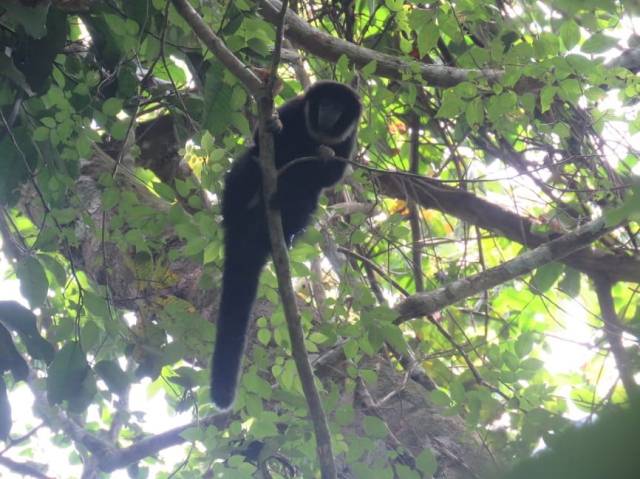
From 1995 onwards my primatological journey took me to many places and I had the opportunity to work with many species, each as unique as the previous one. From red howler monkeys, mantled howler monkeys, Colombian squirrel monkeys, ornate titi monkeys, Japanese macaques, saki monkeys and nocturnal monkeys, my primatology research had included behavior, ecology, landscape ecology and conservation. I had been lucky enough to work with great primatologists such as Dr. Izawa, Dr. Nishimura, Dr. Defler and so many other primatologists, ecologists, landscape ecologists and modelers who had taught me and shared incredible knowledge and experiences with me over the years. I’m very grateful to all of them. I also had the opportunity to share experiences with so many great students and researchers, in many places around the world. This is a journey that I hope continue in the following years as I continue following and studying monkeys in Colombia.

If you want to support our activities, please visit https://fineartamerica.com/art/xyomara+carretero or get in contact with us at xcarretero@gmail.com if you want to collaborate, donate or volunteer in our activities. You can also support our activities by buying our ornate titi monkeys stuff dolls https://www.instagram.com/p/Ctm_sEORvk8/?igshid=MzRlODBiNWFlZA== and our new journals in Amazon https://www.amazon.com/X-Carretero/dp/B0CWD1DBJM/ref=mp_s_a_1_1?

© Copyright Disclaimer. All pictures used on this web page are protected with copyrights to Xyomara Carretero-Pinzón. If you want to use any of these pictures, please leave a message on the website or contact xcarretero@gmail.com

Monkey Forest Tales: Another chapter about how Colombian squirrel monkeys live in fragmented areas

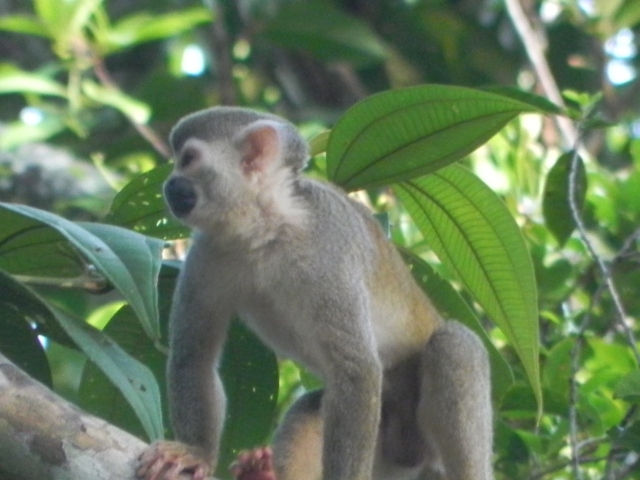
In today’s post, we continue with our series of articles based on information we had been collecting in the study area over the past 21 years. We are going to talk about a chapter in which we use data of Colombian squirrel monkey (Saimiri albigena) from my undergraduate thesis in Tinigua National Park, a continuous forest and my master thesis in Zocay Project study area, a fragmented area. In this chapter we compare the territory size, time spent on each activity and items consumed (i.e. arthropods, fruits, flowers and leaves consumed) of two groups of these monkeys, one in each site. Additionally occasional observations of other groups of Colombian squirrel monkeys were count in both areas and these counts were used to compared group sizes in both areas.

This chapter shows that groups in both areas consumed fruits and flowers of different plant species, however both groups consumed a similar number of arthropods (i.e. insects and spiders), fruits and flowers. In the continuous area Colombian squirrel monkeys also consume a small proportion of leaves that were not consumed in the fragmented area. In terms of the time spent by both groups feeding, the group in Zocay Project area (fragmented area) spent more time in this activity compared with the group in Tinigua (continuous area). Territory size and groups size was smaller in the fragmented area, while the distance they move every day was higher in the fragmented area compared to the continuous area. Time spent resting was lower in the fragmented area, while time spent moving is higher. Therefore, Colombian squirrel monkey’s strategy is to spend more time feeding, increasing the number of plant species of which they consumed fruits near to forest fragment edges and living fences. Living fences increase the space where they can find food.

Español: Otro capítulo sobre cómo los monos titis viven en zonas fragmentadas

En el blog de hoy continuamos con nuestra serie de artículos basados en información que hemos colectado en el área de estudio en los últimos 21 años. Vamos a hablar de un capítulo en el cual usamos datos de monos titis (Saimiri albigena) de mi tesis de pregrado en el parque nacional Tinigua, un bosque continuo y mi tesis de maestría en la zona de estudio del Proyecto Zocay, un área fragmentada. En este capítulo comparamos el tamaño del territorio, tiempo dedicado en cada actividad y los ítems consumidos (es decir, artrópodos, frutos, flores y hojas consumidas) de dos grupos de estos monos, uno en cada sitio. Además, las observaciones ocasionales de otros grupos de monos titis fueron contados en ambas áreas y estos conteos fueron usados para comparar los tamaños de los grupos en ambas áreas.

Este capítulo muestra que los grupos en ambas áreas consumieron frutos y flores de diferentes especies de plantas, sin embargo, ambos grupos consumieron un número similar de artrópodos (es decir insectos y arañas), frutos y flores. En el área continua, los monos titis también consumen una pequeña proporción de hojas que no son consumidas en el área fragmentada. En términos del tiempo empleado por ambos grupos alimentándose, el grupo en el área del Proyecto Zocay (área fragmentada) paso más tiempo en esta actividad comparado con el grupo de Tinigua (área continua). El tamaño del territorio y tamaño de los grupos es más pequeño en el área fragmentada, mientras que la distancia que los monos se mueven diariamente es mayor en el área fragmentada comparado con el área continua. El tiempo dedicado a descansar fue más corto en el área fragmentada, mientras que el tiempo gastado en moverse es mayor. Por lo tanto, la estrategia de los monos titis es pasar más tiempo comiendo, aumentando el número de especies de plantas de las cuales consumen frutos cerca de los bordes de los fragmentos y en las cercas vivas. Las cercas vivas aumentan el espacio donde pueden encontrar comida.

If you want to support our activities, please visit https://fineartamerica.com/art/xyomara+carretero or get in contact with us at xcarretero@gmail.com if you want to collaborate, donate or volunteer in our activities. You can also support our activities by buying our ornate titi monkeys stuff dolls https://www.instagram.com/p/Ctm_sEORvk8/?igshid=MzRlODBiNWFlZA== and our new journals in Amazon https://www.amazon.com/X-Carretero/dp/B0CWD1DBJM/ref=mp_s_a_1_1?© Copyright Disclaimer. All pictures used on this web page are protected with copyrights to Xyomara Carretero-Pinzón. If you want to use any of these pictures, please leave a message on the website or contact xcarretero@gmail.com