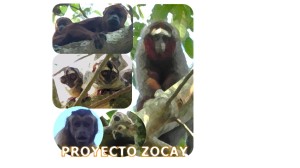

In today’s post we talk about progress in our field projects and a small tribute to one of the landowners in our study area who sadly pass leaving us with great lessons about traditional practices in cattle ranching.
As most of you know from previous posts we continue with our sampling on distribution limits of ornate titi monkeys, Plecturocebus ornatus, with new observations in northern and southeastern limits of its distribution. We want to thank Primate Conservation Inc, for their support to make these samplings possible. This sampling also wouldn’t be possible without the help of local tourism guides and two of my field assistants, Felipe and Francisco. As usual for me this project had giving me more questions to ponder and even more motivation to continue doing fieldwork despite some challenges.
As I mentioned before, species distribution data is challenging to obtain due to logistics constrains, however local people is of great help and we should value more all data that they can provide us, even if that data is not always collected using traditional scientific methods. More news and advances on this project soon!!!
We also were able to visit our permanent forest fragments to count all primate’s groups that we had the privilege of look at every year. Some groups that we didn’t see in the past months were seen again and a special moment with Colombian squirrel monkeys (Saimiri albigena) and black-capped capuchins (Sapajus apella) crossing a living fence on trees above my head while I was siting remind me why I like to do what I do. So, I hope you had the opportunity to feel like me in your daily work…
While in the field, I was also informed of the passing away of one of the landowners with who I started this project, he was the landowner of the neighbor farm who first let me visit his forest to look for monkeys. In an informal conversation we had around 28 years ago, he told me how he buys his farm and how he left living fences and isolated trees in the middle of pastures, so cattle have a place to hide when the sun was too strong. He was the first one to make me look at living fences as connecting landscape structures that can help cattle as well as wildlife to coexist in transformed landscapes. His legacy of living fences as a traditional practice in cattle ranching farms is one, I will always remember and one of the main lessons I had learned over my years working in fragmented landscapes in the Orinoquia region of Colombia. Rest in peace Don Eleodoro and thank you…
If you want to support our activities, please visit https://fineartamerica.com/art/xyomara+carretero or get in contact with us at xcarretero@gmail.com if you want to collaborate, donate or volunteer in our activities. You can also support our activities by buying our ornate titi monkeys stuff dolls https://www.instagram.com/p/Ctm_sEORvk8/?igshid=MzRlODBiNWFlZA== and our new journals in Amazon https://www.amazon.com/X-Carretero/dp/B0CWD1DBJM/ref=mp_s_a_1_1?© Copyright Disclaimer. All pictures used on this web page are protected with copyrights to Xyomara Carretero-Pinzón. Pictures in this post were taken by Francisco Gomez. If you want to use any of these pictures, please leave a message on the website or contact xcarretero@gmail.com
 zocayproject