
Monkey Forest Tales: How is it to fund a long-term project in Colombia?

A few weeks ago, there was a twitter from a person who work/ use to work in government in Colombia asking long-term projects in Colombia to contract national professionals. What this twitter said it wasn’t bad per se, but it has a big lack of knowledge about how difficult actually is to get funding to pay salaries.What most people don’t know is that salaries are rarely cover in most grants, especially small grants that are the ones used to cover most of the expenses in long-term projects. Most long-term project manage by small NGOs where there is only one person managing all aspects of a project, not necessarily had a salary to cover this person. Actually most of the small NGOs are manage by compromised professional who loves what they do and have additional jobs to cover their basic needs. So please don’t assume that if you see a long-term project, or even most of research projects done in countries like Colombia, they had excess to money to pay salaries, especially salaries for professional biologist/ecologist. Most grants cover logistic expenses (transport, food, local people payments per day, and logging) but no salaries to cover the time spend on analyzing data, making financial and technical reports, making grant applications, making maps. All that time is free labor done by most managers and directors of smalls NGOs and research project directors. Support from governments and governmental institutions is limited and depends on political connections and specific interests and government agendas. Therefore we use international grants that doesn’t cover salaries and continue having more than one job to do science and study the organisms that we love and want to conserve. So, my advice to people wanting to do research in Colombia is to get a job in a university/ institution and work in their research projects unless you want to have more than one job and still do research in your passion. It is a reality that not anyone want to tell you while you are studying, but it is part of science reality in countries like Colombia.

If you want to support our activities, please visit https://fineartamerica.com/art/xyomara+carretero or get in contact with us at xcarretero@gmail.com if you want to collaborate, donate or volunteer in our activities. You can also support our activities by buying our ornate titi monkeys stuff dolls https://www.instagram.com/p/Ctm_sEORvk8/?igshid=MzRlODBiNWFlZA== and our new journals in Amazon https://www.amazon.com/X-Carretero/dp/B0CWD1DBJM/ref=mp_s_a_1_1?© Copyright Disclaimer. All pictures used on this web page are protected with copyrights to Xyomara Carretero-Pinzón. If you want to use any of these pictures, please leave a message on the website.
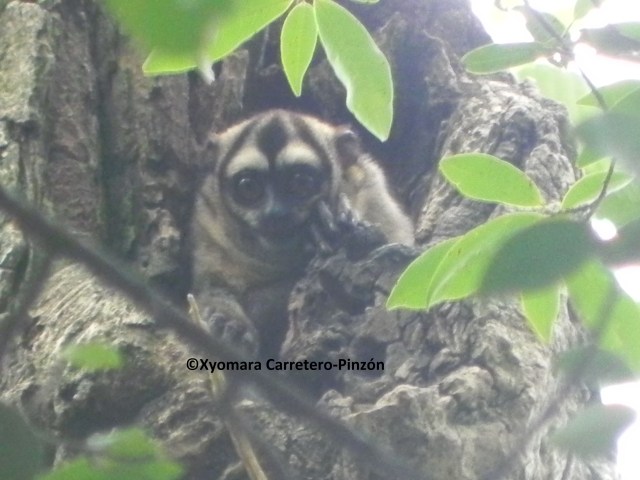
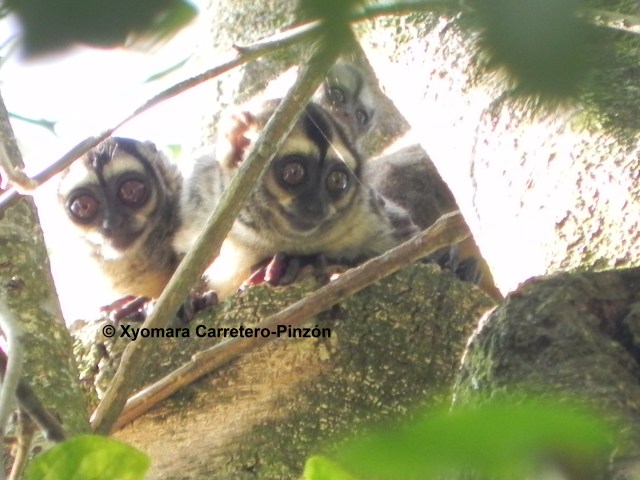
Monkey Forest Tales: Why we had so little information about Brumback nigh monkey (Aotus brumbacki)?

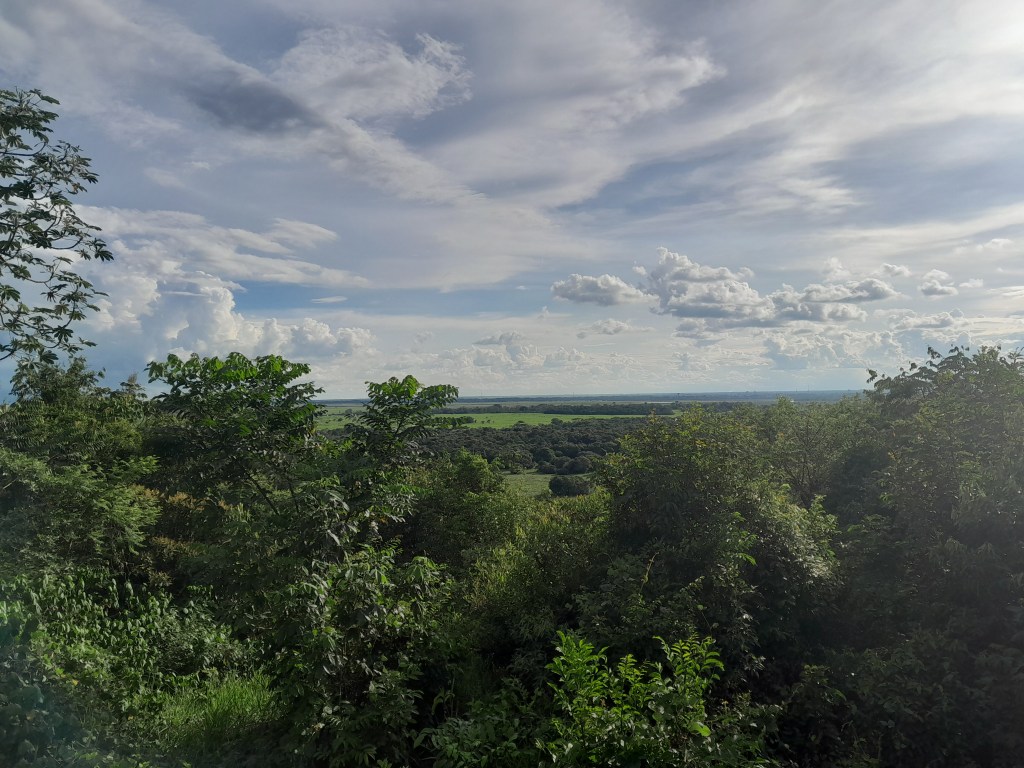
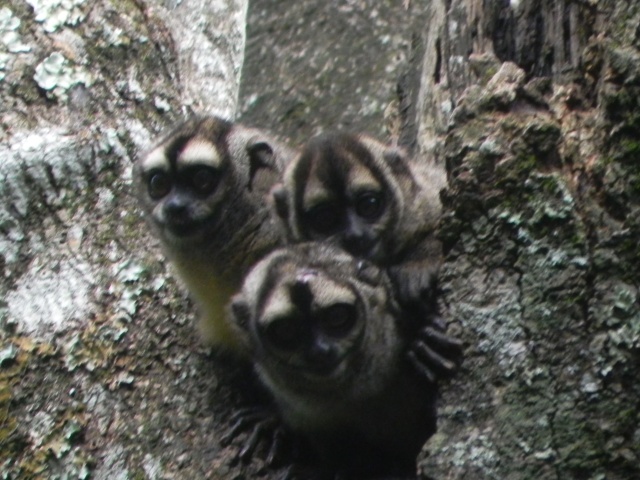
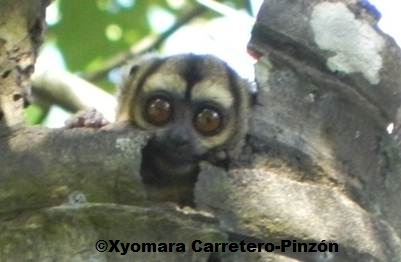
In past days, while talking about Zocay Project results, someone ask me why we had so little information about Brumback nigh monekys (Aotus brumbacki) in general. In this post we are going to talk about this species, what had been done and what is still need it to be done to better understand this nocturnal primate species of Colombian Llanos.Brumback night monkeys are one of the 11 species of nocturnal monkey from genera Aotus spp. They are distributed in the piedmont of Colombian Llanos, but its eastern limits are not clearly defined, although it seems it can go up to Orinoco River. Information about this species is limited to a few studies, an undergraduate thesis from Solano in 1995 where she reported a group’s activities, home range and daily distance, as well as a list of plants from which they feed. An anecdotal report of a female Aotus brumbacki female consumed by a group of black capped capuchins (Sapajus apella fatuellus) by Carretero-Pinzón et al (2008) and a list of plants consumed by this species in forest fragments by (Vargas et al. 2023).But why there is so few studies on this species? Well, working at night have its own challenges and it is not always easy to see them and even more difficult to follow a group of this species, and other species of nocturnal animals. Another issue is that not everyone is good to work at night and to be in the dark inside a forest, this is one of those things that trigger some of our deepest fears, which make even more challenging to work with this and similar species. Some technologies can help and may be that is something we need to explore in the near future. For now, at least, we are working on two additional studies with this species that we hope can help us to better understand and protect this species in the study area and its distribution area. Studies about this species in forest fragments are important as most of its known distribution area is located in an area that is continuously deforested, so if you like to work at night and are interested in monkeys, like hot weather and don’t feel afraid of working at night inside forest, please feel free to contact me.If you want to support our activities, please visit https://fineartamerica.com/art/xyomara+carretero or get in contact with us at xcarretero@gmail.com if you want to collaborate, donate or volunteer in our activities. You can also support our activities by buying our ornate titi monkeys stuff dolls https://www.instagram.com/p/Ctm_sEORvk8/?igshid=MzRlODBiNWFlZA== and our new journals in Amazon https://www.amazon.com/X-Carretero/dp/B0CWD1DBJM/ref=mp_s_a_1_1?© Copyright Disclaimer. All pictures used on this web page are protected with copyrights to Xyomara Carretero-Pinzón. If you want to use any of these pictures, please leave a message on the website.