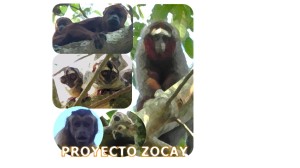

Monkey Forest Tales: Women and girls in science celebration day

On February 11th it was women and girls in science celebration day, a day to increase awareness to all the wonderful girls and women who through our lives and history had make an impact in the world for us to be able to be whatever we want to be. Something that we usually don’t say, or at least I rarely said it, is that most of us who live the life we always dream to live, probably have a mother or some family member who overcome a lot of challenges and showed us that whatever was possible if you try it. So, thank you mom and aunt Julia for showing me that if I wanted I can get it, despite all the challenges life put in your way.
Over the years, several women and sometimes little girls had incentivized me to be better in what I do. Most of them had been students, volunteers, and colleagues of different ages and at different stages in their careers and life. But all of them have something in common, a certain combination of curiosity and fire for do anything possible to make their dreams come true. Curiosity to try and ask questions that other didn’t and a tenacity to continue despite many people telling them they cannot do it.
I had also been lucky to have many men in my life who supported me over the years and give me enough confidence to be able to do what I love the most in life, work with monkeys!! Starting with my father and then all my academic advisor who had been all man. To all of them thank you too.
Now that I had mention people who had inspired me and supported me, my message to all the girls and young women who dream to work in science is first to surround yourself with people who support you and motivate you, fine passion inside and outside of you, don’t give up and even when times looks a bit dark, there is always something or someone who appears in your life in the right moment. And finally, something that I hear once from Jane Goodall, “you’ll have to work hard, take advantage of opportunities and never give up” something that her mother told her when she was a little girl and tell her she wanted to go to Africa. This phrase had resonated with me over the years and that is why I still do what I love (see monkeys in their habitat, in case you had forgotten), even when sometimes it looks that I will need to give up, something appears, or someone gives me a hand an offers me a new opportunity that in some way keep me going.
Finally, to all students, volunteers and colleagues who had share part of your life with me, thank you for helping me to keep going…Happy Girls and Women in Science Day!!!
If you want to support our activities, please visit https://fineartamerica.com/art/xyomara+carretero or get in contact with us at xcarretero@gmail.com if you want to collaborate, donate or volunteer in our activities. You can also support our activities by buying our ornate titi monkeys stuff dolls https://www.instagram.com/p/Ctm_sEORvk8/?igshid=MzRlODBiNWFlZA==
© Copyright Disclaimer. All pictures used on this web page are protected with copyrights to Xyomara Carretero-Pinzón. If you want to use any of these pictures, please leave a message on the website.

Monkey Forest Tales: Problem of common names

In today’s post we want to discuss a common practice that sometimes generates interpretation and identity problems in science, common names. Common names are the names that local people give to animals in a region or country. Sometimes those names came from other regions, countries or even continents as it’s the case of common name for our jaguar that usually is tiger. This is reflection of colonial times when Spanish people who arrive to America called jaguars “tigers” as it is a big cat as the original tiger of Asia. Some of these common names remains in our minds and cultures for centuries and changing these common names to more appropriate names for our species is not always easy. Our last example is one that have been changing over the years although there are areas in which jaguar are still called tigers.
But why we wanted to discuss about this? Our reason is because in this website and many publications product of all work done in this project had one of these confusing common names that we notice recently. As I mentioned several times in this website, I had been studying monkeys for over 25 years, during this time monkey’s taxonomy had changed over the last decade and with taxonomy some common names also changed to be more accurate to reflect that taxonomy. The case we are talking about is dusky titi monkey or ornate titi monkeys (Plecturocebus ornatus). In 1995 when I learned primate taxonomy this species was a subspecies of dusky titi monkeys, todays known as Callicebus moloch, a species from Peruvian Amazon very similar to another specie also called dusky titi Callicebus cupreus from Ecuatorian Amazon, from which Plecturocebus ornatus was a subspecies, until 2016. The reason for using this common name to different species is that at some point all these species were considered the same species, although they have different names in local languages. Therefore, when I started this project ornate titi monkeys were still dusky titi monkey until 2016, by Byrne and collaborators, when a new taxonomy for the whole subfamily Callicebinae.
So, as you see sometimes changing common names cost us a bit of time, but in order to be more precise and follow the IUCN red list classification in this website we are going to use ornate titi monkey as the common name to our endemic Zocay, as it is known in Spanish. A good practice in science is to be updated in taxonomy, even if the focus of your research is focus on other disciplines inside biology as this is a field in which changes are continuous and make exciting discoveries almost everyday.
If you want to support our activities, please visit https://fineartamerica.com/art/xyomara+carretero or get in contact with us at xcarretero@gmail.com if you want to collaborate, donate or volunteer in our activities. You can also support our activities by buying our ornate titi monkeys stuff dolls https://www.instagram.com/p/Ctm_sEORvk8/?igshid=MzRlODBiNWFlZA==
© Copyright Disclaimer. All pictures used on this web page are protected with copyrights to Xyomara Carretero-Pinzón. If you want to use any of these pictures, please leave a message on the website.