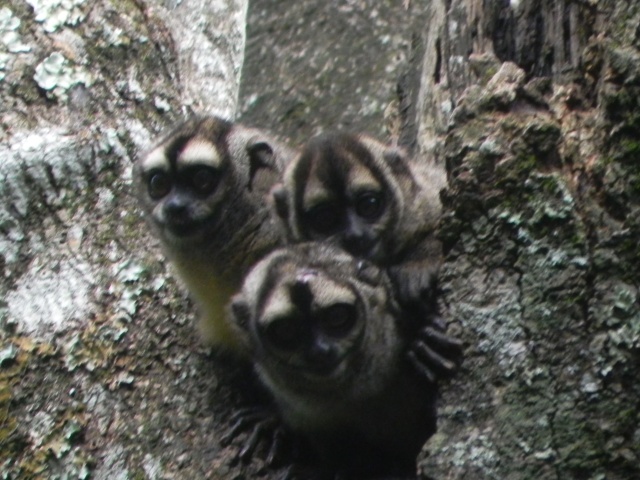
Yesterday was the Biodiversity National Day in Colombia, as a way of celebration we had started a new collaboration project on the effects of landscape-scale and patch-scale variables on Brumback’s night monkeys (Aotus brumbacki) on several towns in the Colombian Llanos. This is a collaboration with SUSA group at University of Los Llanos, a regional university.
It is always exciting to start a new project. This one in particular is more exciting as it has elements similar to the ones I did with my PhD, but with a species that at that time wasn’t possible to work with. It has also some interesting challenges that comes with working with a nocturnal species. Sites need to be carefully chosen, as security for working at night is important. Logistic for nocturnal census, also requires sites where we can rest close to forest fragments where we are doing census due to their sampling times. It is also a challenge to work at night in new sites that you don’t know or that you had not visit recently.
This project also had a big component of GIS and modeling, that is interesting and challenging at the same time. We had limited information on Brumback’s night monkeys, an endemic species of Colombian monkeys, mainly found in the piedmont forest of Colombian Llanos. This is an area highly fragmented and transformed by human activities and despite this Brumback’s nigth monkeys is still present in very degraded areas, close to main roads, inside cities and towns.
Over the years we had observed them eating on fruit crops as well as plants used as forage to cattle. Using different types of trees as nest such as guadua clusters (clusters of Guadua angustifolia), standing death trunks of Mauritia flexuosa, dense vines areas in tall trees, Oenocarpus bataua pals (unamas), hole trees in old and tall trees of Ficus spp. And moving through living fences between forest fragments. However there is still a lot of their ecology and behavior that we don’t know, especially what variables explain the presence of this species of monkey in an specific forest fragment. Something we plan to answer with this new project.
If you want to support our activities, please visit https://fineartamerica.com/art/xyomara+carretero or get in contact with as at xcarretero@gmail.com if you want to collaborate, donate or volunteer in our activities.
© Copyright Disclaimer. All pictures used on this web page are protected with copyrights to Xyomara Carretero-Pinzón. If you want to use any of these pictures, please leave a message on the website.
 zocayproject