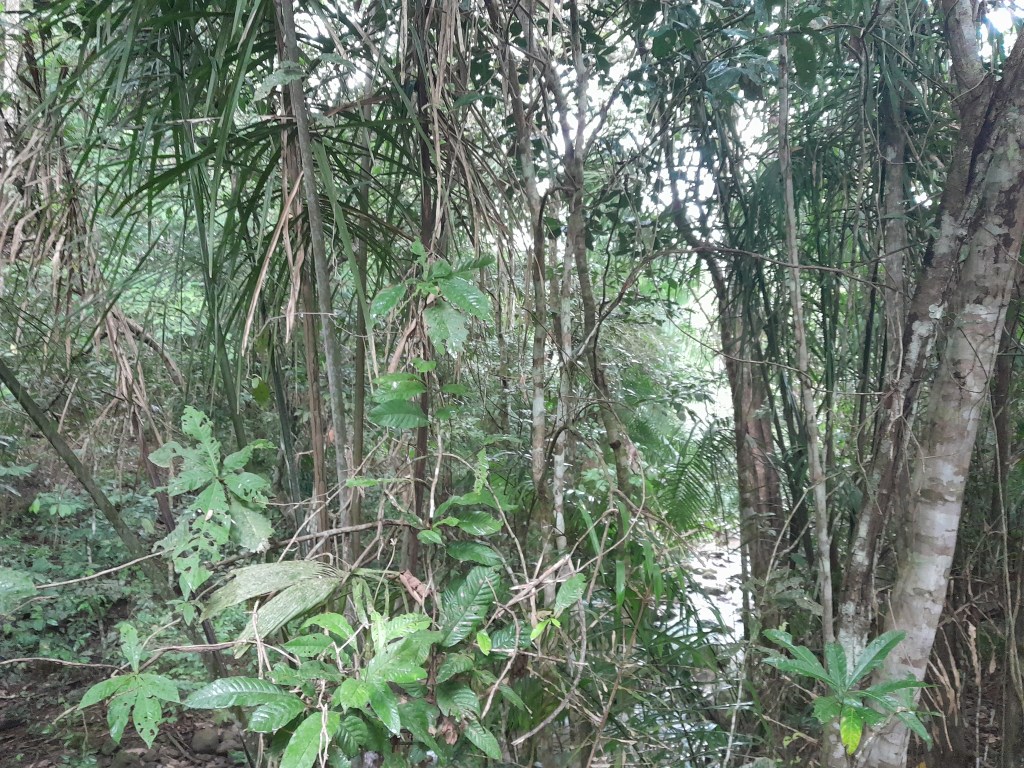
In today’s post we are going to talk about a new project we started this month. In this new project we are looking for dusky titi monkeys (Plecturocebus ornatus) along the eastern limit of their distribution. As we had mention in several post and pages in this website, dusky titi monkeys (Plecturocebus ornatus) is an endemic primate mostly distributed in Meta department and a small part of Cundinamarca, around Medina town. However their distribution limits in the East are poorly known and seems to be delimited by Upia and Meta rivers.
So this new project is focused in surveys done on both sides of Upia and Meta rivers. We started by doing sampling in both sides of Upia river near to Villanueva and Barranca de Upia towns.
Why close to towns? Well when you start a new project in a new area, you start close to places where you can have accommodation and food accessible and in places where you have contacts that can give you access to forest fragments inside private lands. Thanks to our contacts with Stella Gutierrez and don Arturo Aguirre of La Bendición de San Miguel agroturistic farm, we are able to start looking for new additional points that give us a better idea where dusky titi monkeys can be found.
While looking for new places, rural roads passing close to forest fragments can be additional points to detect monkeys. This strategy can help you cover large extensions of area and help you to select possible areas with potential to answer your questions. A detailed study of maps from the potential area you are surveying is always a first step to do projects in which multiple sites are necessary.
Although I will prefer to start project involving multiple sites during dry season, our changing rain patterns make those decisions difficult and in areas with relatively short dry season, such as Orinoquia region, we usually start any time of the year. But why is better to start in dry season? Well multiple sites usually means less time in each site and if it rains too much you can loose lots of time due to rain and you field schedule suffer. Logistics become more complicated and costs increases.
Sometimes those are some considerations not always taken in account while planning a project that can make your fieldwork stressful if you are not flexible enough to understand that weather is not something you can control. Fortunately for us weather has been helpful and rain didn’t stop us to make our surveys.
We already done surveys in one side of the river and get some data, lets hope surveys in the other side give us even more interesting data to clarify the distribution limits of our endemic dusky titi monkey or Mono Zocay as they are know by locals in Spanish.
If you want to support our activities, please visit https://fineartamerica.com/art/xyomara+carretero or get in contact with as at xcarretero@gmail.com if you want to collaborate, donate or volunteer in our activities.
© Copyright Disclaimer. All pictures used on this web page are protected with copyrights to Xyomara Carretero-Pinzón. If you want to use any of these pictures, please leave a message on the website.
zocayproject
Long-term monitoring of primates in Colombian Llanos, research opportunities and some forest stories

 zocayproject